
That gut feeling that something isn’t right about your termination is worth paying attention to. While many firings are legal, even if they feel unfair, some are clear violations of the law. The challenge is knowing the difference. Were you let go right after reporting harassment or taking medical leave? Did your termination seem connected to your age, gender, or race? These are the kinds of questions that can point toward an illegal firing. This article will serve as your guide, providing concrete California wrongful termination examples to help you understand the specific protections you have as an employee and what to do if you believe those rights were violated.
Common wrongful termination examples California employees should recognize include being fired after reporting harassment, requesting medical or family leave, announcing a pregnancy, filing a workers’ compensation claim, complaining about unpaid wages, reporting unsafe work conditions, refusing to break the law, serving on a jury, voting, joining with coworkers about workplace conditions, or being targeted because of a protected trait such as race, gender, age, disability, religion, sexual orientation, gender identity, or pregnancy.
Not every unfair firing is illegal. A wrongful termination claim usually depends on whether the firing was connected to discrimination, retaliation, protected leave, whistleblowing, an employment contract, or another public policy protection. If the timing, explanation, or paperwork does not add up, save evidence and get legal advice quickly.
Key Takeaways
- Know the limits of “at-will” employment: California law protects you from being fired for illegal reasons, such as discrimination based on your race or gender, or as retaliation for reporting harassment.
- Preserve your evidence immediately: After a termination, gather all relevant documents like performance reviews, emails, and official paperwork, and create a detailed timeline of events.
- Don’t wait to seek legal advice: Strict deadlines apply to wrongful termination claims, so consulting with an attorney promptly is essential to protect your right to take action.
What Is Wrongful Termination in California?
Losing a job is tough, but it’s even harder when you suspect the reason for your termination was illegal. In California, employees have strong protections against being fired unfairly. But what exactly makes a firing “wrongful” in the eyes of the law? It’s not just about a termination that feels unjust; it’s about a termination that violates specific legal statutes. Understanding the difference between a lawful firing under “at-will” employment and an unlawful one is the first step to protecting your rights.
At-Will Employment vs. Illegal Firing
In California, most employment is considered “at-will.” This means an employer can fire an employee for almost any reason, or even for no reason at all, without facing legal consequences. They don’t need to prove you did a bad job or give you a reason for letting you go. However, this rule has a huge exception: an employer cannot fire you for an illegal reason. When a termination is motivated by something that violates the law, it crosses the line from a standard firing to a potential case of wrongful termination.
What Makes a Firing “Wrongful”?
So, what makes a reason for termination illegal? A firing is wrongful if it is based on illegal discrimination or is a form of retaliation. State and federal laws protect employees from being fired because of their race, gender, age, disability, religion, national origin, or other protected traits. It is also illegal for an employer to fire you for exercising your legal rights. This includes actions like reporting harassment, requesting a reasonable accommodation for a disability, or taking protected family leave. Even if your employer provides a different, seemingly valid reason for your termination, if the true motivation was illegal, you may have a case.
When Public Policy Protects Your Job
Another key exception to at-will employment is a termination that violates public policy. This legal principle protects you from being fired for doing something the law encourages or for refusing to do something illegal. For example, your employer cannot legally fire you for reporting illegal activity to a government agency, a protected action known as whistleblowing. You are also protected from termination for fulfilling a civic duty like serving on a jury, exercising your right to vote, or taking time for military service. If you were fired for upholding the law or a clear ethical duty, your termination may be considered wrongful.
When an Unwritten Promise Is Broken
Even without a formal employment contract, your employer’s actions and policies can create an “implied contract.” This is an unwritten understanding that you will be treated fairly and not fired without good cause. An implied contract can be established through factors like your length of service, positive performance reviews, and promises of long-term employment from a manager. For example, if your employee handbook outlines a specific disciplinary process (like a series of warnings) and your employer fires you without following it, this could be a breach of an implied contract. These situations are an important part of California employment law.
For a broader overview, read our guide to wrongful termination in California.
Common Myths About Wrongful Termination
Losing a job is stressful enough without the confusion that surrounds your rights as an employee. Many people have ideas about what is and isn’t legal when it comes to being fired, but these are often based on misinformation. It’s important to separate fact from fiction, because understanding the truth can help you recognize when your rights have been violated. Let’s clear up a few of the most common myths about wrongful termination in California so you can feel more confident about your situation and what steps you can take.
Myth #1: “At-will means they can fire me for any reason.”
This is one of the biggest and most damaging misconceptions. While California is an “at-will” employment state, this rule has significant limits. “At-will” simply means that either you or your employer can end the working relationship at any time, for any reason that is not illegal. An employer cannot fire you for reasons that violate public policy or discriminate against you. For example, it is illegal to be fired because of your race, gender, or disability. It is also illegal for an employer to engage in retaliation by firing you for reporting unsafe work conditions or taking protected medical leave. The reason for your termination matters immensely.
Myth #2: “I don’t have a case without a written contract.”
You do not need a formal, signed employment contract to have a valid wrongful termination claim. While a breach of a written contract can be one basis for a lawsuit, most wrongful termination cases are built on other grounds. California law provides protections for all employees, regardless of whether they have a contract. If you were fired for an illegal reason, such as reporting sexual harassment or because of your age, your rights have been violated. These legal protections function like a contract with society, establishing rules that every employer must follow. Your case depends on whether your employer broke the law, not on whether they broke a written promise.
Myth #3: “I need perfect evidence to talk to a lawyer.”
It’s a lawyer’s job to help you build your case, not your job to have it perfectly assembled before you call. Many people hesitate to seek legal advice because they worry they don’t have a “smoking gun.” However, evidence can take many forms: emails, text messages, positive performance reviews that contradict the reason you were fired, or even statements from coworkers. An experienced employment law attorney knows what to look for and can help you gather the necessary documentation. If you feel something was wrong with your termination, don’t let a search for perfect proof stop you. The most important first step is to discuss your situation with a professional who can help you evaluate your options.
12 California Wrongful Termination Examples Employees Should Recognize
Losing your job is tough, but it feels even worse when the reason for your dismissal seems unfair or illegal. While California is an “at-will” employment state, that doesn’t give employers a free pass to fire you for any reason. State and federal laws create important exceptions to protect employees from being fired for unlawful reasons. Understanding these exceptions is the first step to figuring out if you have a case.
Below are 12 common scenarios that could qualify as wrongful termination. If any of these situations sound familiar, it might be time to look closer at the circumstances of your firing.
1. Fired Because of Your Race, Gender, or Disability
California law is very clear: your employer cannot fire you because of who you are. This includes your race, gender, religion, nationality, age (if over 40), or disability. These are known as “protected characteristics.” If you believe your termination was motivated by prejudice rather than your job performance, it may be illegal. For example, if you were let go shortly after your employer learned about your disability or you were the only person of your race fired during a “restructuring,” you could have a case for discrimination. This protection ensures that employment decisions are based on merit, not bias.
2. Fired for Reporting Harassment
You have a right to a workplace free from harassment. If you report inappropriate behavior, whether to HR or your manager, your employer is legally barred from punishing you for it. This is considered a “protected activity.” Firing an employee for reporting sexual or racial harassment is a classic example of illegal retaliation. This protection applies even if an investigation doesn’t confirm the harassment, as long as you made the report in good faith. The law is designed to encourage people to speak up about a hostile work environment without fear of losing their job.
3. Fired for Taking Medical or Family Leave
Life happens, and sometimes you need to take time off to care for your own serious health condition or that of a close family member. Laws like the Family and Medical Leave Act (FMLA) and the California Family Rights Act (CFRA) provide job-protected leave for eligible employees. If you take approved leave and are fired during or immediately after your return, your termination may be unlawful. Your employer cannot use your legally protected family and medical leave as a reason to replace you or eliminate your position.
4. Fired for Being Pregnant or Planning a Family
Pregnancy is a protected status under California law. An employer cannot fire you because you are pregnant, have a pregnancy-related medical condition, or plan to start a family. This includes being fired for needing time off for prenatal appointments or requesting reasonable accommodations, like modified duties. Terminating an employee shortly after she announces her pregnancy is a major red flag for pregnancy discrimination. These protections are in place to ensure that women are not forced to choose between their job and their family.
5. Fired for Filing a Workers’ Comp Claim
If you get injured on the job, you have a legal right to file a workers’ compensation claim to cover medical bills and lost wages. Your employer cannot fire you for doing so. Firing an employee for getting hurt at work and seeking benefits is a direct violation of public policy. This type of retaliation is illegal because it discourages workers from reporting injuries and seeking the care they need, which can lead to unsafe work environments for everyone. If you were fired soon after filing a claim, you may have been the victim of retaliation at work.
6. Fired for Reporting Unpaid Wages
You have the right to be paid fairly for your work, including overtime and legally required meal and rest breaks. If you complain to your employer about not receiving your correct pay, you are engaging in a protected activity. Firing you for raising concerns about unpaid wages is illegal retaliation. This protection allows you to stand up for your rights without fearing for your job. If you were let go after questioning your paycheck or filing a complaint about wage and hour claims, your termination was likely unlawful.
7. Fired for Reporting Unsafe Work Conditions
Your employer has a duty to provide a safe work environment. If you see a safety hazard, you have the right to report it, either internally or to an agency like the California Division of Occupational Safety and Health (Cal/OSHA). Firing you for this is illegal. These whistleblower protections are crucial for keeping workplaces safe. They ensure that employees can report dangers like faulty equipment or hazardous materials without risking their livelihood. An employer cannot punish you for trying to protect yourself and your colleagues from harm.
8. Fired for Refusing to Do Something Illegal
Your boss cannot ask you to break the law as part of your job. If you are fired for refusing to perform an illegal act, such as committing fraud, falsifying records, or lying to investigators, you may have a wrongful termination claim. This is a core violation of public policy. The law protects you from having to choose between keeping your job and committing a crime. Standing up for what is right should not cost you your employment, and a wrongful termination attorney in California can help protect that right.
9. Fired in Breach of Your Employment Contract
While most California employees are “at-will,” some have an employment contract that outlines the terms of their job, including when and how they can be fired. This contract can be a formal written document or an implied agreement based on your employer’s promises and practices. If your contract says you can only be fired for “good cause” (like serious misconduct) and you are let go for a reason not covered in the agreement, your employer has breached the contract. This breach can be grounds for a wrongful termination lawsuit.
10. Fired for Your Political Activities or Beliefs
California law provides unique protections for employees’ political activities. Your employer generally cannot fire you for your lawful political actions or affiliations outside of work. This includes participating in a protest on your own time, volunteering for a campaign, or even posting your political views on your personal social media. If you were fired because your boss disagreed with your political beliefs or your off-duty activism, you may have a wrongful termination claim. This is a form of illegal retaliation for exercising your legal rights.
11. Fired for Unionizing or Union Activities
Federal law protects your right to organize with your coworkers to improve your working conditions. This includes discussing wages, forming a union, or participating in other “concerted activities” for mutual aid or protection. Your employer cannot legally fire, demote, or otherwise punish you for engaging in union-related activities. Terminating an employee who is leading an organizing drive or is an active union member is a common union-busting tactic and a clear violation of labor laws. This is another form of illegal retaliation that undermines workers’ rights.
12. Fired Because of Your Sexual Orientation or Gender Identity
Your sexual orientation and gender identity are protected characteristics under California’s Fair Employment and Housing Act (FEHA). It is illegal for an employer to fire you because you are gay, lesbian, bisexual, transgender, or non-binary. This form of discrimination is just as unlawful as firing someone based on their race or religion. Employment decisions must be based on your qualifications and performance, not on who you are or whom you love. If you believe your identity was a factor in your termination, you may have a strong case.
Know Your Rights: California’s Employee Protections
California has some of the strongest employee protection laws in the country. While “at-will employment” gives employers a lot of freedom, that freedom has firm limits. Firing an employee for an illegal reason is called wrongful termination, and several key state and federal laws define what crosses that line. Understanding these protections is the first step toward standing up for your rights. If you believe your termination was unlawful, knowing which laws support your case is incredibly powerful. Let’s walk through some of the most important ones.
The Fair Employment and Housing Act (FEHA)
California’s Fair Employment and Housing Act, or FEHA, is a powerful law that shields employees from unfair treatment. It makes it illegal for an employer to fire you based on your race, gender, age, disability, religion, or other protected characteristics. This means your performance should be the measure of your job, not your identity. FEHA also includes crucial protections against retaliation. So, if you report harassment or participate in a discrimination investigation, your employer cannot legally fire you for it. This ensures you can speak up about wrongdoing without fearing for your job.
FMLA and the California Family Rights Act (CFRA)
Life happens, and sometimes you need to step away from work to care for your health or a loved one. The federal Family and Medical Leave Act (FMLA) and the California Family Rights Act (CFRA) are designed to protect your job during these times. These laws allow eligible employees to take unpaid, job-protected leave for specific family and medical reasons. It is illegal for your employer to terminate you for taking this protected family and medical leave. These acts ensure you don’t have to choose between your job and your family’s health or your own recovery.
California Labor Code
The California Labor Code sets out many rules for employers, including what happens when your employment ends. One of the most important rules concerns your final paycheck. The law is very clear: your employer must pay you all of your earned wages promptly after you are terminated. If they fail to do so, they can be hit with a “waiting time penalty,” which requires them to pay you a penalty for each day your final check is late. This is just one example of how the code protects your right to be compensated for your work and addresses wage and hour claims.
Whistleblower Protections
Have you ever seen something illegal or unsafe at work and felt afraid to speak up? California law provides strong protections for employees who do the right thing. These whistleblowing protections make it illegal for an employer to fire you or otherwise retaliate against you for reporting unlawful activities. This could include reporting fraud, safety violations, or other illegal conduct to a government agency or even to someone within your company. These laws exist to encourage transparency and hold companies accountable, and they protect you for having the courage to report wrongdoing.
Warning Signs Your Firing May Have Been Illegal
Losing a job is disorienting, and it’s even more confusing when the reason you were given doesn’t quite add up. You might have a gut feeling that something is off, that your firing wasn’t just a business decision but something personal or illegal. It’s important to trust that instinct. While California is an “at-will” employment state, which means an employer can fire you for almost any reason, they absolutely cannot fire you for an illegal one. Many laws protect you from being let go for discriminatory reasons or for exercising your rights as an employee.
Figuring out if your situation qualifies as a wrongful termination can feel overwhelming, but you don’t have to do it alone. Understanding the key signs, what kind of proof is helpful, and the strict deadlines involved is the first step toward clarity. Your story matters, and knowing your rights is the first step in making sure it’s heard. This section will walk you through what you need to know to determine if you might have a case and what to do next.
Red Flags to Document After a Firing
Does the timing of your firing feel a little too convenient? Often, the biggest red flag is when you’re terminated shortly after taking a legally protected action. For example, were you let go just days or weeks after you reported sexual harassment, announced you were pregnant, or requested family leave? Other warning signs include being fired after you complained about unpaid wages, pointed out unsafe working conditions, or refused to do something you believed was illegal. If your employer’s reason for firing you seems vague or contradicts your positive performance reviews, that’s another sign that something else might be going on. These situations could be a form of retaliation at work, which is illegal.
- The firing happened soon after you reported harassment, discrimination, unpaid wages, safety concerns, or illegal conduct.
- Your employer’s explanation changed, contradicted your reviews, or was not supported by written records.
- Managers made comments about your protected trait, medical condition, pregnancy, leave request, complaint, or workplace rights.
- You were treated differently from coworkers who did not share the same protected trait or did not complain.
- You were pressured to resign, sign papers immediately, or accept a story that does not match what happened.
What Evidence Helps Prove Wrongful Termination?
If you believe you were wrongfully fired, start gathering any documentation you have. You don’t need a “smoking gun” to build a case, but the more evidence you have, the better. Look for emails, text messages, or internal communications that relate to your termination or the events leading up to it. Your performance reviews are especially powerful if they show a history of good work, as this can contradict an employer’s claim that you were fired for poor performance. Try to write down a timeline of events while they are still fresh in your mind, and note any colleagues who may have witnessed what happened. This evidence helps tell your story and can be crucial for a discrimination or retaliation claim.
Forced to Quit? It Might Be Wrongful Termination
What if you weren’t technically fired, but you quit because the situation at work became unbearable? Many people assume that resigning means they’ve forfeited their rights, but that’s not always the case. If your employer deliberately created intolerable working conditions to make you leave, it might be considered “constructive discharge.” This is legally treated the same as a wrongful termination. For example, if you return from maternity leave and are immediately demoted with a significant pay cut, forcing you to resign, you may have a case. A hostile work environment that leaves you with no reasonable choice but to quit can be grounds for a legal claim.
Don’t Wait: How Long You Have to File a Claim
This is incredibly important: there are strict deadlines, called statutes of limitations, for filing a wrongful termination claim. If you miss the deadline, you could lose your right to seek justice forever. In California, you generally have three years to file a discrimination or retaliation claim with the state’s Civil Rights Department (CRD). However, for certain federal claims, you may have as little as 180 days to file with the Equal Employment Opportunity Commission (EEOC). The clock starts ticking from the date you were fired or when the illegal action occurred. Because these timelines can be confusing, it is vital to act quickly. Don’t delay in seeking legal advice to understand the specific deadlines that apply to your wrongful termination case.
What Should You Do After a Suspected Wrongful Termination?
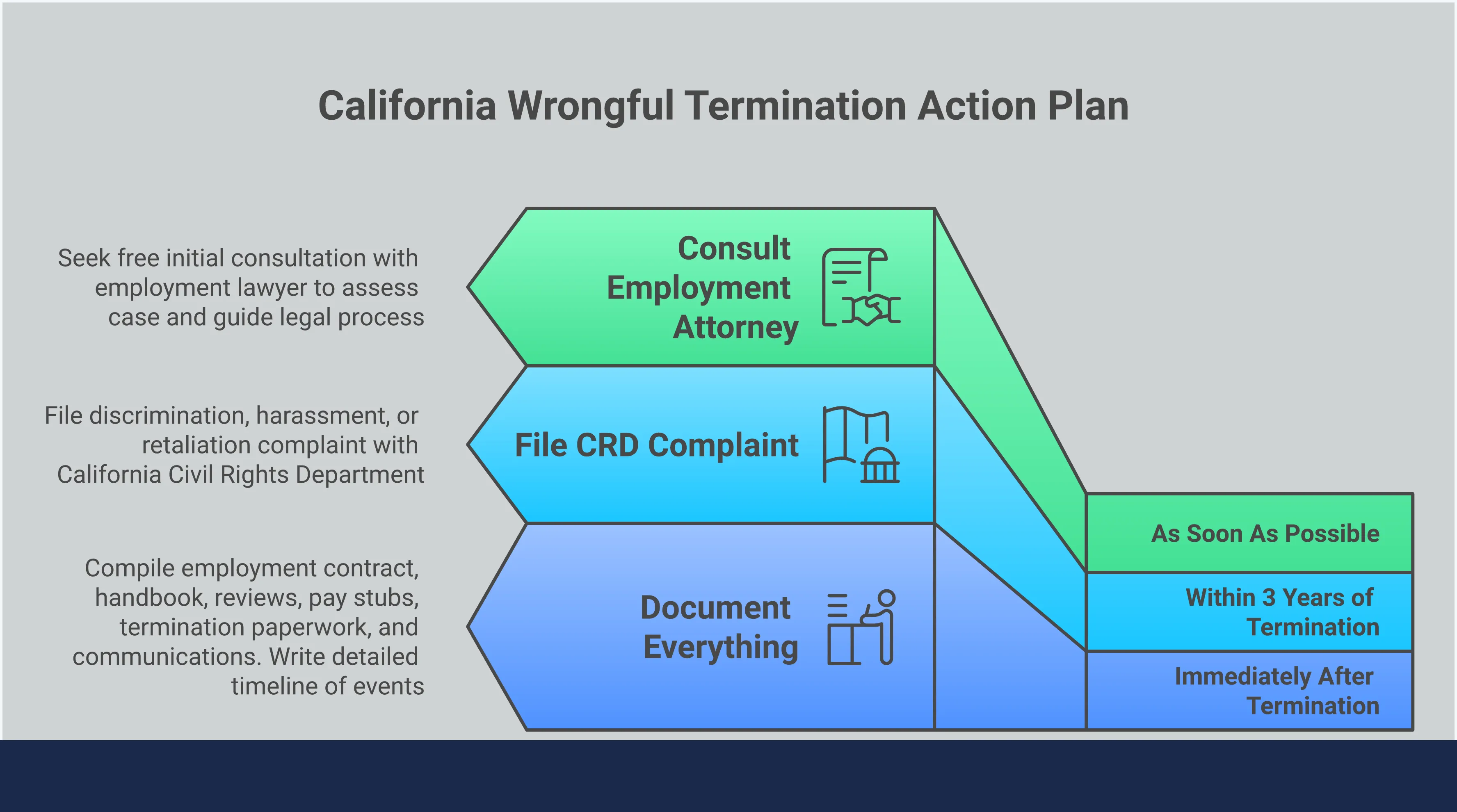
Losing your job is a shock, and it’s easy to feel overwhelmed and unsure of what to do next. If you suspect your termination wasn’t just unfair but illegal, it’s important to act thoughtfully. Taking a few immediate, strategic steps can make all the difference in protecting your rights and determining your next move. You don’t have to have all the answers right away, but you can start by gathering your information, understanding the formal process, and seeking professional advice. These actions will form the foundation for a potential case and help you regain a sense of control. Think of it as a clear, three-step path to help you move forward.
Step 1: Document Everything
Your first step is to become your own best record-keeper. The strength of a wrongful termination claim often rests on the evidence you can provide. Start gathering every relevant document you can find. This includes your employment contract, company handbook, performance reviews (especially positive ones), pay stubs, and any official termination letter or paperwork. Also, save any emails, text messages, or other communications that could support your case. If you recall specific conversations or incidents, write them down with dates, times, and who was present. Don’t dismiss anything as unimportant; strong evidence is what shows your firing was connected to an illegal reason, like retaliation for reporting an issue, rather than your job performance.
Step 2: File a Complaint with the CRD
In California, before you can file a lawsuit for many types of wrongful termination, you must first file a complaint with a state or federal agency. For most claims, this is the California Civil Rights Department (CRD). The CRD is the state agency responsible for investigating claims of discrimination, harassment, and retaliation. Filing a complaint is a critical step that preserves your right to sue later. It’s important to know that there are deadlines; you generally have three years from the date of the wrongful termination to file your claim with the CRD. Don’t worry if you feel your situation is complex. You don’t need to have a perfect case to start the process.
Step 3: Talk to a Wrongful Termination Attorney
While the first two steps are crucial, this is the most important one. You don’t have to figure this out alone. An experienced employment lawyer can listen to your story, review your documents, and help you understand if your firing was illegal. They can explain your rights and outline your best options for moving forward. Having a skilled wrongful termination attorney in California on your side significantly increases your chances of a successful outcome. Many firms, including ours, offer a free consultation to discuss your case, so there is no financial risk in getting the answers and support you deserve.
What Compensation Can You Recover?
If you were fired illegally, the law provides a way for you to seek compensation and help you get back on your feet. The main goal of a wrongful termination lawsuit is to recover what you lost because of your employer’s unlawful actions. This concept is often referred to as being made “whole” again, both financially and emotionally. It’s the legal system’s attempt to restore you to the position you would have been in if the illegal firing had never occurred. The specific compensation, or “damages,” you can recover will always depend on the unique circumstances of your case; it’s not a one-size-fits-all formula.
The damages are typically broken down into a few key categories. First, there are economic damages, which cover tangible financial losses like your lost salary and benefits. Then there are non-economic damages, which address the intangible but very real harm, like the emotional distress and mental anguish caused by the termination. In some rare cases involving extreme misconduct, punitive damages may be awarded. These are designed to punish the employer and deter similar behavior in the future. Understanding what you may be entitled to is a crucial step in deciding how to move forward. Let’s walk through the main types of compensation you may be able to recover.
Lost Wages and Benefits
This is often the first thing people think of, and for good reason. Lost wages, also called “back pay,” cover the salary and other income you would have earned if you hadn’t been illegally fired. This includes not just your base pay but also any bonuses, commissions, or raises you likely would have received. It also covers the value of lost benefits, which can be a significant financial hit. Think about things like health insurance coverage, retirement contributions, paid time off, and stock options. The goal is to calculate everything you missed out on financially from the date you were fired until a settlement or verdict is reached, putting you back in the same position you would have been in.
Compensation for Emotional Distress
Losing a job is incredibly stressful, and when it happens illegally, the emotional impact can be even greater. California law recognizes that a wrongful termination can cause significant mental and emotional harm, like anxiety, depression, and sleepless nights. You can seek compensation for this emotional distress. While no amount of money can erase the pain, these damages acknowledge the real, human cost of your employer’s actions and provide a measure of justice for the suffering you’ve endured. This is especially relevant in cases where the termination was the result of a hostile work environment or discrimination, which can take a heavy psychological toll on a person.
Punitive Damages
Punitive damages are different from the other types of compensation. They aren’t meant to repay you for a specific loss. Instead, their purpose is to punish the employer for particularly outrageous behavior and to discourage them, and other companies, from doing something similar in the future. These are only awarded in cases where you can prove the employer acted with malice, oppression, or fraud. This means their conduct was intentional, despicable, or consciously disregarded your rights. For example, if a manager intentionally fired someone for a discriminatory reason and then created false documents to cover it up, punitive damages might be on the table as an extra penalty for their conduct. They are meant to send a strong message.
Getting Your Job Back (Reinstatement)
In some wrongful termination cases, you might be able to get your old job back. This is called reinstatement. While it sounds like an ideal outcome for some, it’s actually less common in settlements and court awards. You also have to consider whether you’d even want to return to a company that fired you illegally. The work environment could be tense or hostile, making it an uncomfortable situation for everyone involved. Because of this, many employees and their attorneys decide to pursue financial compensation instead. This can include “front pay,” which is money to cover future lost earnings while you search for a new job. This often provides a cleaner break and the resources to find a better opportunity elsewhere.
How Bluestone Law Can Help
Losing your job is incredibly stressful, and it’s even more confusing when you feel the reason for your termination was unfair or illegal. You might be wondering if you have any options or if what happened was even against the law. This is where an experienced employment attorney can make all the difference. Our team at Bluestone Law is dedicated to helping employees understand their rights and figure out the next steps. We are here to listen to your story and provide the clarity you need during a difficult time.
The first thing we do is review the details of your employment and termination to determine if your employer broke the law. California has strong protections for workers, but figuring out if your firing qualifies as a wrongful termination requires a deep understanding of these complex rules. We can help you cut through the legal jargon and give you a clear, honest assessment of your situation. Even if your circumstances don’t seem to fit a perfect example, it is always worth discussing with a professional.
While you might feel like you need a mountain of evidence to call a lawyer, that isn’t the case. Simply bringing what you have, like emails, text messages, or performance reviews, is a great start. We can help you identify what’s important and guide you on what to do next. It is important to act quickly, as there are strict deadlines for filing a claim. You don’t have to face this alone. If you believe you were fired illegally, the team at Bluestone Law is here to advocate for you and ensure your rights are protected.
Employees seeking a Los Angeles wrongful termination lawyer can contact Bluestone Law to discuss their situation.
Frequently Asked Questions
What qualifies as wrongful termination in California? A firing may qualify as wrongful termination when it violates California or federal law, an employment contract, or public policy. Common examples include termination tied to discrimination, retaliation, protected leave, whistleblowing, workers’ compensation activity, wage complaints, or refusing to do something illegal.
Can you sue for wrongful termination in California? You may be able to sue if your termination was connected to an illegal reason and you meet the required claim deadlines. Some cases require filing with an agency before a lawsuit. A California employment attorney can review the facts, deadlines, and best path for your situation.
How do you prove wrongful termination in California? Helpful proof can include termination paperwork, emails, text messages, performance reviews, witness names, policy documents, medical or leave records, wage complaints, and a timeline showing the connection between your protected activity or protected trait and the firing.
How long do you have to file a wrongful termination claim in California? Deadlines depend on the type of claim. Many discrimination, harassment, and retaliation claims involve agency filing deadlines, while contract or public policy claims may follow different rules. Because missing a deadline can affect your rights, employees should get legal advice as soon as possible.
My boss said they can fire me for any reason because California is an “at-will” state. Is that true? That’s a common misunderstanding of the “at-will” rule. While it’s true that an employer can end your employment for many reasons, or even no specific reason, they absolutely cannot fire you for an illegal one. The law protects you from being terminated based on discrimination (like your race or gender), in retaliation for reporting harassment, or for taking protected medical leave. “At-will” does not give employers a free pass to break the law.
I wasn’t fired, but I quit because my work environment was so bad. Do I have any rights? Yes, you might. If your employer knowingly created or allowed working conditions to become so intolerable that any reasonable person would feel forced to resign, it could be considered a “constructive discharge.” The law treats this situation the same as a wrongful termination. This could apply if you were demoted, harassed, or faced other unbearable changes right after engaging in a protected activity, leaving you with no real choice but to leave.
What if I don’t have a “smoking gun” or written proof that my firing was illegal? You don’t need to have a perfect, open-and-shut case before you talk to a lawyer. Evidence can take many forms, and it’s often pieced together from different sources. Things like positive performance reviews that contradict your employer’s reason for firing you, emails or text messages about the situation, and even a detailed timeline of events that you write down yourself can be very powerful. An attorney’s job is to help you identify and gather the proof needed to tell your story.
I’m worried I can’t afford a lawyer. How much does it cost to talk to someone about my case? This is a valid concern, but you shouldn’t let it stop you from seeking help. Most reputable employment law firms, including ours, offer free initial consultations to hear your story and give you an honest assessment of your situation. Furthermore, they typically work on a contingency fee basis. This means you don’t pay any fees unless they successfully recover compensation for you. There is no financial risk in simply getting professional advice.
I think I was wrongfully fired. What is the very first thing I should do? The most important first step is to document everything you can while the details are still fresh in your mind. Write down a timeline of what happened, including who was involved and when key conversations took place. At the same time, gather any relevant paperwork you have, such as your termination letter, employment contract, or recent performance reviews. Once you have this information organized, your next step should be to speak with an employment attorney to understand your rights and options.
Related Articles
- Wrongful Termination Retaliation California: A Guide
- How to Prove Wrongful Termination: A 5-Step Guide
Think you were wrongfully terminated?
Get a free, confidential case evaluation from our experienced employment law attorneys.
Request Your Free Consultation