Was your firing just bad luck, or was it against the law? This is the single most important question to answer after losing your job. In an “at-will” state like California, the line can seem blurry, but it’s actually quite clear. An employer can’t fire you because of your race, for taking medical leave, or for reporting harassment. When they do, it’s not just wrong—it’s illegal. Figuring out if your situation fits this description is the first step toward justice. This guide is designed to help you analyze the facts and understand the process of filing an unlawful termination lawsuit.
Key Takeaways
- An “at-will” policy isn’t a free pass for illegal firing: While employers in California can fire you for almost any reason, they cannot do so for an unlawful one, such as discrimination based on your race or gender, or in retaliation for reporting harassment.
- Your personal records are your strongest evidence: The most crucial step you can take is to gather all employment-related documents and create a detailed timeline of events. This organized evidence is the foundation of a strong wrongful termination case.
- Don’t wait to seek legal advice: Strict deadlines apply to filing a claim, and missing one can prevent you from seeking justice. Consulting with an employment attorney immediately is the best way to protect your rights and understand your options.
Was Your Firing Unlawful?
Losing your job is a stressful and disorienting experience. It’s natural to question the reason you were given—or the lack of one. In California, most employment is “at-will,” which means an employer can fire you for a good reason, a bad reason, or no reason at all. They can let you go because they don’t like your taste in music or because they’re having a bad day. However, what they absolutely cannot do is fire you for an illegal reason.
If you believe your rights have been violated, our Wrongful Termination Attorney in California team can help you understand your options and pursue your claim.
A firing becomes an unlawful or wrongful termination when the underlying motive violates fundamental public policy, your employment contract, or specific state and federal laws. These laws are in place to protect employees from being fired based on prejudice, for exercising their legal rights, or for reporting illegal activities. Understanding the difference between an unfair firing and an unlawful one is the first step in figuring out if you have a legal claim. If you suspect your termination was based on something more than just a personality clash or a minor mistake, it’s worth taking a closer look at the circumstances.
Know if You’re in a Protected Class
State and federal laws protect employees from being fired based on certain personal characteristics. If you belong to a “protected class,” it means your employer cannot use that trait as a factor in their decision to terminate you. This isn’t about getting special treatment; it’s about ensuring you get fair treatment.
Protected characteristics in California include race, color, national origin, religion, gender, age (if you’re over 40), disability, medical condition, marital status, and sexual orientation, among others. If you believe you were fired because of one of these attributes—for example, if you were let go shortly after announcing a pregnancy or requesting an accommodation for a disability—your termination may have been an act of illegal discrimination.
When “At-Will” Employment Doesn’t Apply
The concept of “at-will” employment can be confusing. While it gives employers a lot of flexibility, it is not a blank check to disregard the law. The most significant exception to the at-will rule is that a termination cannot violate public policy. This means an employer can’t fire you for reasons that society recognizes as illegitimate and harmful.
For instance, firing you for serving on a jury, for taking protected family and medical leave, or for your political activities is illegal. Another exception is an implied or explicit employment contract. If you have a contract that promises job security or outlines specific reasons for termination, your employer must honor it. A wrongful termination attorney in California can help you determine if one of these critical exceptions applies to your situation.
Common Examples of Wrongful Termination
Sometimes, the easiest way to understand wrongful termination is to see it in action. While every case is unique, many unlawful firings fall into a few common categories. If any of these scenarios sound familiar, you might have a case.
Common examples include being fired:
- Shortly after you reported sexual harassment or another form of harassment.
- Because of your age, race, gender, or another protected characteristic.
- For requesting a reasonable accommodation for a disability.
- After you filed a workers’ compensation claim.
- For refusing to do something illegal at your boss’s request.
- As a result of a hostile work environment that was created or ignored by your employer.
Constructive Discharge: When You Are Forced to Quit
You do not have to be fired to file a wrongful termination lawsuit. Under the legal doctrine of Constructive Discharge (also known as Constructive Dismissal), you may sue for wrongful termination if your employer made working conditions so intolerable that a reasonable person would have felt compelled to resign.
Proving Constructive Discharge
The burden of proof is high. To win a claim, you typically must prove:
The employer intentionally created or knowingly permitted the intolerable conditions.
The conditions were so severe that resignation was the only viable option.
The employer was notified of the conditions and failed to remedy them.
Settlements for Forced Resignation
In constructive discharge settlements, damages are calculated similarly to a standard firing. You may be entitled to back pay starting from the day you resigned, provided you can prove the resignation was legally equivalent to a termination.
Fired for Speaking Up? Understanding Retaliation
The law protects your right to speak up about illegal or unsafe practices in the workplace without fear of losing your job. When an employer punishes you for engaging in a legally protected activity, it’s called retaliation, and it is illegal. California’s whistleblower statute, Labor Code 1102.5, gives these cases extra teeth: an adverse action within 90 days of your report now creates a legal presumption of retaliation. Protected activities include reporting discrimination, participating in a harassment investigation, or filing a complaint about unpaid wages.
If you were fired soon after you took one of these actions, you may have been a victim of retaliation at work. The timing is often a key piece of evidence. An employer might claim your termination was for performance issues, but if your performance was considered good until you reported a problem, their reason may just be a pretext for unlawful retaliation.
How a Toxic Workplace Can Play a Role
You don’t always have to be officially fired to have a wrongful termination claim. If your employer knowingly created or permitted working conditions so intolerable that you had no reasonable choice but to quit, it may be considered a “constructive discharge.” In the eyes of the law, a constructive discharge is the same as a firing.
To prove this, you need to show that any reasonable person in your position would have also felt compelled to leave. This could be due to severe and pervasive harassment, dangerous working conditions that your employer refused to fix, or being demoted and stripped of all job duties in an effort to humiliate you. In these situations, your resignation wasn’t truly voluntary, and you may have a valid wrongful termination case.
Our guide to wrongful termination in California explains when a firing may violate the law.
How to Build a Strong Case
If you believe your termination was illegal, taking the right steps from the beginning can make all the difference. Building a strong case isn’t just about what happens in a courtroom; it starts the moment you lose your job. It involves careful documentation, understanding your rights, and getting the right support. Think of it as laying a solid foundation for your claim. By being organized and proactive, you can protect your interests and prepare yourself for the legal process ahead. Let’s walk through the key actions you can take to build the strongest possible case for wrongful termination.
Gather Your Documentation and Evidence
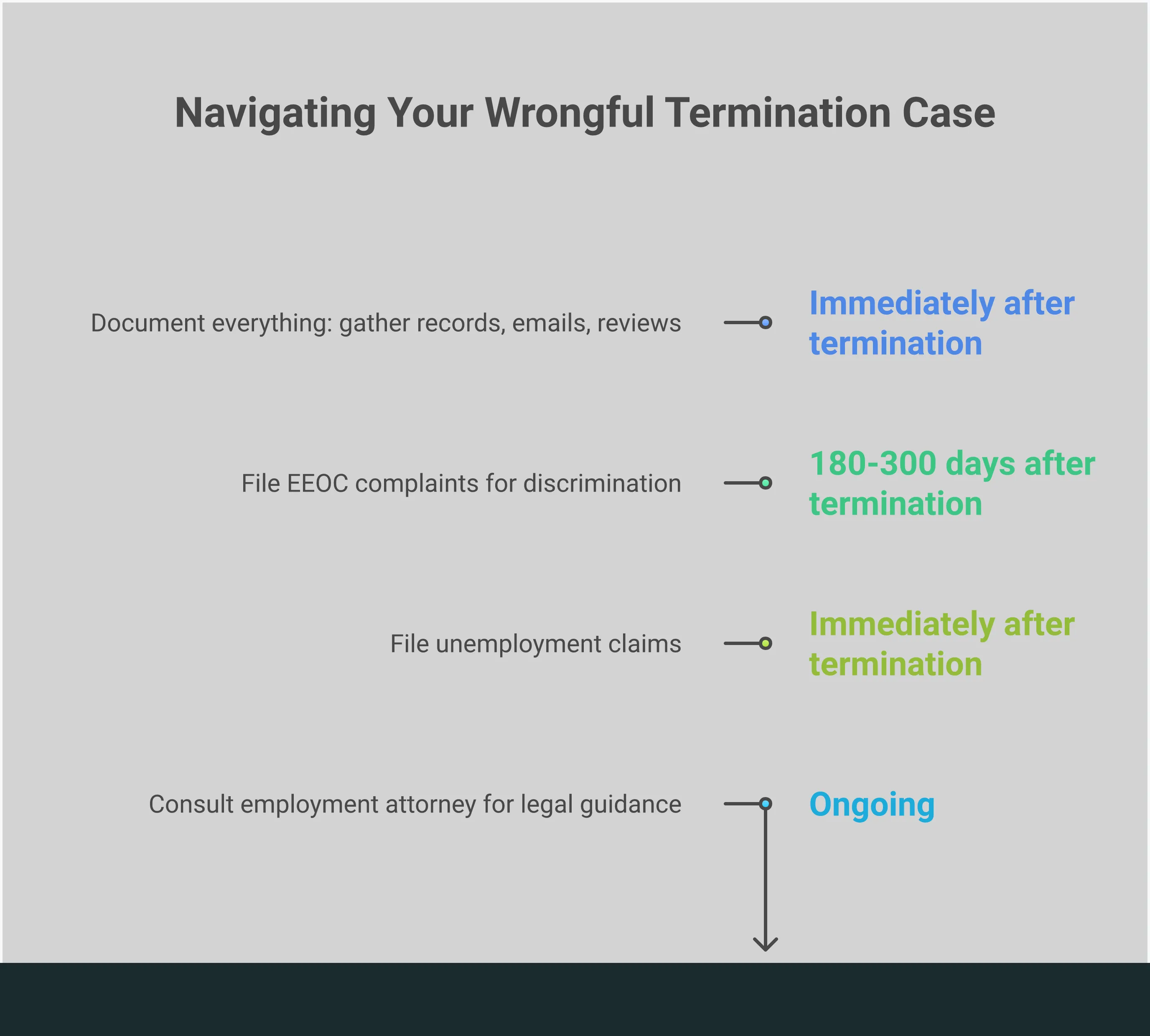
Your personal records are one of your most powerful tools. Start by collecting every document related to your employment. This includes your offer letter, employment contract, performance reviews (especially positive ones), and any emails, letters, or awards that show you were a valued employee. It’s also incredibly helpful to keep a detailed journal of events leading up to your termination. Write down dates, times, locations, who was involved, and exactly what was said or done. If you have copies of the company handbook or specific policies you believe were violated, set those aside as well. This collection of evidence will help you and your attorney piece together the full story.
Understand Key Deadlines
The legal system operates on strict timelines, and missing a deadline can unfortunately mean losing your right to file a claim. In California, the statute of limitations for a wrongful termination lawsuit is generally two years. However, if your case involves discrimination or harassment, you may have a much shorter window to file a complaint with a government agency like the DFEH or EEOC. These deadlines are not flexible, which is why it’s so important to act quickly. Don’t wait to figure out your next steps. Understanding the specific time limits that apply to your situation is critical to preserving your legal options.
Find the Right Employment Attorney
You don’t have to go through this process alone. Finding an experienced employment attorney is one of the most important steps you can take. A lawyer who specializes in employee rights can help you understand the law, evaluate the strength of your case, and explain your options in a way that makes sense. They will handle the complex legal procedures, from filing paperwork to negotiating with your former employer. At Bluestone Law, our firm is dedicated to advocating for employees, and we can provide the guidance you need to feel confident as you move forward. An expert on your side can make all the difference.
Review Company Policies and Handbooks
Your employer is expected to follow its own rules. Take time to carefully review your company’s employee handbook and any written policies related to performance, discipline, and termination. If your employer failed to follow their own established procedures when they fired you, it can be a powerful piece of evidence in your case. For example, if the company has a progressive discipline policy (like a series of warnings before termination) and they skipped all those steps without a good reason, it could suggest that the stated reason for your firing isn’t the real one. Having a copy of these policies is essential.
Communicate Carefully After Termination
After you’ve been let go, be mindful of your communication with your former employer. It’s a good idea to ask for the reason for your termination in writing. If you have an exit interview, take detailed notes on what is discussed. What your employer says in these moments can be very important later on. Filing for unemployment benefits can also be a strategic step, as your employer will have to provide a reason for your termination during that process. Any inconsistencies in their story can help expose the real motive, especially if you suspect illegal retaliation was at play.
Filing Your Wrongful Termination Lawsuit
Taking the step to file a lawsuit can feel overwhelming, but it’s a structured process. Knowing what to expect can make it feel much more manageable. It starts with getting the right advice and moves through a few key administrative and legal phases before you ever see a courtroom. Let’s walk through the initial stages of turning your claim into a formal legal action.
Your First Steps After Being Fired
Before you do anything else, your first move should be to speak with an experienced employment lawyer. It’s easy to feel emotional and unsure of what to do after being fired, but a legal professional can provide a clear, objective assessment of your situation. They will listen to your story, review your evidence, and help you understand if your termination was not just unfair, but unlawful. Consulting with an attorney who specializes in wrongful termination cases is the most critical step you can take to protect your rights and determine the best path forward. This initial consultation gives you a strategic advantage from the very beginning.
Meeting Government Agency Requirements
Depending on the reason for your termination, you may need to file a complaint with a government agency before you can file a lawsuit in court. For example, if you believe you were fired because of discrimination based on your race, gender, or a disability, you typically must first file a charge with the Equal Employment Opportunity Commission (EEOC) or California’s Civil Rights Department (CRD). Similarly, if you were let go for reporting unsafe working conditions, you might need to file a complaint with the Occupational Safety and Health Administration (OSHA). An attorney can identify which, if any, agencies you need to contact and ensure your complaint is filed correctly and on time.
The Legal Complaint Process, Explained
Filing with an agency like the EEOC or CRD is often a required first step. These agencies will investigate your claim. After their investigation, or after a certain amount of time has passed, they will typically issue a document called a “right-to-sue” letter. This letter is your official green light to proceed with a private lawsuit against your former employer. You cannot skip this step if your case falls under their jurisdiction. Navigating the administrative complaint process can be complex, which is another key reason why having an employment law expert on your side is so valuable. They handle the paperwork and deadlines so you can focus on what’s next.
What to Expect Before Litigation
Filing a lawsuit doesn’t mean you’re guaranteed to end up in a lengthy trial. In fact, the vast majority of wrongful termination cases are resolved before they ever reach a courtroom. Once your complaint is filed, your attorney will likely enter into negotiations with your former employer’s legal team. Many employers prefer to settle out of court to avoid the time, expense, and uncertainty of a trial. A settlement can provide you with fair compensation without the stress of litigation. Our firm always aims to find the most effective and efficient path to justice for our clients, whether that’s through skilled negotiation or powerful courtroom advocacy.
What Happens During the Legal Process?
Filing a lawsuit is a major step, but it’s really just the start of the legal journey. Once your complaint is filed, the case moves into a series of phases designed to uncover facts, define legal arguments, and, in many cases, find a resolution without ever stepping into a courtroom. Understanding this process can make it feel much more manageable. It’s not as dramatic as what you see on TV; it’s a structured, methodical process where your attorney guides you every step of the way. From gathering evidence to negotiating a potential settlement, here’s a look at what you can expect after your lawsuit is underway.
The Discovery and Investigation Phase
This is the fact-finding stage of your lawsuit, and it’s called “discovery.” During the discovery phase, both parties exchange information and gather evidence to support their claims. Your attorney and your former employer’s legal team will formally request information from one another. This isn’t a casual chat; it involves legal tools like written questions (interrogatories), requests for documents, and depositions, which are sworn out-of-court testimonies. The evidence gathered here is crucial and can include your complete personnel file, emails between managers, performance reviews, and statements from witnesses. This phase is all about building the foundation of your case with concrete proof.
Deciding Between a Settlement and a Trial
Many people imagine a dramatic courtroom battle, but the reality is that most wrongful termination cases are settled outside of court before they go to trial. A settlement is a negotiated agreement between you and your former employer to resolve the case for a specific amount of compensation. Opting for a settlement can provide a quicker, more certain resolution and helps you avoid the stress and uncertainty of a trial. Your attorney will evaluate the strength of your case, the evidence gathered during discovery, and any offers made by the other side to help you decide if a settlement is the right choice for you.
How Mediation Can Help
Mediation is often a key part of reaching a settlement. It’s a confidential process where a neutral third party, called a mediator, helps both sides work toward a mutually agreeable solution. The mediator doesn’t take sides or make decisions; their job is to facilitate a productive conversation and help find common ground. This process is much less adversarial than a trial and can be an effective way to resolve disputes while saving the time and costs associated with extended litigation. It gives you more control over the outcome and allows for creative solutions that a court might not be able to order.
Who Needs to Prove What?
In a wrongful termination lawsuit, the “burden of proof” is a key concept. Initially, the burden of proof lies with you, the employee, to present evidence that your termination was unlawful. For example, you might show that you were fired just days after you reported illegal retaliation at work. Once you’ve made that initial showing, the burden shifts to the employer. They must provide a legitimate, non-discriminatory reason for their decision. If they do, the burden shifts back to you to prove that their reason was simply a pretext, or a cover-up, for the real, illegal reason you were fired.
What Compensation Can You Recover?
If you’ve been wrongfully fired, you’re likely dealing with financial stress on top of everything else. The good news is that the law allows you to seek compensation, often called “damages,” to help you get back on your feet. A successful wrongful termination lawsuit can help cover the financial and emotional toll of losing your job unfairly. The goal is to make you “whole” again—as if the illegal firing never happened—and in some cases, to punish the employer for their actions. Understanding what you may be entitled to can help you decide on your next steps and see that there is a path forward.
Types of Damages You Can Claim
When you file a lawsuit, you can claim several types of damages. The most straightforward is compensation for lost wages and benefits, which covers the salary, health insurance, and retirement contributions you missed out on. You can also seek damages for emotional distress, which addresses the anxiety, depression, or other psychological suffering caused by the termination. In cases where an employer’s conduct was particularly harmful or malicious, you might be awarded punitive damages. These are meant to punish the company and deter similar behavior in the future. Finally, if you win your case, you can often recover your attorney’s fees, which makes pursuing justice more accessible.
Calculating Back Pay and Lost Wages
Calculating the exact amount you can recover for lost income depends entirely on your specific situation. Back pay covers the wages you lost from the time you were fired until a settlement or verdict is reached. This includes your salary, bonuses, and any other compensation you would have earned. While every case is different, settlements can range from a few thousand dollars to well over six figures. The final amount depends on factors like your salary, how long you were unemployed, and the strength of your case. An experienced attorney can help you accurately calculate your wage and hour claims to ensure you seek the full amount you are owed.
Damages for Emotional Distress
Losing a job illegally can take a significant mental and emotional toll. The law recognizes this hardship, and you may be able to receive compensation for the emotional distress you’ve endured. This can include feelings of anxiety, depression, humiliation, and stress that stem directly from the wrongful termination. Proving emotional distress often involves showing how the firing has impacted your mental health and overall well-being. This is especially relevant in cases involving a hostile work environment or discrimination, where the emotional impact is a central part of the harm you suffered. It’s a way of acknowledging that the damage wasn’t just financial.
Getting Your Attorney Fees Covered
The thought of paying for a lawyer can be intimidating, especially when you’ve just lost your income. However, in many successful wrongful termination cases, you can have your attorney’s fees and other legal costs paid for by your former employer. This provision is designed to ensure that everyone has access to justice, regardless of their financial situation. It allows you to stand up for your rights without the fear of being buried in legal bills. When you consult with our firm, we can explain how this works and discuss fee arrangements, so you can move forward with confidence and focus on your case.
Potential Settlement Outcomes
It’s a common misconception that every lawsuit ends in a dramatic courtroom trial. In reality, the vast majority of wrongful termination cases are resolved through a settlement before they ever reach a judge or jury. A settlement is a negotiated agreement between you and your former employer to resolve the dispute. This is often a favorable outcome, as it provides a quicker resolution, offers certainty, and can be less stressful than a trial. Your attorney will handle the negotiations to secure a fair settlement that compensates you for your losses, allowing you to close this chapter and move on with your life.
How to Protect Your Rights
If you believe you were fired illegally, the actions you take next are critical. Building a strong case starts with being organized, strategic, and informed. While the situation can feel overwhelming, focusing on a few key steps can help you secure your position and prepare for what’s ahead. Think of this as your playbook for protecting your rights and setting the foundation for a potential legal claim. It’s about taking control of your narrative and ensuring you have everything you need to effectively advocate for yourself.
Best Practices for Keeping Records
Your memory is powerful, but documentation is undeniable. Start gathering every piece of paper and digital communication related to your job. This includes your employment contract, performance reviews (especially positive ones), emails, text messages, and any notes about your termination. Create a detailed timeline of events in a journal. For each incident, write down the date, time, location, what was said or done, and who was present. This detailed record-keeping is one of the most effective ways to build a foundation for a wrongful termination claim, as it provides concrete evidence to support your side of the story.
Why Confidentiality Matters
After being fired, you might feel an urge to vent on social media or talk with former coworkers. It’s best to resist this impulse. Discussing the details of your situation can unintentionally harm your case. Anything you post online can be used against you, and conversations with colleagues could put them in an awkward position or muddy the waters later on. The best approach is to keep the details of your termination confidential, sharing them only with your immediate family and your attorney. Protecting your privacy is a key part of protecting your potential legal claim and ensuring you maintain control over the information related to your case.
Common Mistakes to Avoid When Filing
Many people mistakenly believe that any unfair firing is an illegal one. In California, most employment is “at-will,” meaning an employer can fire you for almost any reason—or no reason at all. However, they cannot fire you for an illegal reason, such as discrimination or retaliation. Another common mistake is assuming you don’t have a case without a formal employment contract. This isn’t true. Your rights are protected by state and federal laws, regardless of a signed agreement. The most significant error is waiting too long. There are strict deadlines for filing a claim, so it’s essential to understand your rights and act quickly.
What to Look for in a Lawyer
When you’re facing a former employer, you need an expert in your corner. Look for an attorney who specializes specifically in employment law and has a track record of representing employees, not companies. An experienced lawyer can assess your situation, explain your rights in clear terms, and outline your legal options. During your initial consultation, ask about their experience with cases like yours, such as those involving a hostile work environment or retaliation. You should feel comfortable with them and confident in their ability to guide you through the legal process. Finding the right legal partner is a crucial step toward achieving a just outcome.
Employees seeking a Sacramento wrongful termination lawyer can contact Bluestone Law to discuss their situation.
Fired Without Cause: When At-Will Becomes Unlawful
California is an at-will state, so being fired “without cause” isn’t automatically illegal — but at-will has hard limits. A termination becomes unlawful when the real reason is a protected characteristic (race, sex, age, disability, pregnancy), a protected activity (reporting harassment, taking FMLA/CFRA leave, filing a wage complaint), or a violation of public policy. If your employer gave no reason, a shifting reason, or a reason that doesn’t fit the timing, that’s exactly what employment lawyers look for.
How to Choose the Best Attorney for an Unlawful Termination Case
- Plaintiff-side only — no employer clients, no conflicts
- Contingency fees — no fee unless you win, and free consultations
- Trial record — employers pay more when your lawyer actually tries cases
- CELA membership — California’s plaintiff employment bar
- Straight answers — after one consultation you should know your case’s value, risks, and timeline
Frequently Asked Questions
My employer didn’t give me a reason for firing me. Is that illegal? In California, employers generally don’t have to provide a reason for termination because of the “at-will” employment rule. They can let you go for a reason that seems trivial or for no stated reason at all. However, the lack of a clear explanation can sometimes be a red flag. The key issue isn’t whether they gave a reason, but what their true motive was. If you suspect the real reason was illegal, such as discrimination or retaliation, the absence of a legitimate explanation can actually help support your claim.
I had to quit because my work environment was unbearable. Can I still have a wrongful termination claim? Yes, you absolutely can. This situation is known as “constructive discharge,” and the law treats it as a firing. If your employer knowingly created or allowed working conditions to become so intolerable that any reasonable person would feel they had no choice but to resign, your departure wasn’t truly voluntary. This could be due to severe harassment, dangerous conditions, or a campaign to humiliate you, making it impossible for you to continue your job.
What if the reason I was fired seems unfair, but isn’t related to discrimination or retaliation? While discrimination and retaliation are common grounds for a lawsuit, they aren’t the only ones. A firing is also illegal if it violates a fundamental public policy. This means your employer cannot fire you for exercising a legal right or refusing to participate in illegal activity. For example, it is illegal to be fired for serving on a jury, for taking protected family leave, or for reporting a safety violation to a government agency.
How can I afford a lawyer if I’ve just lost my job? This is a very common and understandable concern. Most employment law firms, including Bluestone Law, handle wrongful termination cases on a contingency fee basis. This means you don’t pay any attorney’s fees upfront. The firm is only paid a percentage of the settlement or award if they successfully resolve your case. Furthermore, in many successful lawsuits, the court can order your former employer to pay your legal costs, making it possible to seek justice without a significant financial burden.
How much proof do I need before I should contact an attorney? You don’t need a perfect, fully assembled case before reaching out for legal advice. It’s an attorney’s job to help you determine the strength of your claim and guide you on gathering the necessary evidence. If you have a strong suspicion that your firing was illegal, that is enough to warrant a consultation. Simply come prepared to share your story and bring any documents you have, such as performance reviews, emails, or a timeline of events. A legal expert can help you understand your options from there.
Related Articles
- Can I Sue for Being Threatened at Work? Know Your Rights
- How to Write a Resignation Letter for Constructive Dismissal
- Your Guide to Free Labor Law Advice in California
Think you were wrongfully terminated?
Get a free, confidential case evaluation from our experienced employment law attorneys.
Request Your Free Consultation