
Feeling singled out at work because of your race is a heavy burden. It’s often not one single event but a series of subtle actions: being passed over for projects, hearing inappropriate jokes, or facing unfair scrutiny. You know something is wrong, but turning that gut feeling into a formal complaint can feel impossible. The path to justice, however, starts with understanding your rights and the specific steps you must take to protect them. This guide is designed to give you that clarity. We will walk you through the entire process, from documenting incidents and reporting them internally to filing a racial discrimination lawsuit and holding your employer accountable.
Key Takeaways
- Start a detailed, private record immediately: Your first step should be to document every incident of discrimination. Write down dates, times, locations, what was said or done, and who was present, as this log will become crucial evidence.
- Filing an agency complaint is a required step: Before you can sue your employer, you must file a formal complaint with a government agency like the California CRD or the federal EEOC. Strict deadlines apply, so it is critical to act quickly to preserve your legal options.
- Consult an attorney to protect your rights: Federal and state laws not only prohibit racial discrimination but also make it illegal for your employer to retaliate against you for reporting it. An employment lawyer can explain your rights and guide you through the process from the very beginning.
What Does Workplace Racial Discrimination Look Like?
It can be tough to put your finger on workplace discrimination. Sometimes it’s an obvious, offensive comment, but more often, it’s a pattern of subtle actions that leave you feeling singled out and undervalued. You might sense that you’re being treated differently, but you can’t always pinpoint why. At its core, racial discrimination is when an employer treats you unfavorably because of your race, skin color, ancestry, or national origin. This isn’t just about personal feelings; it’s about illegal conduct that undermines your professional life and well-being.
If you believe your rights have been violated, our Workplace Discrimination Lawyer team can help you understand your options and pursue your claim.
This unfair treatment can happen at any point in your employment journey, from the moment you apply for a job to the day you’re considered for a promotion or, unfortunately, are let go. It isn’t always about one major event. It can be a series of smaller, seemingly minor incidents that, when viewed together, reveal a clear pattern of bias. For example, you might be consistently left out of important meetings, given fewer resources than your peers, or subjected to heightened scrutiny that others don’t face. The critical question is whether your race is a factor in these negative actions. Recognizing the specific ways racial discrimination shows up is the first step toward understanding your rights and deciding what to do next. It helps you move from a gut feeling that something is wrong to identifying specific, unlawful behavior.
Common Examples of Racial Discrimination
Discrimination can take many forms, and it’s not always as direct as a racial slur. Often, it’s embedded in everyday workplace decisions that disadvantage you because of your race. You might be experiencing it if you notice disparities in how you’re treated compared to your colleagues of a different race.
Here are a few common examples:
- Hiring and Promotions: You are passed over for a job or a promotion you are qualified for in favor of a less-qualified candidate of another race.
- Harassment: You are the target of racist jokes, slurs, or offensive comments about your race or ethnicity, creating a hostile work environment.
- Unequal Discipline: You receive a harsher punishment for a mistake than a coworker of a different race who did the same thing.
- Pay and Assignments: You are paid less or given less desirable work assignments than your peers for reasons tied to your race.
Know Your Protected Status Under the Law
The law provides a shield against this kind of unfair treatment. Both federal and California laws identify certain personal traits as “protected characteristics,” meaning it is illegal for an employer to base job decisions on them. Your race, color, and ancestry are all protected characteristics. This legal protection ensures that you have the right to be judged on your skills and qualifications, not on your background.
It’s important to know that the law also protects against discrimination based on other factors, including religion, gender, age, sexual orientation, and disability. Understanding that your race is a legally protected status is powerful. It confirms that you are entitled to a fair work environment, free from bias and prejudice.
Know Your Rights: Laws That Protect You From Discrimination
When you’re facing discrimination at work, it can feel isolating. But you aren’t alone, and more importantly, the law is on your side. Both federal and state laws establish clear protections for employees, making it illegal for employers to treat you unfairly based on your race. Understanding these laws is the first step toward standing up for yourself and holding your employer accountable. These protections are not just suggestions; they are your fundamental rights in the workplace.
Federal Law: Title VII of the Civil Rights Act
At the federal level, your primary protection comes from Title VII of the Civil Rights Act of 1964. This landmark law is the foundation of workplace discrimination law in the United States. It prohibits employers from discriminating against employees on the basis of race, color, religion, sex, or national origin. This applies to all aspects of employment, including hiring, firing, promotions, and pay. The U.S. Equal Employment Opportunity Commission (EEOC) is the federal agency responsible for enforcing Title VII, and it’s where you can file a formal complaint against your employer.
California Law: The Fair Employment and Housing Act (FEHA)
Here in California, we have even stronger protections under the Fair Employment and Housing Act (FEHA). This state law often goes further than its federal counterpart, offering broader coverage and protections for workers. FEHA makes it illegal for an employer with five or more employees to discriminate against you because of your race. If you’re experiencing race discrimination, both FEHA and Title VII serve as powerful tools to protect your rights and ensure you are treated with the dignity and respect you deserve at work.
Understanding Your Rights as an Employee
Knowing these laws exist is one thing, but understanding how they apply to you is another. To build a successful claim, you generally need to show that your race was a substantial motivating reason for an adverse employment action. This could be anything from being fired or demoted to being passed over for a promotion or being subjected to a hostile work environment. You don’t have to prove that race was the only reason, just that it was a key factor in your employer’s decision or actions.
You’re Protected From Retaliation for Speaking Up
Many people hesitate to report discrimination because they fear losing their job or facing other negative consequences. The law anticipates this fear and explicitly protects you. It is illegal for your employer to punish you, or retaliate against you, for reporting what you reasonably believe to be discrimination. This protection means you can’t be fired, demoted, or otherwise disciplined for speaking up. If you become a victim of retaliation at work, that is a separate legal claim you can pursue in addition to your original discrimination complaint.
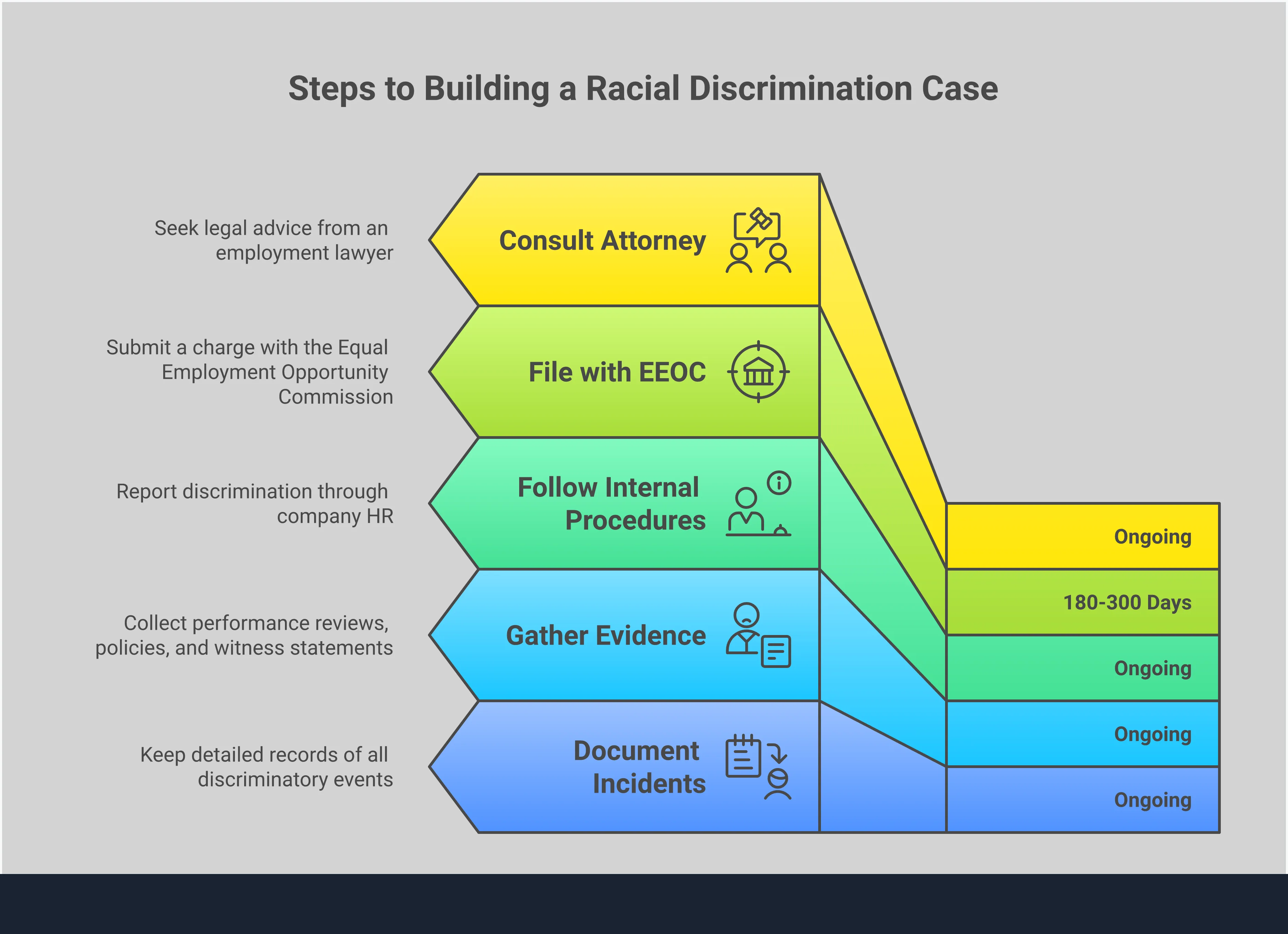
Your Pre-Lawsuit Checklist: 5 Steps to Take First
Taking legal action can feel overwhelming, but preparing properly can make all the difference. Before you file a lawsuit, there are several key steps you should take to build a strong foundation for your case. Think of this as your personal checklist to ensure you are organized, protected, and ready for the road ahead. Following these steps will not only strengthen your claim but also give you a sense of control during a challenging time. Each step is designed to gather the necessary information and fulfill legal requirements before you officially enter the litigation process.
Step 1: Document Every Incident
Before you take any formal action, start writing everything down. Create a detailed, private log of every incident of potential racial discrimination. For each entry, include the date, the time, and where it happened. Write down who was involved and exactly what was said or done. If there were any witnesses, note their names as well. Be as specific as possible. This written record is more than just a diary; it’s a crucial piece of evidence that helps establish a pattern of behavior. Keeping your notes organized and contemporaneous will make your account much stronger and more credible down the line. Make sure to keep this log in a safe, personal space, not on a work computer.
Step 2: Gather Evidence and Identify Witnesses
Your personal log is the foundation, but you should also collect any physical or digital evidence that supports your claim. This includes emails, text messages, voicemails, performance reviews, or any other documents that show discriminatory treatment. For example, if you were passed over for a promotion, save the job posting and any communication about the decision. Think about colleagues who may have witnessed the behavior or experienced something similar. While you should be careful about discussing a potential lawsuit with coworkers, simply making a private list of people who can verify your story is a key step. This evidence helps build a case showing a clear hostile work environment.
Step 3: Follow Your Company’s Internal Reporting Process
Most companies have a formal process for reporting discrimination, which you can usually find in the employee handbook. It’s important to follow this procedure by reporting the incidents to your supervisor or Human Resources department. When you make your report, do it in writing, such as through an email, so you have a time-stamped record. This step is vital for two reasons. First, it gives your employer a chance to fix the problem. Second, it shows that you tried to resolve the issue internally before pursuing legal action. We know this can be intimidating, especially if you fear you’ll become a victim of retaliation at work, but it is a critical part of the process.
Step 4: File a Complaint With the Right Agency on Time
Before you can file a lawsuit, you are legally required to file a formal complaint with a government agency. In California, you can file with either the federal Equal Employment Opportunity Commission (EEOC) or the state’s Civil Rights Department (CRD). These agencies will investigate your claim. It is absolutely essential to be aware of the filing deadlines. Generally, you have 300 days from the last discriminatory act to file with the EEOC and three years to file with the CRD. Missing these deadlines can prevent you from ever being able to file a lawsuit, so it’s important to act promptly once you have decided to move forward.
Step 5: Consult With an Experienced Employment Attorney
Navigating the legal system is complex, and you don’t have to do it alone. Speaking with an experienced employment attorney is the most important step you can take to protect your rights. A lawyer can review your documentation and evidence, determine the strength of your case, and explain your legal options in clear terms. They will guide you through filing with the correct agency, ensure you meet all deadlines, and represent you throughout the entire process. Getting professional legal advice early on can make a significant difference in the outcome of your case and give you the support you need during a difficult time.
How to File Your Official Discrimination Complaint
After you’ve documented everything and reported the discrimination internally, the next step is to make it official with a government agency. This is a mandatory step; you can’t file a lawsuit in court for workplace discrimination without first going through this administrative process. It might sound intimidating, but think of it as formally putting your employer on notice and getting the government’s help to investigate your claim.
This process involves specific forms, strict deadlines, and a formal investigation. While you can do it alone, this is the point where having an experienced attorney becomes invaluable. They can guide you through each step, ensure your complaint is as strong as possible, and protect you from common mistakes that could jeopardize your case. The goal is to build a solid foundation for your claim, whether it gets resolved at the agency level or proceeds to a lawsuit.
Choose the Right Agency: EEOC or California’s CRD
Before you can sue an employer for discrimination in court, you must first file a formal complaint with a government agency. In California, you have two main options: the federal Equal Employment Opportunity Commission (EEOC) or the state’s Civil Rights Department (CRD). While they investigate similar issues, they operate under different laws and have different procedures and deadlines.
For most California employees, filing with the CRD is the typical starting point because state laws often provide broader protections than federal ones. The two agencies have a work-sharing agreement, meaning a complaint filed with one is usually considered filed with the other. An attorney can help you determine the best strategic path for your specific case of discrimination and ensure your complaint is filed correctly.
Fill Out the “Charge of Discrimination” Form
The official process begins when you file a “Charge of Discrimination” with the EEOC or a similar complaint form with the CRD. This document outlines who you are, who your employer is, and the details of the discriminatory actions you experienced. This is where all the evidence you’ve been gathering becomes critical. You’ll need to provide a clear, concise summary of the events, including dates, locations, individuals involved, and any witnesses.
Accuracy and detail are key. This form serves as the foundation for the agency’s investigation and any future legal action. Working with a race discrimination lawyer can help you frame the narrative effectively, ensuring you include all legally relevant facts and present your claim in the strongest possible light.
Understand the Strict Filing Deadlines
When it comes to filing a discrimination complaint, time is not on your side. There are strict deadlines, known as statutes of limitations, and if you miss them, you could lose your right to take legal action forever. In California, you generally have three years from the date of the last discriminatory act to file your complaint with the CRD.
The federal deadline for filing with the EEOC is much shorter, typically 180 or 300 days. Because these timelines can be confusing and depend on the specifics of your situation, it’s vital to act quickly. Don’t wait to seek legal advice. Consulting with an employment law attorney as soon as possible will help you understand which deadlines apply to your case and ensure everything is filed on time.
What to Expect During the Agency’s Investigation
Once your complaint is filed, the agency will notify your employer and begin an investigation. This process can vary but often involves the agency requesting a formal response from your employer, interviewing you and other witnesses, and gathering relevant documents. Some agencies may also offer mediation to see if you and your employer can reach a settlement.
It’s important to know that your employer is legally forbidden from punishing you for filing a complaint. The law protects you from retaliation, such as being fired, demoted, or otherwise disciplined. The investigation process can take several months or even more than a year, so patience is essential while the agency does its work.
Receiving Your “Right-to-Sue” Letter
After the agency reviews your case, or sometimes upon your request, you will receive a document called a “Notice of Right to Sue.” This letter does not mean you’ve won or lost your case. It is simply the official permission slip you need to move your claim from the administrative agency to the court system. It confirms that you have exhausted the required administrative process.
Once you receive this letter, another clock starts ticking. You have a limited amount of time, typically one year under California law, to file a lawsuit in court. This makes the right-to-sue letter a critical milestone. It’s the green light for your attorney to take the fight to the next level and pursue justice for the wrongful termination or discrimination you faced.
The Lawsuit Process: What to Expect and Potential Outcomes
Once you receive your “Right-to-Sue” letter from a government agency, you can move forward with a lawsuit. This step transitions your complaint from an administrative investigation to a formal legal battle in court. It’s a serious undertaking, and it’s completely normal to feel a mix of determination and apprehension. Understanding the path ahead can help you feel more in control. The legal process has distinct stages, potential challenges, and a range of possible outcomes. Knowing what to expect can make all the difference as you prepare to stand up for your rights.
Common Myths About Filing a Lawsuit
One of the biggest misconceptions about workplace discrimination cases is that you can immediately file a lawsuit against your employer. In reality, you must first go through a specific administrative process. Before you can sue in court for racial discrimination, you are required to file a formal complaint, called a “Charge of Discrimination,” with either the federal Equal Employment Opportunity Commission (EEOC) or California’s Civil Rights Department (CRD). Only after the agency investigates and issues a “Right-to-Sue” notice can your case proceed to court. This process ensures that claims are vetted before they enter the judicial system, but it’s a crucial step that can’t be skipped.
How to Prepare for the Challenges Ahead
When you file a lawsuit, you can expect your employer to present a defense. A common legal defense in discrimination cases is the “legitimate, non-discriminatory reason.” This means your employer will argue that their actions (like firing or not promoting you) were based on valid, non-racial factors, such as performance issues or company restructuring. To counter this, you and your attorney will need to present evidence showing that their stated reason is just a pretext for discrimination. This is why your detailed documentation of incidents and witness information is so important. Being prepared for these arguments is a key part of building a strong case.
Resources and Support to Help You Through
You don’t have to face this process alone. The single most important resource you can have is an experienced employment attorney. A lawyer who specializes in employment law will be your guide and advocate every step of the way. They can help you file your initial agency complaint, handle all communication with your employer’s lawyers, build a strategy for your case, and represent you in court. Having a dedicated legal professional on your side not only strengthens your claim but also provides the support and confidence you need to see it through. The team at Bluestone Law is committed to fighting for employees and can help you understand your options.
Potential Outcomes: Compensation, Reinstatement, and Policy Changes
If your lawsuit is successful, you may be entitled to several forms of relief. The court can award financial compensation, often called “damages,” to cover lost wages and benefits if you were fired or denied a promotion. You can also receive damages for the emotional distress, pain, and suffering the discrimination caused. In some cases of wrongful termination, you might even be reinstated to your former position. Beyond personal remedies, a successful lawsuit can lead to meaningful change in the workplace, forcing the company to implement new policies and training to prevent future discrimination.
Understanding the Timeline and How Legal Fees Work
It’s important to have realistic expectations about how long a lawsuit can take. The legal process doesn’t happen overnight. A workplace discrimination lawsuit can last for several months or even years, depending on how complex the case is and whether it settles out of court or goes to trial. Concerns about cost are also valid, but most employment attorneys work on a contingency fee basis. This means you don’t pay any legal fees unless you win your case. The attorney’s fees are then paid as a percentage of your settlement or award. This arrangement allows you to pursue justice without having to pay for a lawyer out of pocket.
Frequently Asked Questions
What if the discrimination I’m experiencing is subtle, not one big obvious event? This is a very common situation. Racial discrimination often isn’t a single, dramatic incident but a series of smaller actions that create a pattern of unfair treatment. This could look like being consistently excluded from meetings, receiving more criticism than your peers for similar work, or being given less desirable assignments. The law recognizes that these subtle acts can add up to create a hostile work environment. Keeping a detailed log of every incident, no matter how small it seems, is key to showing how these actions form a larger, discriminatory pattern over time.
I’m afraid I’ll be fired or punished if I complain to HR. What should I do? This is a completely valid fear, but it’s important to know that the law is designed to protect you. It is illegal for your employer to retaliate against you for reporting what you believe in good faith to be discrimination. This means they cannot fire, demote, harass, or otherwise punish you for speaking up. If they do, you would have a separate legal claim for retaliation, which is often even stronger than the original discrimination claim. Reporting the issue internally is a critical step, and the law provides a shield while you take it.
Do I really need a lawyer, or can I handle filing a complaint on my own? While you can technically file a complaint with the EEOC or CRD by yourself, the process is filled with legal complexities and strict deadlines. An experienced employment attorney does more than just fill out forms. They can properly evaluate the strength of your case, help you frame your complaint in the most effective way, handle all communications with your employer’s lawyers, and ensure you don’t miss any critical deadlines that could jeopardize your right to sue. Having a professional advocate on your side from the beginning can make a significant difference in the outcome.
How much time do I have to take legal action? The deadlines for filing a discrimination claim are very strict, and missing them can mean losing your right to pursue your case. In California, you generally have three years from the date of the last discriminatory act to file a complaint with the state’s Civil Rights Department (CRD). The deadline for the federal Equal Employment Opportunity Commission (EEOC) is shorter, usually 300 days. Because these timelines can be complex, it is vital to act quickly and consult with an attorney as soon as possible to make sure your rights are protected.
What kind of evidence is most helpful for a racial discrimination case? Strong evidence is crucial, and it comes in many forms. Beyond your personal, dated log of incidents, any written communication is powerful. This includes emails, text messages, or performance reviews that demonstrate unfair treatment. It’s also helpful to gather documents that show disparities between you and your colleagues, such as project assignment lists, promotion announcements, or pay stubs if you suspect unequal pay. Identifying coworkers who witnessed the behavior can also be very important, as their testimony can help corroborate your experiences.
Related Articles
- How to Report a Hostile Work Environment Step-by-Step
- Mental Harassment at Workplace: A Guide to Your Rights
- 4 Famous Gender Discrimination Cases & How They Protect You
Think you were wrongfully terminated?
Get a free, confidential case evaluation from our experienced employment law attorneys.
Request Your Free Consultation