
Did your employer tell you one reason for your termination, only for you to later discover the truth was something illegal? This kind of deception is more common than you might think, and the law has a way to address it. When an employer intentionally hides their actions to prevent you from discovering a legal claim, it’s called fraudulent concealment. This is a powerful tool that can create an exception to the normal filing deadline. It’s one of several key exceptions to the statute of limitations in California designed to ensure you have a fair chance to act once you know the full story.
Key Takeaways
- Legal deadlines have built-in exceptions: While every employment claim has a strict filing deadline, California law provides extensions for specific situations, so you should not automatically assume your time has run out.
- The clock may start later than you think: The “discovery rule” can adjust your filing timeline, starting the clock when you found out about the harm, not necessarily when it happened, which is critical if the wrongdoing was not immediately obvious.
- Take organized action, not guesses: If you believe an exception applies to your case, your next steps are critical. Create a detailed timeline, gather all supporting documents, and speak with an employment lawyer to get a clear assessment of your options.
What Is California’s Statute of Limitations?
Think of a statute of limitations as a legal deadline. It’s a law that sets a strict time limit on how long you have to file a lawsuit after you’ve been harmed. Once that window closes, your right to sue is usually gone for good. This concept is a fundamental part of our legal system, designed to ensure that legal claims are brought forward in a timely manner.
While the specifics can get complicated, the basic idea is straightforward. For example, in California, the statute of limitations for most personal injury claims is two years from the date the injury occurred. Different types of legal issues, including those related to employment law, have their own specific deadlines. Understanding which deadline applies to your situation is one of the most critical first steps in protecting your rights. Missing it can mean losing your chance to seek justice, no matter how strong your case is.
Why Filing Deadlines Exist
You might be wondering why these deadlines exist in the first place. They aren’t arbitrary rules meant to trip you up. Instead, statutes of limitations serve a few important purposes. These rules help keep the legal system from becoming overwhelmed with old cases and ensure that evidence is still fresh and reliable. Think about it: memories fade, documents get lost, and witnesses move away. A deadline encourages people to act while the details are still clear.
These time limits also provide a sense of finality for potential defendants, giving them a clear point at which they no longer need to worry about a past incident leading to a lawsuit. The takeaway is simple but crucial: if you try to sue after this deadline, you will almost certainly lose your case.
How Deadlines Vary by Case
It’s important to know that there isn’t one single deadline for every type of case. The exact time limit you have to work with depends entirely on the specifics of your situation, including the nature of your claim and sometimes even who you are suing. For instance, a claim for breach of a written contract has a different deadline than a claim for personal injury.
This is especially true in the world of employment law. A case involving wrongful termination might have a different statute of limitations than one for unpaid overtime. Some claims even require you to file a complaint with an administrative agency, like the Civil Rights Department (CRD), long before you can ever file a lawsuit in court. This complexity is why it’s so important to figure out the specific rules that apply to your circumstances as soon as possible.
How Do Exceptions to the Filing Deadline Work?
While legal deadlines can feel rigid, they aren’t always absolute. California law recognizes that certain circumstances can make it difficult or even impossible for someone to file a claim on time. When this happens, the law provides for exceptions that can extend your filing window. These rules are designed to promote fairness, giving you a real chance to pursue your case even if the standard deadline has passed. Think of these exceptions as a legal safety net, ensuring that a technicality doesn’t prevent you from seeking justice for what you’ve experienced at work.
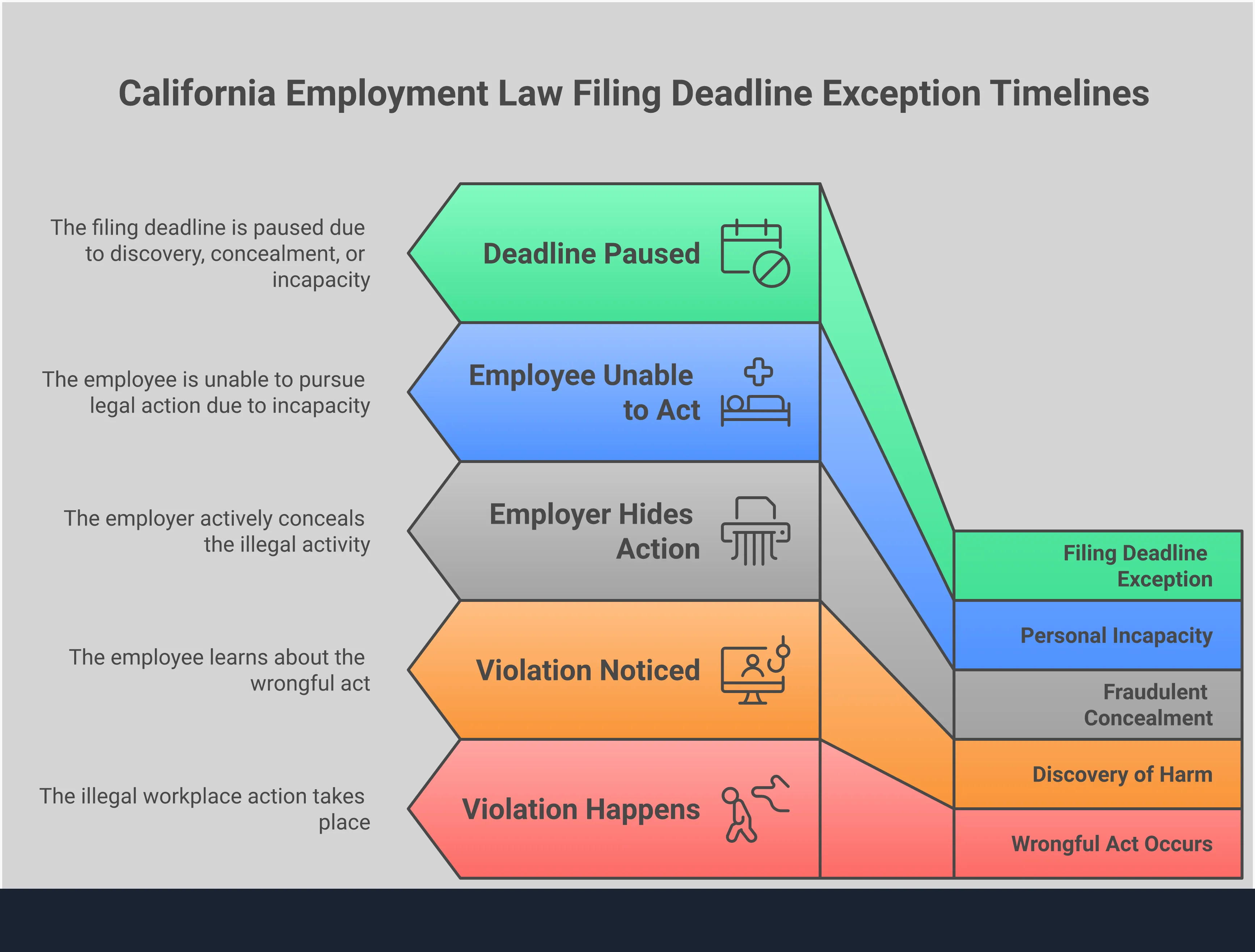
One of the most important concepts here is “tolling,” which is a legal term for pausing the clock on your statute of limitations. It’s a powerful tool that can make a significant difference in your ability to file a claim. Understanding how tolling and other exceptions work is a critical first step if you believe the deadline for your case might have passed. These provisions acknowledge that not every situation is straightforward and that your right to take action shouldn’t be lost due to circumstances you couldn’t control.
What Is “Tolling”?
Think of tolling like hitting the pause button on the stopwatch for your filing deadline. It’s a legal principle that temporarily stops the statute of limitations from running. This doesn’t erase the time that has already passed, but it prevents more time from ticking away while a specific condition is met. For example, if a situation arises that legally prevents you from filing your claim, the clock can be paused until that situation is resolved. This mechanism ensures that your right to seek justice isn’t lost, giving you the necessary time to move forward with your employment law claim.
Pausing the Clock on Your Claim
Several specific situations can pause the clock on your claim. One of the most common is the “discovery rule,” which states that the filing deadline doesn’t begin until you discover, or reasonably should have discovered, the harm you suffered. This is crucial in cases of wrongful termination where the illegal reason for your firing might not be immediately obvious. Additionally, the law provides protections if you are unable to file a lawsuit due to mental or physical incapacity. In these cases, the statute of limitations can be tolled until you regain the ability to take legal action, ensuring you have a fair opportunity to present your case.
What Is the “Delayed Discovery” Rule?
Sometimes, the harm caused by an employer isn’t obvious right away. You might not realize for months or even years that you were being underpaid, that a negative performance review was based on false information, or that you were passed over for a promotion due to discrimination. The delayed discovery rule acknowledges this reality. It essentially adjusts the starting line for your filing deadline.
Instead of the clock starting the moment the wrongful act occurred, it starts when you discovered the harm, or when you reasonably should have discovered it. This is a critical protection that ensures you don’t lose your right to seek justice simply because the wrongdoing was hidden or its effects weren’t immediately clear. It provides a fair chance to address issues like a hostile work environment or complex wage disputes that might only come to light after the fact. This rule gives you a fighting chance when you couldn’t have possibly known about the violation sooner.
How This Rule Can Help Your Case
The main advantage of the delayed discovery rule is that it can preserve your right to file a claim. If you were unaware that you were a victim of workplace discrimination, for example, you shouldn’t be penalized for not taking action before you even knew you had a reason to. This rule recognizes that not all injuries are immediately apparent. It allows the statute of limitations to begin from the date you actually found out about the issue, or reasonably should have. This can be the difference between having your case heard and having it dismissed on a technicality before it even gets started.
When Does the Discovery Rule Apply?
The delayed discovery rule isn’t a free pass; it comes with an important standard of reasonableness. The key question the court will ask is: When would a reasonable person in your situation have noticed the problem? The clock starts ticking from that point, not necessarily from the moment you personally connected all the dots. For instance, if your paychecks were consistently and obviously lower than what was stated in your contract, a court might decide you should have reasonably discovered the issue much sooner. Because these exceptions are complex and applied carefully, determining if the rule applies to your specific wrongful termination case requires a close look at the facts.
Can Your Personal Situation Extend the Deadline?
Life doesn’t always fit neatly into legal timelines. The law recognizes that certain personal circumstances can make it incredibly difficult, or even impossible, to file a lawsuit on time. In these specific situations, California law allows for the statute of limitations to be “tolled,” which is a legal term for pausing the clock on your filing deadline. This ensures you don’t lose your right to seek justice simply because of a situation outside of your control.
These exceptions aren’t loopholes; they are important protections built into the legal system. If you were under 18 when the incident occurred, were dealing with a serious incapacity, or the person you need to sue left the state, you might have more time to act than you think. Understanding these specific scenarios is the first step toward figuring out if your filing window is still open.
Being Under 18
If you experienced a legal wrong at your job while you were still a minor, the clock on your filing deadline works differently. Under California law, the statute of limitations is paused for anyone under the age of 18. This means the deadline doesn’t actually start to run until the day you turn 18. This rule exists to protect young people who may not fully understand their legal rights or have the resources to pursue a claim on their own. So, if you faced issues like wrongful termination or harassment as a teen, your opportunity to take legal action extends well into your adulthood.
Dealing with Mental or Physical Incapacity
California law also provides an exception for individuals who lack the mental or physical capacity to handle their own affairs. If you or a loved one suffered from a condition that made it impossible to make legal decisions, the statute of limitations can be paused. This tolling period lasts as long as the incapacity does. For example, if a severe injury or mental health condition prevents you from understanding your rights and filing a lawsuit, the clock won’t run against you until you regain that capacity. This ensures that a serious health crisis doesn’t also mean losing your right to address a legal issue like disability discrimination.
If the Defendant Leaves California
What happens if the person or company you need to sue leaves the state? California law has a provision for this exact situation. If a defendant leaves California after the incident but before you file a lawsuit, the statute of limitations may be paused for the entire time they are gone. This rule prevents a person or business from avoiding responsibility simply by moving out of state. The clock can resume if and when they return to California. This ensures that you have a fair chance to pursue your employment law claim, regardless of where the defendant has gone.
What If Your Employer Hid Their Actions?
It’s one thing to miss a deadline because you weren’t aware of the rules, but what happens when you didn’t even know you had a reason to file a claim? Sometimes, employers intentionally hide information or mislead employees to prevent them from discovering illegal actions. This could be anything from covering up the real reason for a firing to concealing evidence of a hostile work environment. The law recognizes that this is unfair and has a specific exception to address these situations. If your employer took active steps to keep you in the dark, you may get extra time to pursue your claim.
Defining Fraudulent Concealment
Fraudulent concealment is a legal term for when someone intentionally hides important facts to prevent you from discovering a potential legal claim. Think of it as your employer actively covering their tracks. For this exception to apply, their actions must be more than just staying silent; they have to involve some form of misrepresentation or intentional hiding of the truth. For example, if you were fired and told it was due to “restructuring,” but your employer secretly replaced you for a reason related to discrimination, that could be fraudulent concealment. When this happens, the statute of limitations can be paused, or “tolled,” until you discover the fraud or reasonably should have discovered it.
How to Prove What Was Hidden
Proving that your employer intentionally hid their actions can be challenging, but it’s not impossible. To make a case for fraudulent concealment, you generally need to show three things: your employer had a duty to tell you the truth, they deliberately concealed it, and you were harmed as a result. Evidence is key here. You might use emails, internal memos, or other documents that show your employer’s intent to hide the facts. Witness testimony from colleagues can also be incredibly powerful. Because proving intent is a complex part of any wrongful termination case, gathering as much documentation as you can is a critical first step.
Common Myths About Filing Deadlines
When you’re dealing with a difficult situation at work, the last thing you want to worry about is a legal technicality. But filing deadlines, known as statutes of limitations, are a critical part of any legal claim. It’s easy to get overwhelmed by what you think you know about these timelines. A lot of common beliefs about them are actually just myths, and buying into them could prevent you from seeking the justice you deserve. Let’s clear up a couple of the biggest misconceptions so you can move forward with confidence.
Myth: Deadlines Are Set in Stone
You might have heard that if you miss a filing deadline by even one day, your case is over before it starts. While it’s true that these deadlines are extremely important, they aren’t always as rigid as they seem. California law recognizes that life is complicated, and certain situations can pause or extend the time you have to file a claim. This is a legal concept called “tolling.” For example, the clock might be paused for someone who was a minor when the incident occurred or for a person who was mentally incapacitated. The rules for these exceptions are specific, so you should never assume you’re out of time without first exploring your options.
Myth: The Clock Always Starts Immediately
Another common belief is that the countdown to file a lawsuit begins the exact moment the wrongful act happens. This isn’t always the case. California follows a “discovery rule,” which means the statute of limitations clock may not start ticking until you discover, or reasonably should have discovered, the injury or wrongdoing. This is especially important in employment law cases where the harm isn’t immediately obvious. For instance, you might not realize you were wrongfully terminated based on a discriminatory reason until you learn that your replacement, who is less qualified, was hired under suspicious circumstances. The discovery rule ensures you have a fair chance to act once you have the necessary information.
Think an Exception Applies to You? Here’s What to Do
If you’ve read this far, you might be feeling a glimmer of hope. Realizing that your situation could fall under an exception to the statute of limitations is a big step. But what comes next? It’s easy to feel overwhelmed by the legal complexities, but you don’t have to figure it all out on your own. The key is to be methodical and act with purpose. Below are the essential steps to take if you believe your filing deadline should be extended.
Act Quickly: Your First Steps
Don’t wait. Even if you think you have a valid reason for a delay, time is not on your side. California’s laws on filing deadlines are notoriously complex, and the courts apply exceptions very narrowly. Your first move should be to create a detailed timeline of your case. Write down every important date: when the incident occurred, when you discovered the harm, and any periods where you were unable to act. This simple document will be incredibly valuable. Taking immediate, organized action is the best way to protect your right to pursue a claim for issues like workplace discrimination or harassment.
Gather Your Evidence
To successfully argue for an exception, you need more than just a good reason; you need proof. Your goal is to build a strong case explaining why the clock should have been paused on your claim. Start collecting any documents that support your position. This could include medical records if you were incapacitated, emails or letters showing your employer hid their actions, or travel records proving the defendant was out of state. Every piece of evidence helps tell your story and demonstrates why you couldn’t file sooner. Without this documentation, it becomes much harder to convince a court that your wrongful termination claim deserves an exception.
Why You Should Speak with an Attorney
This is not the time for guesswork. The rules surrounding statutes of limitations are some of the most complicated areas of law, and a small mistake can jeopardize your entire case. Consulting with an experienced employment lawyer is the most critical step you can take. An attorney can analyze the specific details of your situation, review your evidence, and give you a realistic assessment of whether an exception applies. They understand the legal standards for things like the discovery rule and fraudulent concealment. Getting professional legal advice from a firm that handles employment law will give you clarity and the best path forward.
Related Articles
- Wrongful Termination Retaliation California: A Guide
- Statute of Limitations for Sexual Harassment Claim
- How to Prove Wrongful Termination: A 5-Step Guide
- Free Consultation With a CA Wrongful Termination Lawyer
Frequently Asked Questions
What’s the biggest mistake people make with these filing deadlines? The most common mistake is making assumptions. Many people either assume they have plenty of time and put it off, or they assume they’ve missed the deadline and give up without exploring their options. Both can be devastating to a valid claim. The rules are complex and have many nuances, so you should never guess about your timeline.
How can I figure out the exact deadline for my specific employment issue? Unfortunately, there isn’t a simple chart that covers every situation. The deadline for a wrongful termination case can be different from one for an unpaid overtime claim. Some cases even require you to file a complaint with a government agency like the CRD before you can ever go to court, and that has its own separate deadline. The only reliable way to determine the correct timeline for your circumstances is to discuss the details with an employment attorney.
I didn’t realize I was wronged until much later. Is it automatically too late for me? Not necessarily. California law includes a “discovery rule,” which can help in situations like yours. This rule says the filing clock may not start until you discovered the harm, or reasonably should have discovered it. The key is that “should have” part; the court will look at when a reasonable person in your shoes would have noticed the problem. It isn’t an automatic extension, but it ensures you have a fair chance to act once you know something is wrong.
What kind of proof do I need to show that an exception should apply to my case? To argue for an exception, you need evidence that clearly explains why you couldn’t file on time. For example, if you were incapacitated, you would need medical records to support that. If you believe your employer hid their illegal actions, you might use emails, internal documents, or witness statements that show they intentionally misled you. The goal is to create a clear record that demonstrates why the standard deadline should not apply to you.
My situation is really complicated. Can I figure this out on my own, or do I need a lawyer? While it might be tempting to handle it yourself, the rules around statutes of limitations are one of the most technical parts of the law. A simple miscalculation can cause your entire case to be dismissed before it even begins. An experienced attorney can properly analyze the facts, identify the correct deadlines, and determine if any exceptions apply. Getting professional legal advice is the most important step you can take to protect your rights.
Think you were wrongfully terminated?
Get a free, confidential case evaluation from our experienced employment law attorneys.
Request Your Free Consultation