A meal break violation isn’t always as obvious as a manager telling you to work through lunch. It can be much more subtle. It’s the pressure to stay “on-call,” the constant interruptions with “quick questions,” or a workload so heavy that taking 30 minutes feels impossible. These situations create an environment where you are effectively denied meal breaks at work, even if no one says it out loud. Your employer has a legal duty not just to allow breaks, but to ensure you can actually take them without penalty. We’ll break down what a truly legal, duty-free meal period looks like and help you identify the signs that your employer is failing to meet their obligations under California law.
Key Takeaways
- Your break is a right, not a favor: In California, if you work over five hours, you are legally entitled to a 30-minute, duty-free meal break. Your employer must provide this; it is not optional.
- Documentation is your best evidence: If your rights are violated, immediately start a private log of every incident, noting dates, times, and details. Save all related pay stubs, emails, and texts to create a solid record of proof.
- There are penalties for violations: For each missed break, your employer owes you one hour of premium pay. The law also protects you from retaliation, making it illegal for your employer to punish you for asserting your right to a break.
What Are Your Rights to a Meal Break?
Feeling rushed during your lunch or, worse, not getting one at all? It’s a frustrating experience, and it might be illegal. Your rights to a meal break depend heavily on where you work. While federal law offers very little protection, California provides some of the strongest meal break laws in the country. Understanding these rules is the first step to making sure you’re being treated fairly and compensated correctly. Let’s look at exactly what the law requires from your employer.
If you believe your rights have been violated, our Wage & Hour Claims California team can help you understand your options and pursue your claim.
Federal vs. California Meal Break Laws
It might surprise you to learn that federal law doesn’t actually require employers to provide meal breaks. According to the U.S. Department of Labor, companies are not obligated to give you a lunch period. However, if they choose to offer short breaks, typically lasting between 5 and 20 minutes, they must pay you for that time. This is where California law makes a huge difference. Our state doesn’t leave it up to the employer. Instead, California has specific rules that guarantee your right to take breaks, ensuring you have protected time to rest and eat during your workday. These state-level protections are far more comprehensive than the federal baseline.
California’s Specific Meal Break Rules
In California, the rules are clear. If you work a shift of more than five hours, your employer must provide you with a 30-minute meal break. This break must be completely duty-free, meaning you can’t be expected to answer calls, check emails, or perform any work tasks. If your shift is longer than 10 hours, you are entitled to a second 30-minute meal break. If your employer fails to provide a compliant break, the law requires them to pay you a penalty of one extra hour of pay at your regular rate for each day the violation occurs. These meal and rest break laws are in place to protect your well-being and prevent employer overreach.
A Quick Look at Other State Laws
California’s robust meal break laws are not the standard across the United States. Many states simply follow the federal guideline, which, as we’ve covered, doesn’t mandate any breaks for adult employees. For example, states like Ohio have no laws requiring employers to provide lunch breaks. This contrast highlights just how important California’s specific protections are for workers here. Your rights are not guaranteed everywhere, which makes it even more critical to understand and defend them in our state. It’s a good reminder that employment law can vary significantly from one state line to another, and what’s standard practice elsewhere may be illegal in California.
What Makes a Meal Break Legal?
It’s not enough for your employer to just say you have a break. For a meal break to be legal in California, it has to meet specific requirements for timing, duration, and what you’re allowed (or not allowed) to do. If your break doesn’t check all the right boxes, your employer might be violating state law. Understanding these rules is the first step to figuring out if your rights are being ignored.
How Long and When Your Break Should Be
California law is very clear about the timing of your breaks. If you work a shift of more than five hours, you are entitled to a 30-minute meal break. Your employer should provide this break before the end of your fifth hour of work.
There is one exception: if your total shift is no more than six hours, you and your employer can mutually agree to waive the meal break. However, this must be a true agreement, not a demand. If you work more than 10 hours in a day, you are entitled to a second 30-minute meal break.
What “Duty-Free” Really Means
This is where many employers get it wrong. A legal meal break must be completely “duty-free.” This means you are relieved of all work duties and are free to leave the premises. You should not be expected to answer calls, respond to emails, monitor equipment, or handle any work-related tasks. You are on your own time.
If your boss interrupts you or asks you to do something work-related, your break has been compromised. The only exception is for certain jobs where the nature of the work makes it impossible to be relieved of all duty. In these rare cases, you can take a paid, on-duty meal break, but only if you have a signed written agreement in place.
Paid vs. Unpaid Breaks: Know the Difference
Generally, your 30-minute meal breaks are unpaid. Since you are relieved of all duties, your employer isn’t required to pay you for this time. This is different from shorter, 10-minute rest breaks, which are counted as work time and must be paid.
However, if your employer requires you to remain on-site or perform any tasks during your meal break, it is no longer a true, duty-free break. In that situation, the time must be counted as hours worked, and you must be paid for it. If you’re consistently working through unpaid lunches, it could lead to significant wage and hour claims.
Is Your Employer Violating Meal Break Laws?
It’s not always as obvious as a manager telling you, “You can’t take a break today.” Meal break violations can be subtle and often disguised as normal workplace culture. Your employer has a legal duty to provide you with uninterrupted, duty-free breaks. If they fail to do this, they are breaking the law. Understanding what a violation looks like is the first step toward protecting your rights. Common violations include being asked to work during your break, having your break cut short, being required to stay “on-call,” or feeling pressured by management to skip your meal period altogether. If any of these situations sound familiar, your employer might be violating California’s meal and rest break laws.
Working Through Your Break
If you find yourself eating a sandwich with one hand while typing with the other, you are likely not receiving a legal meal break. In California, your break must be completely free of work duties. There is a very narrow exception to this rule. An “on-duty” meal break is only permitted in specific situations where the nature of your job prevents you from being relieved of all duties. Even then, it is only lawful if you agree to it in writing and you are paid for your time. Without that explicit, written agreement, your employer cannot require you to perform any work during your meal period.
Interrupted or Shortened Breaks
A legal meal break must be a continuous, uninterrupted period of at least 30 minutes. If your manager calls you back to your desk after only 20 minutes or asks you to answer a “quick question” in the middle of your lunch, your break has been illegally interrupted. Even a minor interruption can invalidate the entire break because you were not fully relieved of your duties. When your employer fails to provide a proper meal break, California law states you may be owed one extra hour of pay at your regular rate for each day it happens. These penalties can add up quickly, as detailed in California’s wage and hour claims guidelines.
Being “On-Call” During Your Break
Being “on-call” is not a break. To be a valid meal period, you must be free to leave the premises and do as you please. You should not have to answer calls, check emails, or be ready to jump back into work at a moment’s notice. If your employer requires you to stay on-site or remain available to handle work tasks, you are not truly on a break. This includes situations like a security guard having to eat while monitoring cameras or a receptionist eating at their desk to answer the phone. If you aren’t free from all work duties, you are essentially still on the clock, and your employer is violating wage and hour laws.
Feeling Pressured to Skip Breaks
Sometimes, the violation isn’t a direct order but a cultural pressure. Your employer doesn’t have to chain you to your desk to break the law. They can create an environment where you feel you can’t take a break. This might look like a manager who praises employees for working through lunch, assigns an unmanageable workload that makes a 30-minute break impossible, or makes passive-aggressive comments when you step away. If you feel that taking your legally entitled break will lead to negative consequences or judgment from management, your employer is failing in their duty. This kind of pressure can be a form of retaliation at work, especially if you have previously asserted your rights.
What to Do If Your Meal Break is Denied
Finding out your employer is denying your legally required meal breaks can be incredibly frustrating and disheartening. You have a right to that time, and it’s important to know what steps you can take to correct the situation. If you’re consistently being asked to work through lunch or take shortened breaks, you don’t have to just accept it. Taking clear, methodical steps can help you protect your rights and get the compensation you deserve. Here’s a straightforward guide on what to do.
Document Every Incident
Your first and most important step is to create a detailed record of every time your meal break is denied, cut short, or interrupted. Think of this as building the foundation for your case. Memories can fade, but a written log is concrete evidence. For each incident, write down the date, the time your break should have started, and what actually happened. Note who your supervisor was, if any colleagues were present who saw what happened, and the reason you were given for missing your break. This log will be invaluable whether you’re reporting the issue to HR or speaking with an attorney.
Report the Issue Internally
Once you have some documentation, the next logical step is to raise the issue with your manager or Human Resources department. It’s possible the violation is due to a misunderstanding of the law, and a direct conversation can sometimes resolve it. I recommend putting your complaint in writing, like in an email, so you have a record of your report. Be professional and specific. For example, you could write, “I’m writing to address a recurring issue where I have been unable to take my full, uninterrupted 30-minute meal break as required.” This creates a paper trail and shows you made a good-faith effort to fix the problem internally, which is important if you become a victim of retaliation at work.
File a Formal Complaint
If talking to your employer doesn’t solve the problem, you can file a formal complaint with the state. In California, you can file a wage claim with the Labor Commissioner’s Office, also known as the Division of Labor Standards Enforcement (DLSE). This government body is responsible for investigating violations of labor law, including denied meal and rest breaks. Filing a claim initiates a formal process to recover the premium pay you are owed for each missed break. This step officially puts your employer on notice and brings in a neutral third party to enforce the law.
When to Get Legal Advice
You can seek legal advice at any point in this process, but it’s especially important if the violations are ongoing or if you’ve faced retaliation for speaking up. An employment lawyer can help you understand the full scope of your rights and calculate the compensation you’re owed, which in California is one extra hour of pay for each day you were denied a proper break. An attorney can also manage the process of filing a claim or lawsuit on your behalf, ensuring all deadlines are met and your case is presented as strongly as possible. Consulting with a lawyer can give you clarity and a powerful advocate in your corner.
How to Document Denied Meal Breaks
If you suspect your employer is violating meal break laws, your feeling that something is wrong is the first step. The next, and most critical, step is to document everything. Solid evidence is what transforms a complaint from your word against your employer’s into a strong legal claim. Think of yourself as a detective building a case file. Your goal is to create a clear, detailed record of every time your right to a break was denied. Here’s how to gather the proof you need, step by step.
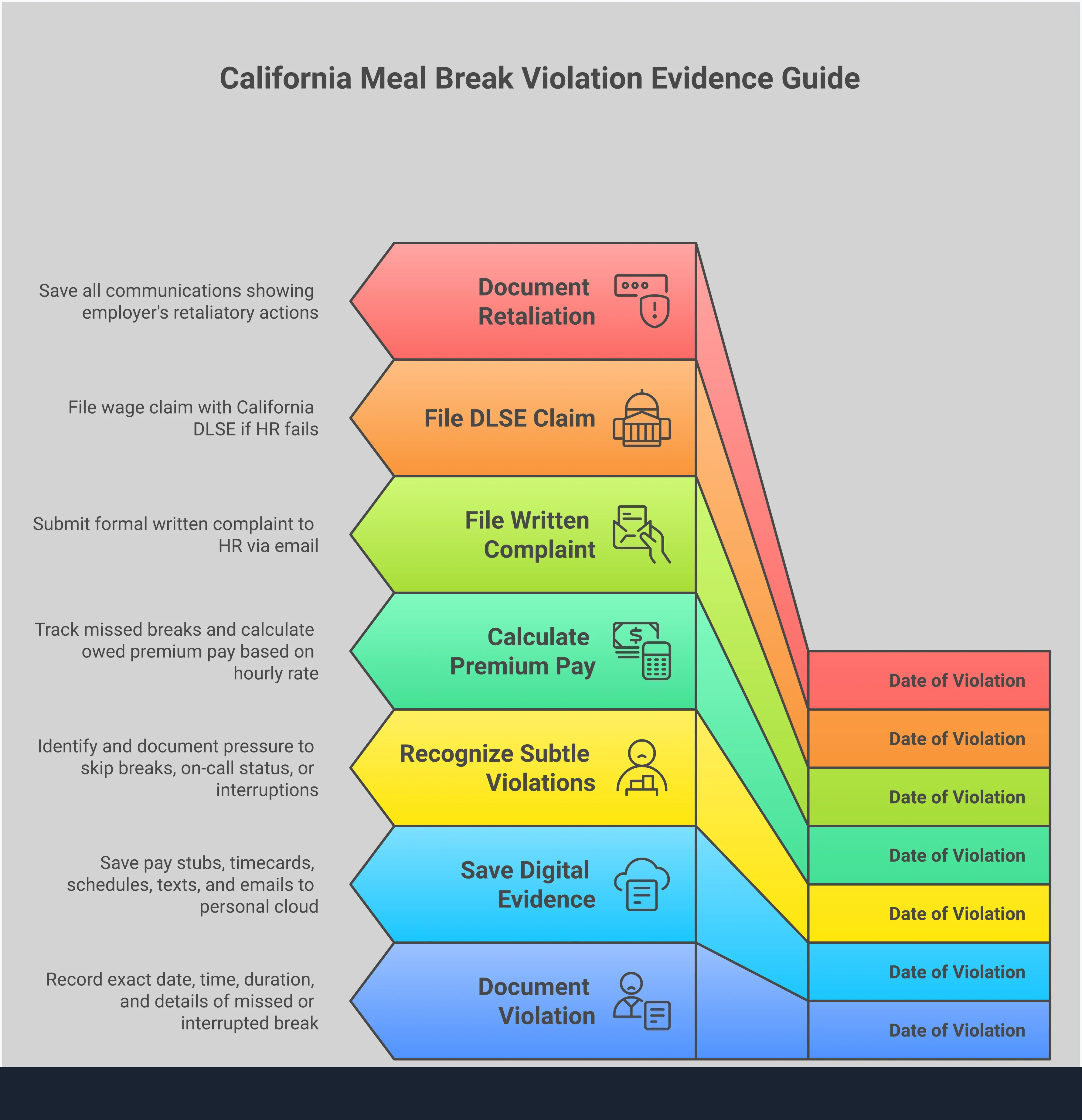
Keep a Detailed Log
Start a private log to record every meal break incident. You can use a physical notebook or a notes app on your personal phone, but keep it separate from your work devices. For each entry, write down the date and the specific time you were denied your break or had it interrupted. Note exactly what happened. For example, “Manager asked me to finish a report during my lunch,” or “My 30-minute break was cut short after 15 minutes to handle a client call.” Be sure to include the names of any managers or coworkers who were involved or witnessed the event. This detailed journal will become a crucial timeline for your case.
Collect Pay Stubs and Other Evidence
Your personal log is powerful, but it’s even better when supported by official documents. Make a habit of saving copies of all your pay stubs, timecards, and work schedules. These records can help verify the hours you worked and show whether you were compensated with the required premium pay for missed breaks. Don’t leave these documents at the office. Scan them or take clear photos and save them to a personal email address or cloud storage account. This ensures you have access to your evidence, even if you leave your job. These documents help paint a full picture of your wage and hour claims.
Identify Potential Witnesses
You are likely not the only one affected by unfair break policies. Think about which of your colleagues have witnessed you working through lunch or have had their own breaks denied. Make a confidential list of these potential witnesses. You don’t need to talk to them about taking legal action; just note their names and what they might have seen. For instance, “Sarah in accounting saw me eating at my desk while working on the quarterly budget.” If they have complained about similar issues, make a note of that too. Their testimony could provide valuable support for your claim down the road.
Save All Emails and Texts
Any written communication is a form of evidence. Carefully save any emails, texts, or messages in company chat apps (like Slack or Teams) that relate to your breaks. This could be a manager texting you to come back to work early or an email where you mention being unable to take a full lunch. Forward important emails from your work account to your personal email and take screenshots of any text or app-based conversations. Creating this paper trail is essential, as it provides undeniable proof of your situation and protects you from retaliation if you decide to formally report the violations.
What Happens When Employers Break the Rules?
When your employer doesn’t follow the rules for meal breaks, it’s more than just an inconvenience; it’s a violation of your rights. California law is very clear about this and has established specific consequences to hold companies accountable. These aren’t just suggestions, they are legal requirements with real teeth. If your employer is denying you proper breaks, they could face financial penalties that go directly to you, as well as potential lawsuits and government fines. Understanding these consequences can help you see why it’s so important to stand up for your right to a break.
California’s “Premium Pay” Penalty
If your employer fails to provide a compliant meal break, California law requires them to pay you for it. This isn’t just your regular hourly wage; it’s a specific penalty known as “premium pay.” For each workday that you are denied a proper meal period, you are entitled to one additional hour of pay at your regular rate. Think of it as automatic compensation for the violation. This rule is designed to make sure employers take meal and rest break laws seriously. It’s a direct consequence that acknowledges your time was not respected and ensures you are paid for that infringement.
Potential Lawsuits and Payouts
What if your employer denies your breaks and also fails to give you the premium pay you’re owed? This is where the situation can escalate. You have the right to take legal action to recover the money you are due. Filing a lawsuit can help you claim not only the unpaid premium pay but also other potential damages and interest. This is a common reason employees file wage and hour claims. When multiple employees at the same company are affected, it can even lead to a class-action lawsuit, which can result in significant financial payouts and force the company to change its policies for everyone.
Government Fines and Penalties
Beyond paying you directly, employers who violate meal break laws can also face consequences from the state. Government agencies, like the California Labor Commissioner’s Office, are tasked with enforcing these labor laws to protect workers’ rights. If an investigation finds that a company has a pattern of denying breaks, it can be hit with substantial fines and penalties. These government actions are separate from any lawsuit you might file. They serve as a broader punishment and a strong deterrent to ensure the company complies with the law in the future, protecting not just you but all of its employees.
When Should You Call an Employment Lawyer?
Deciding to contact a lawyer can feel like a big step, but you don’t have to wait until a situation becomes unbearable. While documenting incidents and reporting them internally are important first steps, there are key moments when getting professional legal advice is the best move you can make. An employment lawyer can provide clarity and support, ensuring your rights are protected. If you find yourself in any of the following situations, it’s probably time to make the call.
If Violations Are Frequent or Severe
A single, accidental interruption during your lunch might be something you can resolve with a simple conversation. However, if you are consistently denied breaks or pressured to work through them, you’re dealing with a much bigger problem. California law is clear: if your employer doesn’t provide a proper meal break, you may be owed one extra hour of pay for each day it happens. When these violations become a pattern, it signals a systemic issue within the company. This is more than just an oversight; it’s a potential violation of your rights that can add up to significant unpaid wages. An attorney can help you assess the severity and pursue the compensation you deserve for these ongoing wage and hour claims.
To Build a Strong Case
Having a feeling you’re being treated unfairly is one thing; proving it is another. An employment lawyer can help you turn your experiences into a strong, evidence-backed case. They know exactly what kind of documentation is needed, from detailed logs of missed breaks to saved emails and text messages. A lawyer can guide you on how to gather this information effectively and legally. They will also help identify witnesses and piece together a timeline that clearly demonstrates your employer’s failure to comply with the law. Getting an expert involved early ensures you are building the strongest possible foundation for your claim, whether you end up negotiating a settlement or filing a formal complaint.
To Understand Your Options and Deadlines
Employment law can be confusing, and the path forward isn’t always clear. A lawyer can explain all your available options in plain language, helping you understand the pros and cons of each. They can clarify what you might be owed, such as premium pay or other penalties, and outline the steps involved in filing a claim with the California Labor Commissioner’s Office or pursuing a lawsuit. Most importantly, there are strict time limits, known as statutes of limitation, for filing a claim. Missing a deadline could mean losing your right to take action entirely. Consulting with an employment law firm ensures you know your rights, your options, and the critical timelines you need to follow.
How to Protect Yourself From Retaliation
It’s one thing to know your rights, but it’s another to feel safe enough to exercise them. The fear of getting fired, demoted, or punished for speaking up is real, and it’s a major reason why many employees stay silent about workplace violations. But here’s the important part: the law is on your side. When you assert your right to a meal break, you are engaging in a legally protected activity. If your employer punishes you for it, that isn’t just unfair, it’s illegal.
Understanding what retaliation looks like and how to respond is your best defense. It allows you to stand up for your rights with confidence, knowing that you have a clear path forward if your employer tries to penalize you. This isn’t about starting a fight; it’s about ensuring you’re treated fairly and according to the law. Protecting yourself starts with knowing the rules of the game and documenting every move. This way, you aren’t just relying on your memory or your manager’s version of events. You’re building a case based on solid facts, which is the strongest position you can be in. We’ll walk through what counts as illegal retaliation, what to do if it happens, and how to create the paper trail you need to protect yourself.
What Is Illegal Retaliation?
Illegal retaliation happens when your employer takes a negative action against you because you engaged in a protected activity, like complaining about denied meal breaks. It’s their way of punishing you for speaking up. This “negative action” can be obvious, like being fired or demoted. But it can also be more subtle. Things like changing your shift to an undesirable time, excluding you from meetings, giving you an unfair performance review, or reassigning you to a less desirable role can all be forms of retaliation. The key is that the action would be enough to discourage a reasonable employee from making a similar complaint. Federal and state laws, including those enforced by the Equal Employment Opportunity Commission, make it unlawful for an employer to punish you for asserting your rights.
Steps to Take If You’re Punished for Reporting
If you face punishment after reporting a meal break violation, it’s important to act strategically. First, try to stay calm and continue performing your job to the best of your ability. Don’t give your employer any legitimate reason to take action against you. Next, immediately start documenting the retaliatory behavior. Write down exactly what happened, including the date, time, and any witnesses. Then, you should report the retaliation. You can report it internally through your company’s HR department, but you should also consider filing a formal complaint with an external agency. In California, you can file a retaliation complaint with the Labor Commissioner’s Office. This creates an official record and initiates an investigation into your employer’s conduct.
Creating a Paper Trail for Your Protection
A paper trail is your most powerful tool. It turns a “he said, she said” situation into a documented record of events. Your goal is to create a clear, factual timeline that shows a link between your meal break complaint and your employer’s negative actions. Save everything: emails, text messages, and any written communication with your manager or HR about your breaks. Keep copies of your pay stubs, especially if they show you weren’t paid the premium for a missed break. Note any changes in your performance reviews before and after your complaint. This collection of evidence is crucial if you need to build a case for wrongful termination or other retaliatory actions.
Frequently Asked Questions
My shift is only a little longer than five hours. Do I still get a meal break? Yes, you do. The law is very specific: once you work for more than five hours, you are entitled to a 30-minute, duty-free meal break. Even if your shift is just five hours and fifteen minutes, your employer must provide that break. The only exception is if your total workday is no more than six hours, in which case you and your employer can mutually agree to waive the break. This must be a true agreement, not a demand from your boss.
What if my boss doesn’t forbid breaks, but my workload is too heavy to take one? This can still be a violation. Your employer has a legal duty to provide a break, which means creating an environment where taking one is actually possible. If your workload is consistently so demanding that you cannot step away for 30 minutes, your employer is effectively preventing you from taking your legally required break. It is their responsibility to manage staffing and assignments in a way that allows all employees to take their protected breaks.
How is the “extra hour of pay” for a missed break calculated? The penalty for a missed break is one hour of pay calculated at your regular hourly rate, not your overtime rate. For instance, if you earn $30 per hour, your employer owes you an additional $30 for each day they fail to provide a compliant meal break. This is often called “premium pay,” and it is intended to compensate you for the denial of your right to rest. These penalties can add up significantly over time.
I’m worried I’ll get fired if I complain about not getting my breaks. What should I do? It is illegal for your employer to punish you for asserting your right to a meal break. This is called retaliation, and it is prohibited by law. If you are worried, the best thing you can do is create a paper trail. Put your complaint in writing, such as in an email to your manager or HR, so you have a dated record. If your employer takes any negative action against you after your complaint, this documentation will be crucial evidence to show that you were punished for speaking up.
Does a quick, work-related question during my lunch really count as a violation? Yes, it absolutely can. For a meal break to be legal in California, it must be completely uninterrupted for a continuous 30-minute period. If your manager asks you to answer a “quick question” or handle a minor task, you are no longer relieved of all duties. This interruption, no matter how brief, can invalidate the entire break because you were not given a true, duty-free rest period.
Related Articles
Owed wages, overtime, or break pay?
California employers who underpay can owe back pay plus penalties. Get a free, confidential case review.
Request Your Free Consultation