
Facing off against an employer can feel like an unfair fight. They often have deep pockets and a team of lawyers on retainer. So how can you, as an individual employee, level the playing field? The answer lies in the contingency fee agreement. This powerful arrangement gives you access to high-quality legal representation without any upfront cost. It ensures your case is judged on its merits, not on your ability to pay. Having the California employment lawyer contingency fee explained is crucial for understanding how you can secure justice and hold your employer accountable for wrongful termination or discrimination.
Key Takeaways
- Access legal help without upfront fees: A contingency agreement means you only pay attorney fees if you win your case. This arrangement removes the financial barrier to pursuing justice and ensures your lawyer is motivated to achieve the best outcome for you.
- Understand the full financial picture: Look beyond the main percentage to see how case costs, like filing fees, are handled. Remember that the fee is often negotiable and may change if your case goes to trial, so all terms should be clear.
- Get it in writing and ask questions: A written contract is required and protects you. Before you sign, ask your attorney to explain the fee structure, your responsibility for costs if you lose, and how a final settlement is distributed.
What Is a Contingency Fee?
When you’re facing a difficult situation at work, the last thing you need to worry about is how you’ll afford legal help. This is where a contingency fee agreement comes in. Simply put, it’s an arrangement where you only pay your attorney if they win your case and recover money for you. This model allows you to seek justice without paying any legal fees upfront. It aligns your lawyer’s goals with yours, as they are directly invested in achieving the best possible outcome. At our firm, we believe this approach provides access to quality legal representation for everyone.
The “no win, no fee” promise
The core of a contingency agreement is its “no win, no fee” promise. If your lawyer doesn’t secure a settlement or win a verdict in your favor, you do not owe them any attorney’s fees for the time they spent on your case. This structure removes the financial risk that often prevents people from pursuing a valid legal claim. It gives you the peace of mind to stand up for your rights, knowing you won’t end up with a large legal bill if things don’t go your way. It’s a powerful tool that levels the playing field between an individual employee and a large company.
Contingency vs. hourly fees
Many lawyers work on an hourly basis, where you pay for every hour of their time, regardless of the case’s outcome. With hourly rates for employment lawyers in California often being quite high, costs can quickly become overwhelming. A contingency fee is different. Instead of an hourly rate, your lawyer receives a pre-agreed percentage of the final settlement or award. This percentage is only taken from the money you receive. This model is standard for cases like wrongful termination and discrimination, making legal help accessible when you need it most.
Key legal terms to know
Before you sign any agreement, it’s important to understand the details. In California, a contingency fee agreement must be in writing and should be easy to understand. It must clearly state the exact percentage your attorney will receive. The contract should also explain how other case-related costs, such as court filing fees or the cost of hiring an expert witness, will be handled. It’s also worth knowing that the fee percentage is often negotiable. Don’t hesitate to ask questions to ensure you are completely clear on the terms before moving forward with your employment law claim.
Which Employment Cases Use Contingency Fees?
If you’ve been wronged at work, the financial impact can be immediate and overwhelming. The good news is that you don’t need a lot of money saved up to seek justice. Many employment law cases are handled on a contingency fee basis, which means your lawyer only gets paid if they win your case. This arrangement is common for claims where you are seeking to recover money for financial losses or damages. Let’s look at the specific types of cases that typically fall under this “no win, no fee” model.
Wrongful termination
Losing your job is stressful enough without worrying about how to pay for a lawyer. That’s why wrongful termination cases are almost always handled on a contingency fee basis. If you were fired for an illegal reason, such as retaliation or discrimination, you’ve lost your source of income. A contingency agreement allows you to pursue your claim without any upfront costs. Your attorney is paid a percentage of the settlement or verdict they obtain for you. This structure ensures your lawyer is just as motivated as you are to achieve a successful outcome and recover the compensation you deserve for your lost wages and other damages.
Discrimination and harassment
Cases involving discrimination or a hostile work environment are also well-suited for contingency fees. Experiencing illegal treatment based on your race, gender, disability, or another protected characteristic can cause significant financial and emotional harm. Whether you were denied a promotion, paid less than your peers, or forced to endure constant harassment, a contingency fee lawyer can help you fight back. They will work to build a strong case to prove the damages you’ve suffered, so you can focus on moving forward while they focus on securing justice and fair compensation on your behalf.
Wage and hour disputes
Did your employer fail to pay you for overtime? Were you denied proper meal and rest breaks? These are common wage and hour violations, and they are frequently handled on a contingency basis. In these cases, the goal is to recover the money you rightfully earned, along with any penalties your employer may owe. A contingency fee arrangement makes it possible to hold your employer accountable without dipping into your own savings. Your attorney’s fee comes directly from the money they recover for you, making legal help accessible even when your paycheck has been shorted.
When a contingency fee might not apply
It’s important to know that contingency fees don’t apply to every legal situation. This model works when there’s a potential for a monetary award or settlement. If you’re seeking legal help that doesn’t involve a direct claim for money, you’ll likely pay an hourly rate. For example, if you need a lawyer to review a severance agreement or an employment contract before you sign it, that work is typically billed by the hour. The key difference is that these services are about providing advice or preventing future issues, not recovering money from a past injustice.
What Is a Typical Contingency Fee in California?
When you’re dealing with a stressful work situation, the last thing you want to worry about is how to afford a lawyer. That’s where contingency fees come in. This fee structure is common in employment law because it makes legal help accessible. Let’s break down what you can expect from a typical contingency fee agreement in California, so you can feel confident and prepared.
Standard fee percentages
In California, a standard contingency fee for an employment lawyer usually falls between 33% and 40% of the money you recover from your employer. Depending on the case’s complexity, some agreements might be higher. This means if you win and receive a settlement or award, your attorney’s payment is a percentage of that total. If you don’t win, you don’t owe your attorney any fees for their time. This “no win, no fee” model ensures your legal team is just as motivated as you are to achieve a successful outcome.
Can you negotiate the fee?
Yes, you absolutely can. California law requires that contingency fee agreements state that the fee is negotiable. This is a key piece of information to have when you’re speaking with a potential attorney. Don’t be afraid to discuss the percentage. The final agreed-upon rate will depend on several factors, including the strength of your case and the estimated amount of work required. The most important thing is that the final percentage is clearly written into the agreement you both sign, leaving no room for confusion later on.
How case costs are handled
Beyond the attorney’s fee, every lawsuit involves other expenses, known as case costs. These can include court filing fees, costs for depositions, and fees for expert witnesses. Most employment law firms, including ours, will cover these costs for you as the case progresses. The contingency fee agreement should clearly explain how these costs will be handled. Typically, these expenses are deducted from your final settlement or award before the attorney’s percentage is calculated. Make sure you understand this part of the agreement and ask for clarification if anything is unclear.
What happens if your case goes to trial
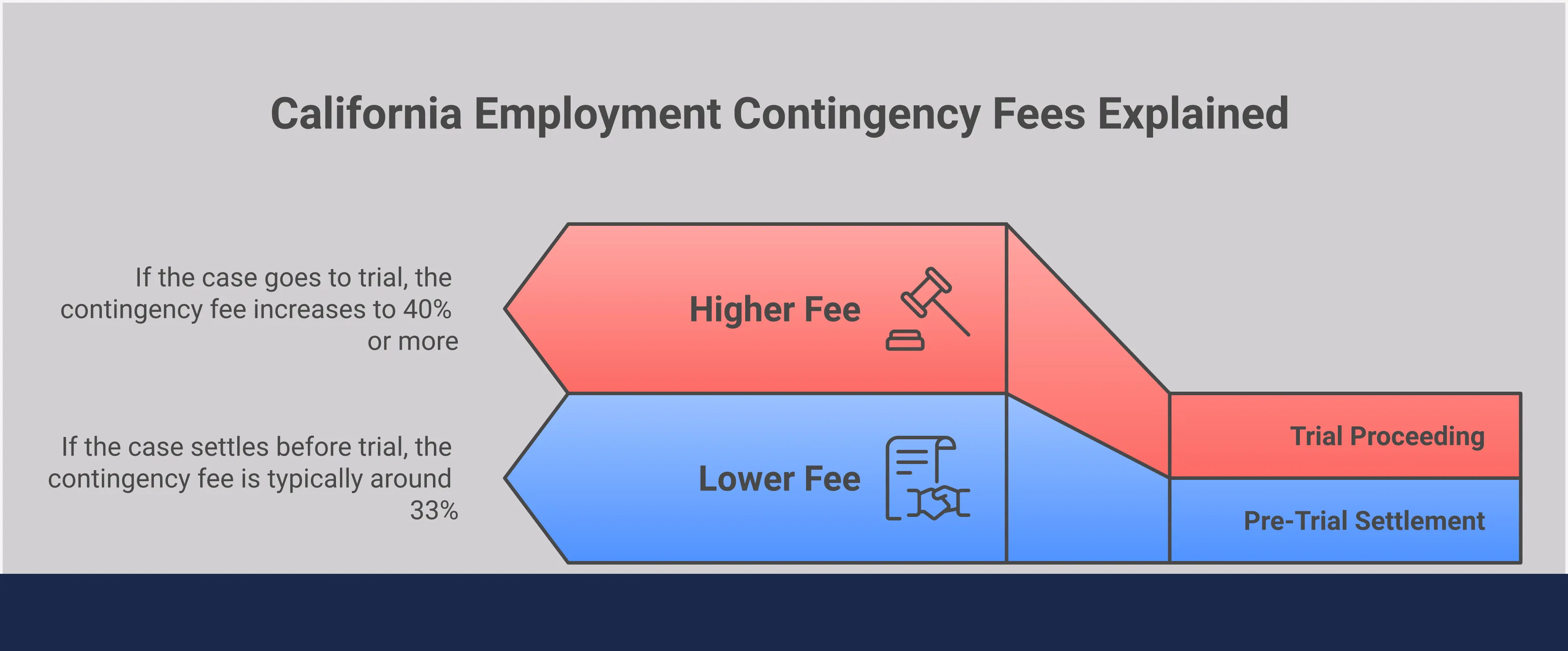
Most employment cases settle out of court, but some do proceed to trial. Because a trial requires a much greater investment of time and resources from your attorney, the contingency fee percentage often increases. For example, a fee might be 33% if the case settles but jump to 40% or higher if it goes to court. This is a standard practice that accounts for the increased risk and work involved in litigation. Your fee agreement should spell out this tiered structure, so you know exactly what to expect at every stage of your wrongful termination or discrimination case.
The Benefits of a Contingency Fee Agreement
When you’re facing a difficult situation at work, the last thing you need is another financial burden. A contingency fee agreement is designed to remove that stress, making it possible to pursue justice without paying out of pocket. This arrangement creates a partnership between you and your attorney, aligning your goals from day one. Let’s look at the key benefits that make this a powerful option for employees.
Pay nothing upfront
The most significant advantage of a contingency fee is that you don’t pay any attorney fees unless you win your case. If your lawyer successfully secures a settlement or a court award for you, their fee is a percentage of that amount. If you don’t receive any money from your employer, you owe your lawyer nothing for their time. This model removes the financial barrier that prevents many people from seeking legal help for issues like wrongful termination. You can focus on your case and your well-being without the pressure of upfront retainers or mounting legal bills.
Your lawyer is invested in winning
With a contingency fee, your attorney’s success is directly tied to yours. Since they only get paid if you do, they are highly motivated to secure the best possible outcome for your case. This isn’t just about winning; it’s about maximizing your recovery. This shared goal ensures your lawyer is fully committed to building a strong case, negotiating effectively, and fighting for your rights every step of the way. It transforms the attorney-client relationship into a true partnership, where both parties are working together toward a common financial goal.
Access to quality legal help
Contingency fees level the playing field. Corporations and employers often have vast resources to hire expensive legal teams. This arrangement allows employees to access top-tier employment law representation without needing deep pockets. It ensures that your ability to stand up for your rights isn’t determined by your bank account. You can hire an experienced and dedicated firm that believes in your case, giving you the same caliber of legal support that your employer has. This access is fundamental to achieving a fair and just resolution.
You and your attorney share the risk
Litigation can be expensive and unpredictable. Case costs, which are separate from attorney fees, can include filing fees, deposition costs, and payments for expert witnesses. Under a contingency agreement, the law firm typically advances these costs on your behalf. If you don’t win the case, you usually don’t have to pay them back. This means the law firm takes on the financial risk of the lawsuit. This arrangement shows the attorney’s confidence in your case and protects you from being left with a hefty bill if the outcome isn’t successful.
What to Know Before You Sign a Contingency Agreement
A contingency fee agreement is a contract, and like any contract, you should understand every detail before you put your name on it. This document outlines the entire financial relationship between you and your attorney for the duration of your case. Taking the time to review it carefully ensures there are no surprises down the road and that you and your legal team are aligned from the very beginning. Think of it as the financial roadmap for your legal journey.
Always get it in writing
First and foremost, your contingency fee agreement must be a written contract. A verbal promise or a handshake deal is not enough when it comes to legal representation. A formal, written document protects both you and your attorney by clearly laying out the terms. This contract should explicitly state the fee percentage your lawyer will receive, how other case-related costs will be paid, and that the fee is negotiable. Having everything in writing provides clarity and a solid foundation for the trust you place in our firm. It ensures everyone is on the same page about the financial aspects of your case from day one.
Understanding out-of-pocket costs
It’s important to know that the contingency fee covers your lawyer’s time and legal services, but it doesn’t include other case-related expenses. These out-of-pocket costs can include court filing fees, the cost of ordering medical records, or fees for deposition transcripts. Many firms, including ours, will often pay for these costs upfront to move your case forward. If you win your case, these advanced costs are typically reimbursed to the firm from your settlement or award. You should always ask what happens if you don’t win; it’s crucial to clarify whether you would be responsible for repaying these expenses.
Factoring in expert witness fees
In some employment cases, the opinion of an expert is needed to strengthen your claim. For example, a medical expert might be required in a disability discrimination case, or a financial expert might be needed for complex wage and hour claims. The fees for these experts can be substantial. Your contingency agreement should specify how these costs are handled. Additionally, be aware that the attorney’s fee percentage might increase if your case goes to trial. Trials demand significantly more time and resources, and this potential change in the fee structure should be clearly outlined in your agreement from the start.
Common misconceptions to avoid
It’s easy to think that if your rights were clearly violated, your case should be an easy win. However, there are rarely “easy wins” in employment law. These cases are often complex, hard-fought, and require a deep understanding of legal precedent and procedure. Your attorney invests years in education and practice to handle these challenges. If your case were truly simple, you might not need a lawyer’s help. Understanding this helps set realistic expectations and appreciate the skill and effort your attorney dedicates to fighting for your rights in a wrongful termination or discrimination case.
Questions to ask your attorney
During your initial consultation, don’t hesitate to ask direct questions about the contingency fee agreement. Being an informed client is your greatest strength. Here are a few key questions to ask:
- What is the exact contingency fee percentage?
- Does that percentage change if the case goes to trial?
- Who pays for case-related costs as they come up?
- If we lose the case, am I responsible for repaying any of the costs the firm advanced?
- Can you walk me through how the final settlement distribution is calculated?
Asking these questions will help you fully understand the agreement and feel confident in your decision to move forward with your employment law case.
Frequently Asked Questions
If I don’t win my case, do I really owe nothing? The “no win, no fee” promise applies specifically to your attorney’s fees, which is the payment for their time and work. If your case is not successful, you will not receive a bill from your lawyer for the hours they spent fighting for you. However, every lawsuit has other expenses called case costs. These are things like court filing fees or payments for deposition transcripts. Your written agreement will clearly state who is responsible for these costs if you lose, so be sure to discuss this detail with your attorney.
Are the attorney’s fee and case costs the same thing? No, they are two separate items. The attorney’s fee is the pre-agreed percentage of the settlement that pays for your lawyer’s expertise and service. Case costs are the direct expenses required to pursue your claim. Think of them as the operational expenses of your lawsuit. Typically, a law firm will advance these costs for you, and they are reimbursed from the settlement money before the attorney’s fee percentage is calculated.
Why is the contingency fee a percentage instead of a flat amount? A percentage-based fee creates a true partnership between you and your attorney. If the fee were a flat amount, a lawyer might be tempted to accept the first low offer to resolve the case quickly. A percentage ensures your lawyer is motivated to get the largest possible settlement or award for you. When your recovery amount goes up, so does their payment, which means your financial interests are perfectly aligned throughout the entire process.
Is the fee percentage negotiable? Yes, it is. In California, the law requires contingency fee agreements to state that the fee is negotiable between the attorney and the client. You should always feel empowered to discuss the percentage. The final rate often depends on the complexity of your case, the risks involved, and the amount of work your attorney anticipates. The most important thing is to reach a number you are comfortable with and have it clearly documented in your signed agreement.
What if my employer offers a settlement right away? Does the attorney still get the full percentage? A quick settlement offer is almost always the result of the strong case your attorney has already built on your behalf. Before ever contacting your employer, your legal team invests significant time investigating your claim, gathering evidence, and preparing a powerful legal argument. This upfront work is what pressures an employer to settle. The contingency fee compensates the attorney for this critical early work that leads to a fast and favorable outcome for you.
Related Articles
Think you were wrongfully terminated?
Get a free, confidential case evaluation from our experienced employment law attorneys.
Request Your Free Consultation