
That “working lunch” at your desk might feel normal, but in California, it’s often illegal. Many workplace violations aren’t big, dramatic events; they’re the slow creep of being asked to answer one more email or take a quick call during your unpaid break. These small interruptions add up, and they represent a serious breach of your rights. The law is clear: your break time is your own. If you’re consistently being denied that time, you may have a strong legal claim. Many employees wonder if they can sue their employer for no lunch break, and the answer is frequently yes. This guide will walk you through the signs of a violation, the steps to document what’s happening, and how to build a case to get the compensation you are owed.
Key Takeaways
- Your breaks are legally protected: In California, you are owed a 30-minute, uninterrupted meal break for any shift longer than five hours, and this time must be completely free from all work duties.
- Create a detailed record of violations: Your most powerful tool is a private log. Note the date, time, and specifics of every missed or shortened break, and save all your pay stubs and timecards as proof.
- You can claim compensation and are protected from retaliation: California law allows you to recover an additional hour of pay for each day a proper break was denied, and it is illegal for your employer to punish you for asserting your rights.
Know Your Rights: Lunch Breaks at Work
Understanding your rights around lunch breaks can feel confusing, especially since the rules aren’t the same everywhere. What’s legal in one state might be a clear violation in another. For California employees, the law provides some of the strongest protections in the country. It’s crucial to know what these protections are so you can ensure you’re being treated fairly.
If you believe your rights have been violated, our Wage & Hour Claims California team can help you understand your options and pursue your claim.
Many workplace issues stem from a simple misunderstanding of the law, both by employees and employers. Getting clear on the specific requirements for meal breaks in California is the first step toward protecting yourself. This isn’t just about getting a chance to eat; it’s about ensuring you get the uninterrupted, duty-free rest you are legally owed. Let’s break down what federal and state laws say, what California specifically requires, and some common myths that can cause confusion.
Federal vs. California Break Laws
It might surprise you to learn that federal law doesn’t actually require employers to provide meal breaks. According to the Fair Labor Standards Act (FLSA), the federal government leaves this decision up to employers. However, if an employer chooses to offer breaks, federal law does have rules. Short breaks, usually 20 minutes or less, must be paid. Longer meal breaks, typically 30 minutes or more, can be unpaid, but only if you are completely relieved of all work duties. This is a key point: if you’re answering emails or taking work calls, it’s not a real break. California, however, offers much more specific and protective employment law for workers.
What California Law Requires
California doesn’t leave meal breaks up to an employer’s discretion. State law is very clear: if you work a shift of more than five hours, you are entitled to a 30-minute, unpaid meal break. Your employer must provide this break before you start your sixth hour of work. If your workday extends beyond 10 hours, you are entitled to a second 30-minute meal break. During these meal and rest breaks, you must be completely free from your employer’s control and relieved of all job duties. You should be able to leave the worksite if you choose. If you aren’t, your employer is breaking the law.
Common Myths About Your Break Rights
One of the biggest myths is that a “working lunch” is acceptable. Many employees feel pressured to eat at their desks to catch up on work. If your meal break is unpaid, your employer cannot legally require or allow you to do any work. Answering a “quick question” or finishing a report means you are on the clock, and that time must be paid. Another common misconception is that you can regularly waive your break. While there are very limited circumstances where a break can be waived in writing, it cannot be a company-wide policy or a condition of your employment. These violations can lead to valid wage and hour claims.
Is Your Employer Violating Your Break Rights?
California’s laws on meal and rest breaks are designed to protect you, but it’s not always obvious when your employer is crossing a line. Violations aren’t always as dramatic as being told you can’t take a lunch break at all. Often, they are more subtle, like being asked to answer a quick email or having your break interrupted. Understanding the specific rules can help you identify if your rights are being ignored. Let’s look at some of the most common ways employers violate meal and rest break laws and what that means for you.
Being Forced to Work Through Lunch
Your 30-minute meal break is your time, and it must be completely uninterrupted and unpaid. If your employer expects you to perform any work duties during this time, they are breaking the law. This includes seemingly small tasks like answering work-related calls, responding to emails, or finishing up a report. If your employer makes you work during an unpaid meal break and doesn’t pay you for that work, it’s against the law. Essentially, if you aren’t free to leave the premises for your entire break, you are still “on the clock.” These small interruptions add up and can be a clear sign of wage and hour violations.
Not Getting Your Full Break Time
California law is very specific about when and for how long you get to take a break. If you work a shift of more than five hours, your employer must provide a 30-minute meal break, and it must begin before the end of your fifth hour of work. For longer shifts, a second 30-minute meal break is required if you work more than 10 hours. Additionally, you are entitled to a paid 10-minute rest break for every four hours worked. These breaks are separate from your meal period. An employer who shortens these breaks or fails to provide them at the proper time is violating your rights.
Poor Timing or Interrupted Breaks
A proper meal break means you are completely relieved of all job responsibilities. During your meal break, you must be completely free from all work duties. You should be able to leave the workplace if you want to. This means you can’t be considered “on-call” or required to stay nearby in case you’re needed. If your manager interrupts your lunch to ask a question or a coworker pulls you away to help with a task, that break doesn’t count. An interrupted break is legally considered a missed break, and you may be owed compensation for it. These situations often lead to wage and hour claims.
Facing Retaliation for Taking Breaks
You have the right to take your legally mandated breaks without fear of punishment. It is illegal for an employer to retaliate against an employee for requesting breaks or complaining about missed breaks. Retaliation can take many forms, such as cutting your hours, assigning you to less desirable shifts, giving you an unfair performance review, or even firing you. The law protects you from this kind of treatment. If you’ve noticed negative changes at work after you tried to assert your right to a break, you may be a victim of retaliation at work. You shouldn’t have to choose between your job and your rights.
Can You Sue for Missed Lunch Breaks?
If you’re consistently being denied your lunch breaks, you might be wondering what you can do about it. The short answer is yes, you can often sue your employer for these violations. But knowing if you have a strong case depends on a few key factors, from your employment contract to the specific labor laws in California. Understanding your rights is the first step toward holding your employer accountable and getting the compensation you deserve.
When to Consider Legal Action
It’s time to consider legal action when missed breaks become a pattern, not a rare exception. If your employer regularly requires you to work through your unpaid meal break without paying you for that time, they are breaking the law. This includes being asked to stay on-call, answer emails, or handle tasks while you’re supposed to be off the clock. A single, accidental interruption might not be enough for a lawsuit, but a consistent policy or practice of denying breaks is a serious violation of your rights. These situations often fall under broader wage and hour claims that an experienced lawyer can help you pursue.
If Your Employment Contract Was Broken
Even outside of state law, your own employment agreement or the company handbook can be a powerful tool. If your employer outlines a policy for lunch breaks in these documents, they are legally required to follow it. For example, if your employee handbook promises a one-hour lunch break, but you’re only ever allowed to take 30 minutes, that could be considered a breach of contract. Always review your hiring paperwork and the company’s official policies. These documents create binding obligations, and failing to uphold them can be solid grounds for a legal claim. It’s a straightforward way to check if your employer is failing to meet the standards they set for themselves.
When State Labor Laws Are Violated
California has some of the strongest employee protections in the country, especially when it comes to breaks. State law is very clear: employers must provide their employees with timely and uninterrupted meal and rest breaks. If your employer fails to do this, it’s a direct violation of the California Labor Code. This isn’t just a suggestion; it’s a legal requirement. A violation gives you a clear basis to file a lawsuit or an administrative claim to recover penalties for each break you were denied. Your employer can’t simply ignore these rules without facing consequences, and knowing the specifics of the law is your best defense.
Understanding Class Action Lawsuits
Sometimes, a company’s policy of denying breaks affects not just you, but dozens or even hundreds of your colleagues. In these situations, a class action lawsuit may be the most effective option. This allows a group of employees with similar complaints to file a single lawsuit together. This approach can be more powerful than an individual claim and can lead to significant compensation. Through a class action, employees can recover unpaid wages, interest, and additional penalties designed to punish the employer for their widespread violations. It’s a way to create systemic change while getting justice for everyone who was impacted by the company’s illegal practices.
4 Steps to Take Before Filing a Lawsuit
Thinking about suing your employer can feel overwhelming, but you don’t have to jump straight to a lawsuit. Taking a few strategic steps first can strengthen your position and sometimes even resolve the problem without going to court. Before you file, it’s important to build a solid foundation for your claim. Here’s a clear, four-step process to follow if you believe your employer is violating your right to meal and rest breaks.
1. Document Every Violation
Your best tool in a dispute is a detailed record. Start a log and keep it somewhere safe and private, not on a work computer. For every shift, write down the date, the time you started and ended work, and the exact times you took your breaks. If you were forced to work during a break or couldn’t take one at all, note that, along with who told you to work and why. This consistent record-keeping is crucial. It helps establish a pattern of violations and serves as powerful evidence if you need to prove your case later.
2. Report the Issue Internally
Before taking formal action, it’s often best to report the problem internally. You can speak with your direct supervisor or go to the Human Resources department. It’s a good idea to put your complaint in writing, like in an email, so you have a timestamped record of your report. This step shows you made a good-faith effort to resolve the issue. Pay close attention to how your employer responds. If they fix the problem, great. If they ignore you or you become a victim of retaliation at work, their reaction becomes another important piece of your case.
3. File a Complaint with the Labor Board
If reporting the issue internally doesn’t work, your next step is to file a formal complaint. In California, you can file a wage claim with the Labor Commissioner’s Office, also known as the Division of Labor Standards Enforcement (DLSE). This government agency is responsible for investigating labor law violations. Filing a claim creates an official record of the dispute and can sometimes lead to a resolution, such as recovering unpaid wages for missed breaks, without needing to file a lawsuit. This is a serious step that signals to your employer that you understand your rights regarding wage and hour claims.
4. Consult with an Employment Lawyer
After you’ve documented everything and tried to resolve the issue, it’s time to get professional legal advice. An experienced employment lawyer can review your records, listen to your story, and give you a clear assessment of your case. They will explain your legal options and help you understand what to expect. This is especially important if your employer has punished you for speaking up. A lawyer can protect your rights, handle the complex legal procedures, and build the strongest possible case on your behalf, ensuring you have a dedicated advocate for your employment law rights.
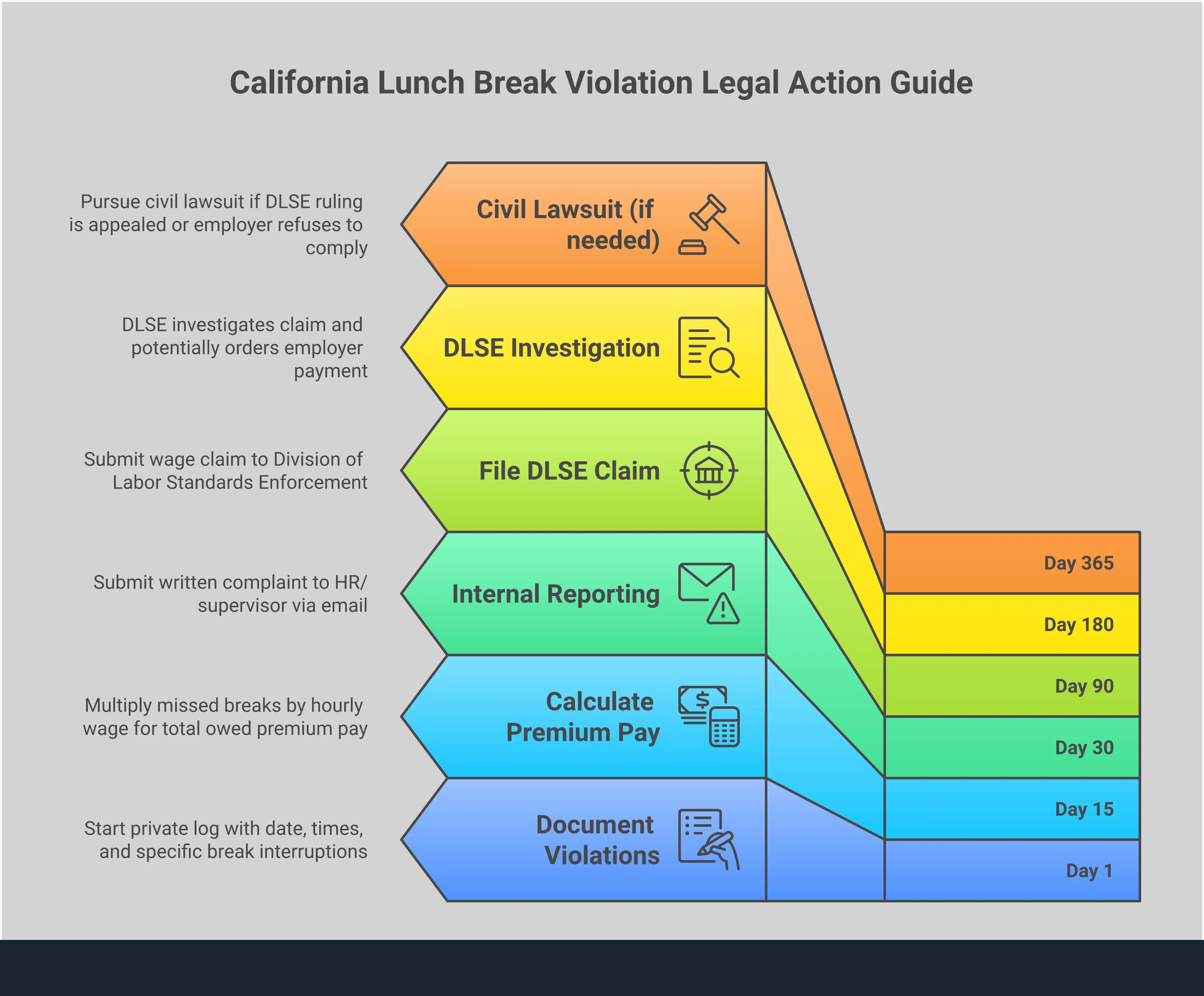
How to Build a Strong Case
If you’re thinking about taking legal action for missed lunch breaks, the strength of your case will depend heavily on the evidence you can provide. A general feeling that your rights were violated won’t be enough in a legal setting; you need clear, organized proof. Building a strong case starts long before you step into a lawyer’s office. It begins with your own careful documentation of what happened. By gathering the right information and keeping detailed records, you create a powerful and credible account that can validate your claim and help you fight for the compensation you deserve.
Keep a Detailed Daily Log
Your memory is a good starting point, but a written record is your best evidence. Start keeping a detailed log of every time your break rights are violated. For each incident, write down the date, the specific time, and exactly what happened. Was your break cut short? Were you asked to work through it? Was it interrupted? Note who was involved, including any managers or supervisors, and list any coworkers who witnessed the event. This consistent, detailed record is one of the most important tools you have. You can keep this log in a private notebook or a document on your personal computer, just make sure it’s somewhere safe and accessible only to you.
Save Pay Stubs and Timecards
Your financial records are another critical piece of the puzzle. Make a habit of saving all your pay stubs and copies of your timecards or timesheets. These documents can provide concrete proof to support the entries in your daily log. For example, your timecard might show you clocking out for a 30-minute break that you were actually forced to work through. Your pay stub can confirm whether you were paid the one-hour penalty required for a missed break. These official records help connect the dots and create a clear picture of the wage & hour claims you may have, making your case much stronger and harder for your employer to dispute.
Gather Statements from Witnesses
Having someone else who can back up your story can significantly strengthen your case. Think about coworkers who saw you being asked to work through lunch or who experienced similar violations themselves. When you document an incident in your log, make a note of who was there and saw what happened. While you shouldn’t pressure your colleagues, simply knowing who can corroborate your account is valuable information to share with an attorney. Many people hesitate to get involved for fear of employer retaliation, but a lawyer can approach these situations carefully and professionally to gather the support you need without putting your coworkers at risk.
Calculate Your Lost Wages
Understanding what you are owed is a key part of building your case. Under California law, you are generally entitled to one additional hour of pay at your regular rate for each workday that a meal or rest break is not provided. Go through your detailed log and count every single violation. From there, you can begin to calculate the premium pay you should have received. This calculation gives you a tangible sense of what’s at stake and helps an attorney quickly assess the potential value of your claim. You can find more details on the specific remedies available for these types of violations in California.
Common Hurdles in a Lunch Break Lawsuit
Deciding to take legal action against your employer is a big step, and it’s natural to wonder what challenges you might face. While California law is on your side when it comes to meal breaks, the process of filing a lawsuit isn’t always simple. Your employer will likely have their own legal team ready to challenge your claim. They may try to argue that the violations never happened or that you are misinterpreting the law. This can feel intimidating, but being prepared is your best defense. Understanding the potential obstacles from the start can help you build a stronger case and feel more in control of the situation. From the practical challenge of gathering sufficient proof to the emotional weight of fearing what might happen at work, being aware of these hurdles is the first step toward successfully clearing them. This section will walk you through the most common challenges so you can move forward with confidence. We’ll cover how to prove your case, what your rights are if you fear retaliation, how to make sense of complex laws, and what to expect from your employer’s defense team. It’s about turning uncertainty into a clear plan of action.
The Challenge of Proving Your Case
One of the biggest hurdles in any employment lawsuit is proving that your rights were violated. The responsibility falls on you to provide evidence that you were denied your proper lunch breaks. This is why meticulous record-keeping is so important. Your employer isn’t likely to admit they broke the law, so you need to build a case with clear documentation. Start by writing down the specific dates and times you were forced to work through lunch or had your break interrupted. Note who was present and what you were asked to do. Strong evidence makes it much harder for your employer to dispute your claim.
Dealing with the Fear of Retaliation
It’s completely understandable to worry about what will happen if you speak up. Many employees stay silent because they fear being fired, demoted, or treated poorly for asserting their rights. However, you should know that it is illegal for your employer to punish you for filing a complaint or requesting the breaks you are entitled to. This type of punishment is called retaliation, and it is a separate violation of the law. If your employer takes negative action against you after you’ve raised concerns about missed breaks, you may have an additional legal claim against them. The law is designed to protect you.
Making Sense of Complex Labor Laws
Employment law can be confusing, and the differences between federal and state rules often create misunderstandings. For example, federal law doesn’t actually require employers to provide meal breaks. This is a common misconception that employers sometimes use to their advantage. Fortunately, California provides much stronger protections for workers. Our state laws clearly mandate when meal and rest breaks must be provided. Understanding the specific requirements of California’s meal break laws is essential, and it’s one of the key areas where an experienced attorney can provide critical guidance.
What to Expect from Your Employer’s Defense
When you file a lawsuit, your employer will present a defense to try and invalidate your claim. They might argue that you voluntarily chose to skip your breaks or that you were fully relieved of all duties and simply decided to stay at your desk. Some employers may even try to claim they were unaware you weren’t taking your breaks. These are common tactics used to avoid responsibility. Anticipating these arguments is a key part of a successful legal strategy. With solid evidence and a clear timeline of events, you can effectively counter these defenses and show what really happened.
What Compensation Can You Win?
If your employer has been denying you proper lunch breaks, you might be wondering what you can actually gain by taking legal action. It’s about more than just getting an apology; it’s about being compensated for the time and rights that were taken from you. California law provides several ways for employees to recover financially when their break rights are violated.
The compensation you could receive goes beyond just the wages for the 30 minutes you missed. It can include payment for unpaid work, penalties your employer has to pay for breaking the law, and even coverage for your legal fees. In situations where your employer punished you for speaking up, you could be entitled to additional damages for that retaliation. Understanding these potential outcomes can help you see why it’s so important to stand up for your rights. Let’s look at the specific types of compensation you may be able to win.
Payment for Missed Breaks and Overtime
First and foremost, you are entitled to be paid for all the time you worked. If your employer forced you to work through an unpaid lunch break, that time must be compensated. This often means more than just your regular hourly rate. Forcing you to work through lunch can easily push your daily or weekly hours into overtime territory. If working through that break meant you worked more than eight hours in a day or 40 hours in a week, you are owed overtime pay, which is typically 1.5 times your regular rate. These unpaid wages can add up quickly, and a successful claim ensures you get the money you rightfully earned through your wage and hour claims.
State-Mandated Penalties and Interest
California law takes meal and rest breaks very seriously. To discourage employers from violating these rules, the state imposes a specific penalty. For each workday that you were denied a proper meal or rest break, your employer owes you one additional hour of pay at your regular rate. This is often called “premium pay.” For example, if you missed your lunch break every day for a month, you could be entitled to an extra hour of pay for each of those days, on top of being paid for the time you actually worked. This penalty is a direct consequence for the employer’s failure to comply with the law and can significantly increase the amount you can recover.
Covering Your Attorney’s Fees and Costs
The thought of paying for a lawyer can be intimidating, but California law has provisions to help with that. In many successful employment cases, the court can order your employer to pay your reasonable attorney’s fees and legal costs. This means you can pursue justice without the burden of high legal expenses coming out of your pocket. The goal of these laws is to make it possible for everyone to stand up for their rights, not just those who can afford to pay a lawyer upfront. This provision helps level the playing field, allowing you to hire an experienced employment law firm to represent you without worrying about the cost.
Damages for Employer Retaliation
It is illegal for your employer to punish you for asserting your right to a lunch break. If you were fired, demoted, had your hours cut, or faced any other negative action after complaining about missed breaks, you may have a case for retaliation. If you can prove that your employer retaliated against you, you could be awarded additional damages. This can include compensation for lost wages (both past and future), emotional distress, and in some cases, punitive damages, which are designed to punish the employer for their unlawful conduct. These protections ensure you can speak up about illegal working conditions without fear of losing your job.
How We Can Help You Stand Up for Your Rights
Deciding to take action against your employer can feel overwhelming. You might worry about the complexity of the legal system or the potential consequences at work. At Bluestone Law, we understand these concerns completely. Our entire practice is built around supporting employees like you. We believe you deserve to be treated fairly and paid for every minute you work, and we’re here to make sure that happens.
Standing up for your rights doesn’t mean you have to become a legal expert overnight. That’s our job. We handle the legal heavy lifting so you can focus on your life. We’ll listen to your story, explain your options in plain English, and create a clear strategy to move forward. Our team is dedicated to California employment law, which means we have the focused knowledge and experience to champion your case effectively. You don’t have to face this situation alone; we’ll be your advocates every step of the way.
Our Approach to Fighting for You
Our process begins with a simple but crucial step: listening. Once we understand the details of your situation, we help you gather the right evidence to build a strong foundation for your case. This often involves documenting specific dates, times, and any colleagues who witnessed the break violations. We then apply our deep knowledge of California labor law to determine exactly what you are owed. For instance, if your employer failed to provide a compliant meal or rest break, you are entitled to one additional hour of pay at your regular rate for each day the violation occurred. We calculate these damages and fight to recover every dollar you deserve.
Why a Specialized Employment Lawyer Matters
Employment law is a highly specific field with its own set of rules and precedents. A general practice attorney may not recognize all the nuances of your case. For example, we know to examine your employee handbook and contract for promises your employer made about breaks. If they failed to follow their own policies, it could be a breach of contract. More importantly, we know how to protect you from illegal retaliation. It is against the law for an employer to retaliate against an employee for requesting breaks or reporting violations. A specialized lawyer anticipates these illegal tactics and knows exactly how to respond, ensuring your rights and your job are protected throughout the process.
Frequently Asked Questions
What is the difference between a meal break and a rest break? It’s easy to mix these up, but they are two separate rights under California law. A meal break is a 30-minute, unpaid period you are entitled to if you work more than five hours. A rest break is a paid, 10-minute break you get for every four hours you work. Your employer can’t combine them or have one substitute for the other; you are entitled to both.
Can my employer require me to stay at the office during my unpaid lunch break? No. For an unpaid meal break to be legal, you must be completely relieved of all work duties and free from your employer’s control. This includes the freedom to leave the premises. If your employer requires you to stay on-site, even just to be available “in case,” you are not truly on a break, and that time should be paid.
I sometimes agree to skip my lunch to finish work. Does that mean I can’t make a claim? Not necessarily. Even if you verbally agree, the law is very protective. An occasional, voluntary waiver might be permissible under very specific written circumstances, but it cannot be a regular practice or an unspoken expectation of your job. If you feel pressured to skip breaks to keep up with your workload, your employer is likely violating the law, and you may still have a valid claim.
What if I’m afraid of getting fired for reporting missed breaks? This is a valid and common fear, but the law is designed to protect you. It is illegal for your employer to fire, demote, cut your hours, or punish you in any way for reporting labor violations. This is called retaliation, and it is a serious offense that can give you grounds for an additional legal claim against your employer.
How much does it cost to hire an employment lawyer for a missed breaks case? Most employment lawyers who represent employees work on a contingency fee basis. This means you don’t pay any fees out of your own pocket. Instead, the lawyer’s fee is a percentage of the settlement or award they win for you. If you don’t win your case, you typically don’t owe any attorney’s fees, which allows you to seek justice without a financial risk.
Related Articles
- Why You Need an Attorney for Wage and Hour Violations
- How to Report a Company to the Labor Board Anonymously
Think you were wrongfully terminated?
Get a free, confidential case evaluation from our experienced employment law attorneys.
Request Your Free Consultation