
Not every denial of an accommodation request is illegal, but many are. Employers can only refuse a request if it creates an “undue hardship” on their business, a standard that is intentionally difficult to prove. They cannot deny your request because it’s inconvenient or because they simply don’t want to make a change. When an employer refuses a legitimate request without a valid, legally sound reason, they are crossing a line into potential discrimination. This is the point where you need to understand your legal options. This article will help you determine if your employer’s actions were unlawful and explain how you can sue for denial of reasonable accommodation.
Key Takeaways
- The “interactive process” is a legal requirement: Your employer cannot legally deny your request without first having a good-faith conversation with you to find a workable solution. A simple “no” without any discussion is a major violation of your rights.
- Documentation is your most powerful tool: Keep a detailed record of every communication, including emails, doctor’s notes, and summaries of verbal conversations. A written denial from your employer is a critical piece of evidence.
- You must file a formal complaint before suing: Taking legal action requires first filing a claim with a government agency like the EEOC or California’s Civil Rights Department (CRD). This is a mandatory step that protects your right to file a lawsuit later.
What Is a “Reasonable Accommodation”?
When you have a disability or medical condition that affects your ability to do your job, the law is on your side. Both federal and California laws require employers to make adjustments for you, as long as your request is considered “reasonable.” Think of a reasonable accommodation as a change to your work environment or the way things are usually done that allows you to perform your job duties despite your disability. It’s about creating a level playing field so you have the same opportunities for success as your colleagues.
This isn’t about asking for special treatment. It’s about getting the support you need to handle your essential job functions. The process is meant to be a collaborative conversation between you and your employer, often called the “interactive process.” Your employer has a legal duty to engage in this conversation with you in good faith to find a workable solution. Understanding what qualifies as a “reasonable” request is the first step in advocating for yourself and ensuring your rights are protected at work. If you believe your employer is failing to provide these adjustments, you may be facing disability discrimination.
Defining a “Reasonable” Request
So, what exactly makes a request “reasonable”? A reasonable accommodation is any change or adjustment to your job that enables you to perform its essential functions. “Essential functions” are the core tasks that are fundamental to your position, not the minor or occasional duties. For example, for a graphic designer, creating visuals is an essential function, while making coffee for the office is not.
The accommodation doesn’t have to be the most expensive option or even the specific one you asked for. Your employer can suggest an alternative, but it must be effective. The goal is to find a solution that works. The focus is always on whether the change allows you to do your job successfully without causing major issues for the company.
Examples of Common Accommodations
Accommodations can take many forms, and they are often simple and low-cost. The right one for you will depend entirely on your specific needs and your job responsibilities. You can find a comprehensive list of options at the Job Accommodation Network, but some common examples include modifying your work schedule to attend medical appointments or allowing you to work from home a few days a week.
Other adjustments might involve physical changes to your workspace, like providing an ergonomic chair or a screen reader for your computer. It could also mean restructuring your job by reassigning non-essential tasks, allowing for more frequent breaks, or providing a reserved parking space closer to the building entrance. These changes are meant to remove workplace barriers for employees with disabilities.
What Makes a Request “Unreasonable”?
While employers have a duty to provide accommodations, they don’t have to grant requests that would cause an “undue hardship” on the business. This is the legal standard for a request being unreasonable. An undue hardship means the accommodation would be excessively costly, extensive, or disruptive to the nature and operation of the business. This is a high bar for an employer to prove, and it isn’t about minor inconveniences.
For example, asking a small, five-person startup to build a brand-new elevator would likely be an undue hardship. However, asking a large tech corporation for a specialized keyboard would not. When determining undue hardship, factors like the company’s size, financial resources, and overall operations are considered. An employer cannot simply say “no” without exploring all the options and proving it would genuinely harm the business.
Can You Sue If Your Employer Denies Your Request?
Yes, you can sue your employer for denying a reasonable accommodation, but it’s not an automatic green light for a lawsuit just because they said no. The law provides strong protections for employees with disabilities, but you have to meet certain criteria to build a successful case. Think of it as a checklist: if your situation ticks these specific boxes, you may have solid grounds to take legal action.
An employer can’t legally deny a request that is reasonable and necessary for you to perform your job, unless they can prove it would cause them an “undue hardship.” This is a very high standard for a company to meet, often involving significant difficulty or expense. More often, illegal denials happen when an employer misunderstands their obligations, ignores the request, or simply refuses to have a conversation about it. If your employer denied your request and you believe their reasoning was unfair or nonexistent, it’s worth looking closer at the circumstances. The following points will help you understand if their denial crossed the line from a simple “no” into a potential violation of your rights. Understanding these elements is the first step in standing up for yourself and ensuring you get the support you need to succeed at work.
You Have a Qualifying Disability
First things first, your medical condition must be considered a “disability” under the law. Both federal and California state laws protect employees, but the definitions can be specific. Generally, a qualifying disability is a physical or mental impairment that substantially limits one or more major life activities, like walking, speaking, learning, or working. This doesn’t have to be a permanent or severe condition. It can include chronic illnesses, mental health conditions like anxiety or depression, and temporary conditions related to an injury or pregnancy. Proving you have a qualifying condition is the foundation of any disability discrimination claim, as it’s what legally requires your employer to consider your request in the first place.
You Formally Requested an Accommodation
Your employer isn’t a mind reader. You must inform them about your condition and request an accommodation. While you don’t have to use the words “reasonable accommodation,” you do need to make it clear that you need a change at work because of a medical condition. It is always best to put your request in writing, creating a paper trail that proves you asked for help and when you asked for it. Your request should be clear and connect your limitation to the specific accommodation you need to do your job. This formal step is crucial because it legally triggers your employer’s obligation to respond and engage with you.
Your Employer Knew and Failed to Act
Once you’ve made your request, the ball is in your employer’s court. They have a legal duty to respond and take your request seriously. An employer who ignores you, endlessly delays the process, or flat-out refuses to discuss your request is failing to act in good faith. This inaction itself can be a violation of the law. An employer cannot simply hope you’ll give up and drop it. They must actively work with you to find a solution. If they know about your disability and your need for an accommodation but do nothing, they are opening the door to a potential lawsuit for their failure to provide a reasonable accommodation.
They Didn’t Engage in the “Interactive Process”
The law requires your employer to engage in a “timely, good faith, interactive process” with you after you request an accommodation. This is just a formal way of saying you and your employer need to have a conversation. The goal is to discuss your request and work together to find a reasonable and effective solution. If your employer denies your request without any discussion, refuses to consider alternative accommodations, or doesn’t explain their reasoning, they have failed to participate in this critical process. A company can only legally deny a request if it creates an “undue hardship,” and they can’t determine that without talking to you first. This failure to engage is often a key piece of evidence in a wrongful termination or discrimination case.
Your First Steps Before Filing a Lawsuit
Feeling frustrated and ignored after your accommodation request was denied is completely understandable. It can feel like you’ve hit a wall and don’t know where to turn next. Before you move toward filing a lawsuit, there are a few critical steps you should take to build the strongest possible foundation for your case. By being methodical and proactive now, you can gather the proof you need and show that you did everything possible to resolve the situation directly with your employer. These initial actions will protect your rights and prepare you for whatever comes next.
Document Everything
Your most powerful tool at this stage is a detailed paper trail. Start gathering and saving every piece of communication related to your accommodation request. This includes your doctor’s notes, the formal request you submitted, and all email exchanges with your manager or HR. If you have conversations in person or over the phone, keep a personal log with the date, time, who was present, and a summary of what was discussed. This isn’t just busywork; it’s the evidence that will support your claim. Having clear documentation is essential when fighting a case of disability discrimination, as it creates a factual record that is difficult for an employer to dispute.
Get the Denial in Writing
A verbal “no” is hard to prove. If your employer denies your request in a conversation, it’s important to follow up with an email. Send a polite message summarizing the discussion and asking for a formal written response explaining their decision. This puts the responsibility on them to provide a clear reason for the denial. A written denial is valuable evidence because it can reveal if your employer failed to engage in the required “interactive process” to find a workable solution. If their reasoning is weak or discriminatory, you’ll have it in writing. This simple step can make a huge difference in holding your employer accountable for their legal obligations.
Follow Your Company’s Internal Process
Before taking external action, show that you made a good-faith effort to resolve the issue internally. Check your employee handbook for any formal policies on accommodation requests or grievance procedures. If there’s a process, like speaking with an HR representative or filing an internal complaint, make sure you follow it. This demonstrates that you tried to work within the system. It also prevents your employer from later claiming that you failed to follow their established procedures. Employees often worry about workplace retaliation when escalating an issue, but following the official process is a protected activity that gives you more legal standing.
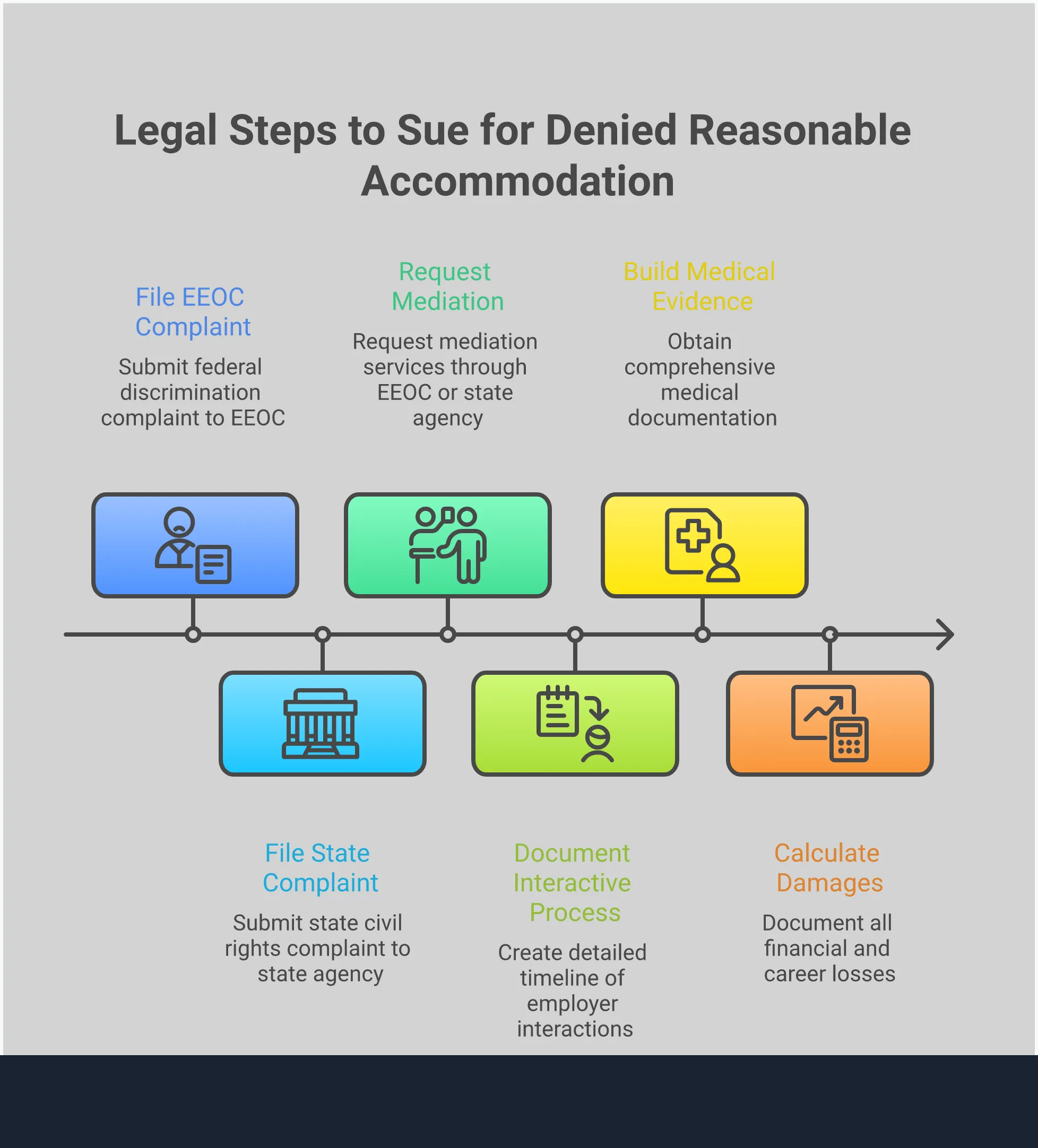
File a Complaint with the EEOC
Filing a formal complaint with a government agency is a major step and often a legal requirement before you can sue your employer. In California, you can file with either the federal Equal Employment Opportunity Commission (EEOC) or the state’s Civil Rights Department (CRD). These agencies are responsible for investigating claims of workplace discrimination. Once you file a complaint, the agency will look into your situation, which may involve interviewing you and your employer. This investigation can sometimes lead to a resolution or mediation. If the agency finds evidence of discrimination, it will issue you a “Right to Sue” letter, which officially allows you to proceed with a lawsuit.
Gather the Evidence to Build Your Case
When you’re facing a denial of reasonable accommodation, solid evidence is your strongest asset. Think of it as building the foundation for your case, piece by piece. Your personal account is powerful, but backing it up with clear, organized documentation makes it difficult for your employer to dispute the facts. A strong collection of evidence shows that you have a legitimate disability, you followed the correct procedures, and your employer failed to meet their legal obligations. This preparation is not just for a potential lawsuit; it strengthens your position in any negotiation or complaint process. Start collecting these documents now, as it’s much easier to gather them as events happen rather than trying to recall details months later. This process can feel overwhelming, but taking it one step at a time will make it manageable. By methodically gathering proof, you are taking control of the situation and preparing yourself for the next steps, whether that involves speaking with an attorney or filing a formal complaint. Remember, the goal is to create a comprehensive record that tells the full story of your request and your employer’s response.
Medical Records Proving Your Disability
The first step in proving your case is establishing that you have a qualifying disability under the law. Your medical records are the official documentation of your condition. These records should clearly state your diagnosis and explain the limitations it imposes on your ability to perform certain job functions. This isn’t about sharing your entire medical history, but about providing specific proof that connects your condition to your need for an accommodation. Having this documentation from a healthcare provider is essential, as it validates your request and makes it much harder for an employer to claim they were unaware of your needs or that your request wasn’t legitimate. This is a cornerstone of any disability discrimination claim.
Emails, Letters, and Other Communications
Create a paper trail of every conversation you have about your accommodation. Save every email, formal letter, and even text message related to your request. This includes your initial request, any follow-up questions from HR, and your employer’s official response. If you have verbal conversations, follow up with an email summarizing what was discussed, for example: “Hi [Manager’s Name], just to confirm our conversation today, we discussed…” This creates a written record of the interaction. This documentation proves you made a good-faith effort to engage in the interactive process and provides a clear timeline of your employer’s responses, or lack thereof. This evidence is critical in all types of employment law cases.
Positive Performance Reviews and Witness Support
Your work performance is a key piece of the puzzle. Gather any positive performance reviews, awards, or complimentary emails from managers or clients. This evidence helps demonstrate that you are a capable employee and that your request for accommodation is about getting the support you need to continue doing your job well, not about an inability to perform. It counters any potential argument from your employer that your performance was the real issue. Additionally, consider if any trusted colleagues would be willing to act as witnesses. They can speak to your work ethic and the challenges you faced without the accommodation, adding a powerful human element to your documented evidence.
A Detailed Timeline of Events
Organizing your evidence into a clear timeline can make your case much easier to understand. Start a document and list every relevant event in chronological order. Include the date you first submitted your request, every meeting or conversation you had about it, when you received a response, and any instances where your work was affected by the lack of accommodation. Be as specific as possible with dates, times, and who was involved. This timeline creates a narrative that clearly shows how events unfolded and highlights any unreasonable delays or failures by your employer to act. This detailed record is invaluable when filing a formal complaint or pursuing a wrongful termination claim.
How to File a Reasonable Accommodation Lawsuit
Deciding to file a lawsuit is a significant step, but it’s often the most effective way to protect your rights when an employer refuses to provide a necessary accommodation. The legal process can seem intimidating from the outside, filled with unfamiliar terms and strict procedures. However, understanding the key stages can make the entire experience feel more manageable. This isn’t about aggression; it’s about holding your employer accountable to the law and getting the support you need to do your job effectively.
Both California and federal laws provide strong protections for employees with disabilities. When your employer fails to meet their legal obligations, you have the right to take formal action. Filing a lawsuit involves more than just telling your story to a judge. It requires meeting specific deadlines, filing the correct documents with the right agencies, and strategically navigating the court system. Having a clear roadmap of the process helps you prepare for what’s ahead and ensures you don’t miss a critical step that could jeopardize your case. An experienced attorney will handle the complexities, but knowing the path forward empowers you to be an active participant in your own fight for justice.
Know Your Deadlines (Statute of Limitations)
In the legal world, timing is everything. A “statute of limitations” is a strict deadline for filing a lawsuit. If you miss this deadline, you could lose your right to sue, no matter how strong your case is. For disability discrimination and failure to accommodate claims, these deadlines can be surprisingly short. The clock usually starts ticking from the date your employer denied your request or from the last discriminatory action they took. Calculating the exact deadline can be tricky, so it’s crucial to speak with an employment lawyer as soon as possible to ensure your rights are preserved.
Decide Where to File: State vs. Federal Court
You generally have two options for filing your lawsuit: state court under California law or federal court under federal law. The federal Americans with Disabilities Act (ADA) provides a baseline of protection for employees across the country. However, California’s Fair Employment and Housing Act (FEHA) often offers even broader protections. For example, FEHA applies to smaller employers and may have a more expansive definition of disability. An attorney can analyze the specifics of your situation to determine the best strategy and which court offers a more favorable path for your disability discrimination claim.
Follow the Correct Filing Procedures
Before you can file a lawsuit in court, you must first file an administrative complaint with a government agency. This is a mandatory step called “exhausting your administrative remedies.” In California, you can file with the state’s Civil Rights Department (CRD) or the federal Equal Employment Opportunity Commission (EEOC). The agency will investigate your claim and may try to mediate a solution. If they don’t resolve the issue, they will issue a “right-to-sue” letter. Only after you receive this letter can you proceed with filing your lawsuit in court. Following these procedures correctly is essential for any employment law case.
What to Expect After You File
Once your attorney files the official complaint in court, the lawsuit formally begins. The next step is to “serve” your employer with the legal documents, officially notifying them of the suit. Your employer will then have a set period to file a formal response. From there, the case enters the “discovery” phase. During discovery, both sides exchange information, documents, and evidence. This can involve written questions, requests for documents, and depositions (sworn out-of-court testimony). This process can take months, but it is a critical part of building a case that can sometimes lead to a wrongful termination claim if you were fired for requesting an accommodation.
What Are the Potential Outcomes of a Lawsuit?
Filing a lawsuit can feel like a huge step, and it’s natural to wonder what might happen at the end of the process. While every case is unique, there are several common outcomes you can pursue when your employer denies a reasonable accommodation. The goal is always to find a resolution that addresses the harm you’ve experienced and helps you move forward. This could mean securing financial compensation, getting the workplace changes you need, or a combination of different remedies. Understanding these potential outcomes can help you clarify your goals and decide on the best path for your situation.
Financial Compensation for Damages
One of the most common outcomes is receiving financial compensation for the damages you suffered. This isn’t just about getting a check; it’s about making you whole for the losses caused by your employer’s actions. Damages can cover lost wages if you were unable to work or were fired, as well as the cost of medical bills that resulted from the denial. You may also be compensated for emotional distress, like anxiety or depression, caused by the discriminatory treatment. In cases of disability discrimination, holding an employer financially accountable sends a strong message that their failure to provide accommodations is unacceptable.
Getting Your Job Back or the Accommodation You Need
Sometimes, the primary goal isn’t money, but simply being able to do your job effectively and without barriers. A successful lawsuit can result in a court order that requires your employer to provide the specific accommodation you requested. If you were fired because of the dispute, another possible outcome is reinstatement, which means getting your job back. This is often called an “equitable remedy,” as it focuses on fairness and correcting the wrong rather than just paying for it. The aim is to restore you to the position you would have been in if your employer had engaged in the interactive process and approved your request in the first place.
Reaching a Settlement Out of Court
It’s important to know that most employment lawsuits don’t end in a dramatic courtroom trial. The vast majority are resolved through a settlement, which is a negotiated agreement between you and your employer to resolve the dispute. A settlement can be a great option because it gives you more control over the outcome and is typically faster and less stressful than going to trial. The terms can be flexible and may include financial payment, an agreement to provide the accommodation, a neutral job reference, and confidentiality clauses. Your attorney will handle the negotiations to ensure the final agreement is fair and meets your needs.
Covering Your Attorney’s Fees
The cost of hiring a lawyer can be a major concern, but in many employment law cases, there’s a solution. If you win your lawsuit, California law often allows you to recover your attorney’s fees and legal costs from your employer. This means your employer would be responsible for paying your lawyer’s bill in addition to any damages you are awarded. This provision makes it possible for employees to stand up for their rights without having to bear a heavy financial burden. Many employment lawyers also work on a contingency basis, meaning they only get paid if you win your case, which further reduces your upfront financial risk.
Is It Worth It to Sue?
Deciding to sue your employer is a major decision, and it’s not one to take lightly. Before you move forward, it’s helpful to step back and look at the situation from a few different angles. Thinking through the strength of your case, the potential career impact, and the costs versus rewards will give you the clarity you need to make the right choice for you. This process is about weighing the facts and your personal circumstances to determine the best path forward.
How Strong Is Your Case?
The strength of your case often comes down to whether your employer’s denial was legal. Both state and federal laws require companies to provide reasonable accommodations for employees with disabilities, unless doing so would cause the business an “undue hardship.” This is a high standard for an employer to meet, meaning they can’t deny a request simply because it’s inconvenient. If your request was well-documented and would not have created a significant financial or operational burden on the company, your case is likely stronger. An experienced attorney can help you understand the nuances of disability discrimination law and evaluate how an employer’s justification for denial holds up against legal standards.
Consider the Impact on Your Career
It’s also important to think about how a lawsuit could affect your professional life. If you plan to stay at your job, litigation can create a tense atmosphere. While it is illegal for your employer to punish you for taking legal action, you should be aware of your rights against workplace retaliation. For some, the stress of a lawsuit makes finding a new job a better option. A lawsuit is part of the public record, but it shouldn’t stop you from getting hired in the future. Protecting your legal rights is a valid and necessary step to ensure you are treated fairly at work, and many future employers will respect that.
Weigh the Costs vs. Potential Rewards
Finally, take a practical look at what you could gain versus what the process will demand from you. A successful lawsuit can result in financial compensation, getting the accommodation you need, or even job reinstatement. On the other hand, litigation takes time and can be emotionally draining. While many employment lawyers work on a contingency basis, meaning you don’t pay unless you win, you are still investing your energy. A lawyer can help you determine if your employer’s denial was lawful and what a realistic outcome might look like. Filing a claim with the Equal Employment Opportunity Commission (EEOC) is often a required first step and a good way to formalize your complaint without immediately heading to court.
Find the Right Disability Rights Attorney
Facing a denial for a reasonable accommodation can feel isolating and overwhelming. The laws protecting employees are complex, and employers have legal teams to defend their decisions. This is where having a dedicated advocate on your side makes all the difference. An experienced employment lawyer can help you understand your rights, evaluate the strength of your claim, and guide you through the necessary legal steps. They handle the complicated procedures so you can focus on your health and well-being.
Why You Shouldn’t Go It Alone
If you’re facing disability discrimination or your employer has failed to provide a necessary accommodation, it’s crucial to seek legal assistance. Employment law is intricate, and a small misstep can jeopardize your case. An attorney can properly assess whether your employer’s actions were illegal, gather the right evidence, and communicate with your employer’s lawyers on your behalf. They understand the deadlines and procedural rules for filing with agencies like the EEOC and in court. Trying to manage this process alone while dealing with a disability and a difficult work situation adds unnecessary stress and risk.
What to Look For in an Employment Lawyer
When searching for legal representation, look for a lawyer who focuses specifically on plaintiff’s employment law. This means they represent employees, not employers. You want someone with a proven track record in disability discrimination and reasonable accommodation cases. A knowledgeable attorney understands that employers must engage in a “good faith interactive process” to find a solution. They can effectively argue why your request was reasonable and why your employer’s denial caused you harm. Find a firm whose values align with yours and who makes you feel heard and supported. The right legal team will be your partner every step of the way.
How Do Attorney Fees Work?
Many people worry about the cost of hiring a lawyer, but you shouldn’t let that stop you from seeking help. Most plaintiff’s employment attorneys work on a contingency fee basis. This means you don’t pay any attorney’s fees unless they win your case through a settlement or a court verdict. The lawyer’s fee is a percentage of the financial compensation they recover for you. This arrangement allows you to access high-quality legal representation without any upfront cost. During your initial consultation, which is often free, the attorney will explain their fee structure clearly so you know exactly what to expect.
Where to Find Additional Help and Resources
Facing a denial for a reasonable accommodation can feel isolating, but you don’t have to handle it alone. Several government agencies and nonprofit organizations are dedicated to protecting employee rights and providing the information you need. These resources can help you understand your options, from filing a formal complaint to finding creative accommodation solutions. Knowing where to turn for support is a powerful first step in advocating for yourself and ensuring your rights are respected in the workplace.
The EEOC
The U.S. Equal Employment Opportunity Commission (EEOC) is the federal agency responsible for enforcing laws against workplace discrimination. If you believe your employer unfairly denied your request for an accommodation, the EEOC is a critical resource. You can file a complaint directly with the agency. They will investigate your claim, work to determine if discrimination occurred, and help you understand the next steps available to you. The EEOC provides a formal channel to have your case reviewed by an impartial government body, which can be an essential move in protecting your rights.
State Advocacy Agencies
In addition to federal protections, your state has agencies designed to fight discrimination. In California, the Civil Rights Department (CRD), formerly the DFEH, handles these issues. If your employer refuses your accommodation request without a valid reason or won’t engage in a productive dialogue about your needs, you can file a complaint with the CRD. These state-level agencies are equipped to investigate and resolve disability discrimination cases, offering a more local avenue for addressing your employer’s failure to accommodate.
The Job Accommodation Network (JAN)
Sometimes, the challenge is figuring out what accommodation to ask for. The Job Accommodation Network (JAN) is a fantastic free resource that offers expert guidance on workplace accommodations. JAN provides extensive information on different types of accommodations for various disabilities and can help you brainstorm practical solutions for your specific job. Using their resources can empower you to have more informed and productive conversations with your employer, making it easier to advocate for the support you need to perform your job effectively.
Legal Aid and Pro Bono Services
When your rights have been violated, getting legal advice is crucial. If you’ve experienced disability discrimination or your employer has failed to provide a reasonable accommodation, speaking with an attorney can clarify your path forward. Many organizations offer legal aid and pro bono services to help people manage the complexities of employment law. These services can provide the legal support you need to build a strong case and pursue justice, ensuring you have a knowledgeable advocate on your side.
Related Articles
- How Long Must an Employer Accommodate a Disability?
- How to Prove Disability Discrimination: A Legal Guide
- California Disability Discrimination Lawyer – Bluestone Law
Frequently Asked Questions
Do I have to tell my employer my specific medical diagnosis when I ask for an accommodation? No, you generally do not have to disclose your exact diagnosis. Your privacy is important. You do, however, need to provide enough information for your employer to understand your limitations and why you need an adjustment at work. Often, a note from your doctor that describes your functional limitations and supports your need for an accommodation is sufficient, without naming the specific medical condition.
What if my employer offers a different accommodation than the one I asked for? Your employer doesn’t have to provide the exact accommodation you requested, but they are required to provide an effective one. This is a normal part of the interactive process. If they suggest an alternative, your focus should be on whether it truly allows you to perform the essential duties of your job. If you believe their suggestion won’t work, you should explain why and continue the conversation to find a solution that is genuinely effective.
Can my employer fire me just for asking for an accommodation? Absolutely not. It is illegal for an employer to fire, demote, or otherwise punish you for requesting a reasonable accommodation. This is considered a protected activity, and taking negative action against you for it is a form of retaliation. If you are fired shortly after making a request, you may have a strong case for wrongful termination.
How long does my employer have to respond to my request? The law requires employers to respond in a “timely” manner, but it doesn’t set a strict deadline like 48 hours or one week. The appropriate timeframe can depend on the urgency and complexity of your request. The key is that your employer cannot unreasonably delay the process or ignore you. A long, unexplained delay can be seen as a failure to engage in the interactive process in good faith.
Am I still entitled to an accommodation if my disability is temporary? Yes, you can be. Accommodations are not limited to permanent conditions. If you have a temporary impairment, such as a broken leg or a serious illness, that substantially limits a major life activity, you are protected by the law. Your employer would be required to provide a reasonable accommodation for the duration of your limitation.
Think you were wrongfully terminated?
Get a free, confidential case evaluation from our experienced employment law attorneys.
Request Your Free Consultation