
Not all denials for a workplace accommodation are legal. While employers have the right to refuse a request under specific circumstances, such as an “undue hardship,” they must follow a strict set of rules before doing so. A vague, dismissive, or poorly justified letter can be a major red flag that your employer has not met their legal obligations. The reasonable accommodation denial letter you received should contain specific information, including a lawful reason for the denial and evidence of a collaborative discussion. If it doesn’t, your rights may have been violated. This article will serve as your guide to spotting the warning signs of an unlawful denial.
Key Takeaways
- A conversation is a legal requirement: Your employer cannot deny an accommodation request without first engaging in a good-faith dialogue, known as the interactive process, to explore potential solutions.
- The reason for denial must be specific and valid: An employer must provide a legitimate, lawful justification for their decision, such as undue hardship or a direct safety risk, not a vague or convenient excuse.
- Your documentation is your evidence: Protect yourself by keeping a detailed record of every communication, including emails, meeting notes, and the official denial letter, to build a clear timeline of events.
What Is a Reasonable Accommodation Denial Letter?
Receiving a formal letter from your employer denying a request for a reasonable accommodation can feel disheartening. This document is your employer’s official communication explaining why they cannot approve the workplace adjustment you asked for related to a disability. While it’s a serious response, it isn’t necessarily the final word. The letter serves as a critical piece of documentation that outlines your employer’s position and their reasoning. Understanding what this letter means and the common reasons behind a denial is the first step in figuring out what to do next. It’s important to analyze the letter carefully, as it provides insight into whether your employer has followed the legally required steps.
What a Denial Letter Means
A denial letter is more than just a simple “no.” It’s a formal record of your employer’s decision and is supposed to provide a clear explanation for it. A proper letter should confirm that your employer engaged in the required “interactive process,” which is the collaborative conversation between you and your employer to find a workable solution. It should clearly state your name, the date you made the request, and exactly what you asked for. Most importantly, it must give a specific, lawful reason for the denial that is directly related to your job or the workplace, not a vague excuse. This documentation is crucial for protecting your rights against disability discrimination.
Why You Might Receive One
An employer can’t deny an accommodation request just because they don’t want to provide it. They must have a legitimate, legally recognized reason. Some of the common reasons you might receive a denial letter include the employer determining that the accommodation would cause an “undue hardship,” meaning it would be excessively difficult or expensive for the business to implement. Other valid reasons could be that the request would remove an essential function of your job, pose a direct safety threat to you or others, or that the medical documentation you provided was insufficient to support the need for an accommodation. Understanding the specific reason cited in your letter is key to evaluating its legality under employment law.
What Are Your Employer’s Legal Obligations?
When you request a reasonable accommodation, your employer can’t simply ignore you or give you a quick “no.” Federal and state laws, like the Americans with Disabilities Act (ADA) and California’s Fair Employment and Housing Act (FEHA), create a clear set of rules they must follow. These aren’t just best practices; they are legal requirements designed to protect you from disability discrimination.
Understanding these obligations is your first step in figuring out if a denial was lawful. Your employer is required to take your request seriously, communicate with you openly, and explore potential solutions before making a final decision. They can’t deny your request based on a whim, a personal bias, or a minor inconvenience. The law demands a structured and fair process. If they skip these steps, their denial might not just be unfair, it could be illegal.
Following ADA Compliance Rules
Under the ADA, your employer has a duty to engage with you as soon as they are aware you might need an accommodation for a medical condition. You don’t have to use specific legal terms like “reasonable accommodation” or “ADA” to start this process. Simply telling your manager or HR that you’re having difficulty with a job task because of a health issue is often enough to trigger their legal responsibility. They must consider your request and begin a dialogue, even if you made the request verbally or through an informal email. The key is that they are on notice about your need for a potential workplace change.
The Required “Interactive Process”
The law requires your employer to participate in a timely, good-faith “interactive process” with you. Think of this as a collaborative conversation. It’s a mandatory dialogue where you and your employer discuss your limitations and what accommodations could help you perform your job. An employer cannot legally deny your request without first engaging in this process. According to the U.S. Equal Employment Opportunity Commission, this back-and-forth is essential for sharing information and ideas to find a workable solution. A flat denial without any discussion is a major red flag and may violate your rights.
Defining “Undue Hardship” and Safety Risks
An employer can legally deny an accommodation if it creates an “undue hardship” or a direct safety threat. However, these terms have very specific legal meanings. An undue hardship isn’t just an inconvenience; it must be a significant difficulty or expense for the company as a whole, not just one department’s budget. Similarly, a safety risk must be a significant, direct threat to the health or safety of you or others that cannot be eliminated or reduced by another accommodation. An employer can’t use these as vague excuses to avoid their responsibilities, which could lead to a wrongful termination claim if you are fired for pursuing your rights.
When Can an Employer Legally Deny Your Request?
While your employer has a legal duty to consider your request for a reasonable accommodation, the law doesn’t require them to approve every single one. There are specific, legitimate reasons why a company might deny your request. Understanding these reasons can help you figure out if your denial was lawful or if your employer may have violated your rights. It’s important to remember that the burden isn’t just on you; your employer must engage in a good-faith interactive process to explore solutions. If they deny your request, they need to have a legally sound basis for doing so.
The Request Causes Undue Hardship
An employer can legally deny an accommodation if it would cause “undue hardship” on the business. This means the proposed change would create a significant difficulty or expense for the company. What counts as a hardship depends on the employer’s size and resources. A large, multinational corporation would have a much harder time proving that providing a specific piece of ergonomic equipment is an undue hardship compared to a small, five-person startup. This isn’t just about inconvenience; it must be a substantial burden on the business’s operations or finances. If your employer claims this, they should be able to provide specific reasons why the accommodation is not feasible for them. This is a key concept in disability discrimination law.
It Poses a Direct Safety Threat
Your employer can also deny a request if the accommodation would create a direct threat to the health or safety of you or your colleagues. The key here is that the risk must be significant and based on objective evidence, not on stereotypes or assumptions about your condition. For example, if you operate heavy machinery and request an accommodation that could impair your ability to do so safely, your employer might have grounds for denial. However, they must first consider if there are other accommodations that could eliminate that risk. Simply assuming a safety issue exists without proper assessment isn’t enough to justify a denial and could contribute to a hostile work environment.
It Removes an Essential Job Function
A reasonable accommodation is meant to help you perform the essential functions of your job, not to eliminate them. Essential functions are the core duties you were hired to do. If your request involves removing a fundamental part of your role, your employer can deny it. For instance, if a core part of your job is to travel to meet clients and your requested accommodation is to stop all travel, your employer might argue that this removes an essential function. This can be a gray area, and disagreements over what is “essential” can sometimes lead to claims of wrongful termination if not handled correctly.
Your Medical Documentation Is Insufficient
If your disability and need for an accommodation aren’t obvious, your employer has the right to ask for medical documentation to support your request. This is to confirm that you have a medical condition that requires an accommodation. If you fail to provide sufficient information from your doctor after your employer has requested it, they can legally deny your request. The employer’s request for information must be reasonable and directly related to your limitation and the accommodation you need. This process is similar to providing documentation for family and medical leave, where clear medical support is also required.
The Proposed Accommodation Is Ineffective
Finally, an employer is not required to provide an accommodation if it won’t actually help you perform your job. The entire purpose of an accommodation is to enable you to meet your job’s requirements. If the solution you propose wouldn’t effectively achieve that goal, your employer can deny it. However, this is where the interactive process is crucial. If your initial idea is unworkable, your employer should work with you to identify an alternative that would be effective. A flat denial without exploring other options may not be acting in good faith, which is a cornerstone of California employment law.
What Does the “Interactive Process” Look Like?
The “interactive process” is a formal term for what should be a straightforward, collaborative conversation between you and your employer. It’s a legal requirement under both the Americans with Disabilities Act (ADA) and California’s Fair Employment and Housing Act (FEHA). This isn’t just a courtesy; it’s your employer’s duty to engage with you to find a workable solution that allows you to perform your job.
Think of it as a problem-solving session. The goal is to explore potential accommodations together. Your employer can’t simply issue a flat “no” without first having this discussion. The process is triggered as soon as you request an accommodation or your employer becomes aware that a medical condition is impacting your work. For example, if you tell your manager you’re struggling with a task because of a medical issue, they are obligated to start this conversation. A legally sound interactive process involves three key elements: communicating in good faith, documenting the conversation, and acting in a timely manner. Understanding these components will help you recognize if your employer is meeting their legal obligations or if their denial of your request might be unlawful.
Communicating in “Good Faith”
“Good faith” means both you and your employer are genuinely committed to finding a solution. Your employer must actively listen to your needs and explore options, rather than looking for reasons to say no. Importantly, you don’t have to use specific legal terms like “reasonable accommodation” to start the process. If you mention a challenge at work related to a medical condition, that’s enough to require your employer to begin the conversation. This dialogue is central to preventing disability discrimination and ensuring you have the support you need. The focus should always be on what’s possible, not on putting up roadblocks.
Documenting the Conversation
While the interactive process can feel like a series of informal chats, keeping a written record is crucial. Your employer should be documenting every step, and you should too. Keep a log of all communications, including dates of meetings, who was present, what was discussed, and any accommodations that were suggested or tried. Save all related emails and letters. This documentation creates a clear timeline and serves as evidence that the process took place. If your employer later denies your request, this record will be essential for understanding whether they fulfilled their legal obligations under employment law.
Following Key Timelines
The interactive process should not drag on indefinitely. While there isn’t a single, rigid deadline that applies to every situation, employers are required to respond to accommodation requests promptly. Unnecessary delays can be considered a form of denial. The complexity of your request will influence the timeline, but your employer should communicate clearly about any expected holdups and move the process forward without unreasonable lags. Many requests can be handled in just a few days. If weeks turn into months with no resolution, it could be a sign that your employer is not engaging in the process in good faith.
What to Look For in a Denial Letter
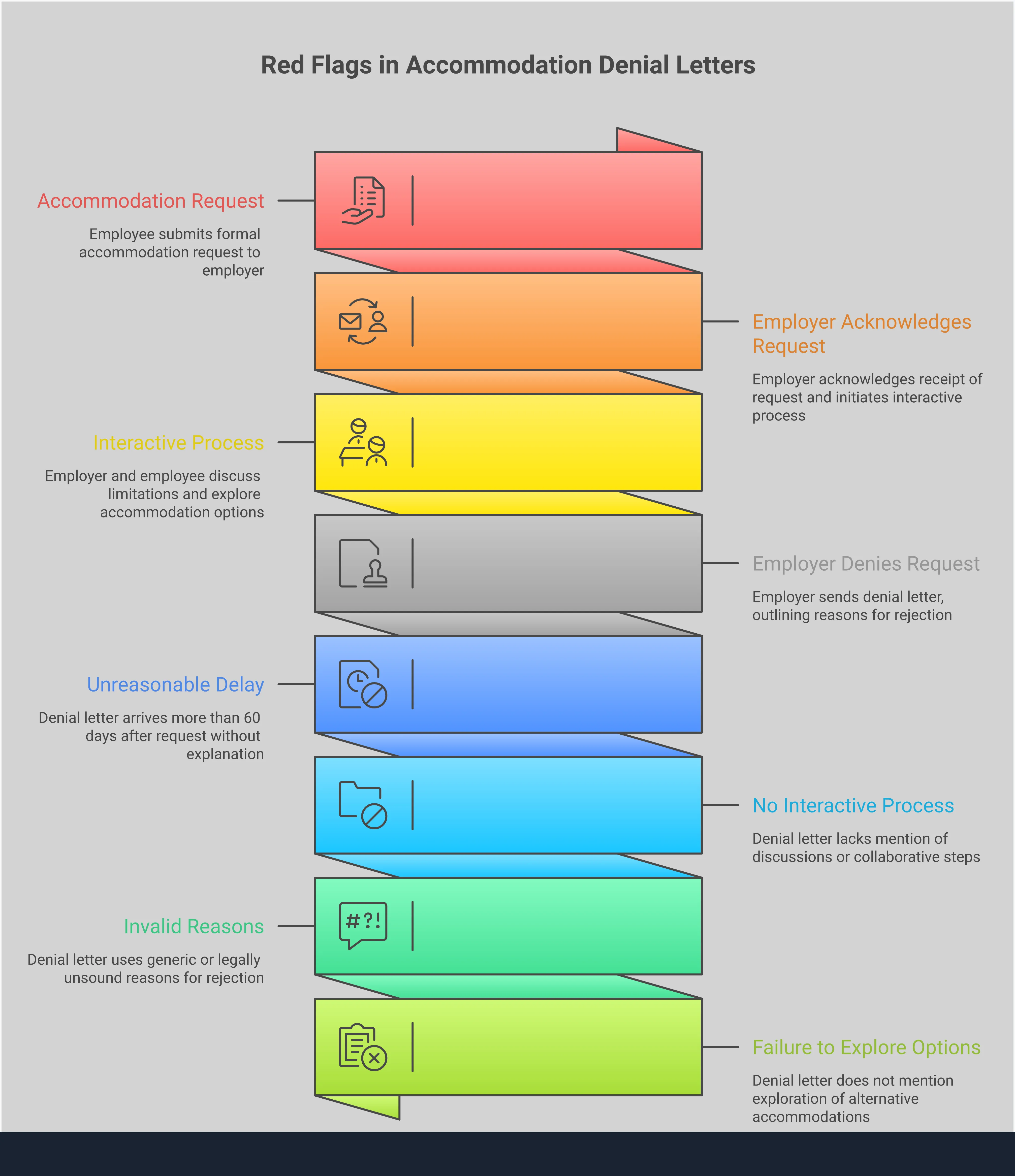
When you receive a letter denying your request for a reasonable accommodation, it can feel like a final verdict. But this letter is more than just a “no.” It’s a formal legal document that your employer must get right. Knowing what to look for is the first step in protecting your rights and deciding what to do next. A legally sound denial letter should be clear, specific, and demonstrate that your employer followed a fair process. If key elements are missing, it could be a sign that your employer mishandled your request and violated your rights under disability discrimination laws. Think of this letter as a piece of evidence; your job is to examine it closely for clues about how your employer handled their legal duties.
A Clear Summary of Your Request
The very first thing you should see in the letter is a clear acknowledgment of what you asked for. The document should state your name, the date you made the request, and a straightforward description of the specific accommodation you proposed. This confirms that your employer understood what you needed. If the letter misrepresents your request or is vague about the details, it could indicate a fundamental misunderstanding from the beginning of the process. This section sets the stage for the entire letter, and getting it right is a basic but critical part of your employer’s responsibility. It establishes a factual record of the interaction.
Specific, Lawful Reasons for the Denial
An employer can’t deny your request without a legitimate, legally recognized reason. Vague statements like “we are unable to grant your request at this time” are not enough. The letter must explain why your request was denied, citing specific and lawful justifications. Legally acceptable reasons could include that the accommodation would cause an “undue hardship” on the business, pose a direct safety threat, or remove an essential function of your job. The reason provided must be directly related to your specific request and your role, not a generic company policy. A lack of a clear, lawful reason is a major red flag and could be grounds for a wrongful termination claim if the denial leads to you losing your job.
Proof of the Interactive Process
Before an employer can deny a request, they are required to engage in a good-faith “interactive process” with you. This is simply a conversation meant to explore your needs and find a workable solution. The denial letter should reflect that this conversation happened. It might reference meetings, emails, or phone calls where you discussed your limitations and potential accommodations. If the letter makes no mention of this dialogue, or if you know it never took place, your employer may have failed to meet a key legal obligation. This process is a cornerstone of employment law, and skipping it is a serious misstep.
Any Alternative Solutions Offered
A flat-out denial with no discussion of other options can be a sign of bad faith. Part of the interactive process involves exploring alternatives if your original request isn’t feasible. A thorough denial letter will often document other accommodations that were considered or even offered to you. For example, if you asked to work from home full-time and the company denied it, did they offer a hybrid schedule or a modified workspace instead? The absence of any suggested alternatives could imply that your employer wasn’t genuinely interested in finding a solution. It suggests they were focused on saying “no” rather than collaborating to help you succeed in your role.
How to Analyze the Denial Letter You Received
Getting a formal denial letter can feel like a final roadblock, but it’s actually a critical piece of information. This document is your employer’s official stance, and how it’s written can tell you a lot about the process they followed and whether your rights were respected. Instead of just feeling discouraged, it’s time to put on your detective hat and examine the letter closely. By breaking it down piece by piece, you can get a clearer picture of why your request was denied and identify any red flags that suggest your employer may not have met their legal obligations. Let’s walk through exactly what you should be looking for.
Review the Stated Reasons and Justifications
The most important part of the letter is the reason your employer gives for the denial. Vague explanations aren’t enough; they need to provide a specific, legally sound justification. Legitimate reasons for a denial include claims that the accommodation would remove an essential job function, create a significant safety risk, or cause the business an “undue hardship,” meaning a major financial burden. They can also deny a request if you didn’t provide sufficient medical documentation to support it. Compare the reason in your letter to these valid justifications. If their explanation seems weak, unrelated to your job, or doesn’t add up, it could be a sign of disability discrimination.
Check the Timeline of Events
The law requires employers to respond to accommodation requests promptly. While there isn’t a rigid deadline, the process shouldn’t drag on indefinitely. Think back on the timeline. When did you submit your request? How long did it take for your employer to acknowledge it and begin a conversation with you? An unreasonable delay in either starting the discussion or providing a final decision can be a sign that your employer isn’t taking the process seriously. Your request deserves timely consideration, and a long wait followed by a denial could indicate a failure to engage in the process in good faith.
Evaluate the Letter’s Tone
While it might seem subjective, the tone of the denial letter matters. The letter should be professional, respectful, and show that your request was given serious, individualized consideration. A letter that is dismissive, cold, or uses generic, boilerplate language might suggest that your employer didn’t actually conduct a thoughtful analysis of your needs. The document doesn’t have to be long, but it should reflect a careful decision-making process based on facts. A letter with a hostile or careless tone can sometimes be evidence that your employer’s denial was not made in good faith and could contribute to a hostile work environment.
Note How and When It Was Delivered
A denial letter should never come as a complete surprise. Before making a final decision, your employer is required to engage in an “interactive process” with you. This is simply a conversation to understand your limitations and explore potential accommodations. If the first communication you received after submitting your request was this denial letter, that is a major red flag. It strongly suggests your employer skipped this critical step. A proper process involves a collaborative discussion, and receiving a denial out of the blue often means your employer failed to meet a key legal requirement under employment law.
What Happens When an Employer Gets It Wrong?
When an employer mishandles a reasonable accommodation request, it’s not just a simple mistake. They can face significant legal and financial consequences. The laws protecting employees with disabilities are robust, and companies that fail to follow them open themselves up to serious claims. Understanding these potential outcomes can help you see why your rights in this process are so protected and what leverage you have if you believe your employer has acted unlawfully.
Facing Discrimination and Retaliation Claims
An employer cannot punish you for requesting an accommodation. If they deny your request and then take negative action against you, like cutting your hours, demoting you, or firing you, they could be facing a lawsuit. This is because the law prohibits retaliation against employees who exercise their rights under the Americans with Disabilities Act (ADA). If you believe you’ve been discriminated against, you have the right to file a claim with government agencies like the Equal Employment Opportunity Commission (EEOC). Courts often look closely at the timing of events; if you were disciplined shortly after making your request, it can be strong evidence of retaliation.
The Cost of Poor Documentation
Employers are expected to keep clear records of the interactive process. This includes notes from conversations, copies of emails, and a well-reasoned, written explanation for their final decision. When an employer fails to do this, it becomes a major problem for them. A lack of documentation can suggest they didn’t take your request seriously or that they are trying to hide an improper motive. If your case goes to court, a jury may see this failure to document the process as evidence that the company was not acting in good faith. This is one of many reasons why employers must follow strict employment law standards.
Damage to the Company’s Finances and Reputation
Beyond the courtroom, a poorly handled accommodation request can have lasting effects on a company. Lawsuits involving discrimination and retaliation can result in costly settlements or jury verdicts that impact the company’s bottom line. But the damage isn’t just financial. A company that earns a reputation for being discriminatory will struggle to attract and retain talented employees. It can also harm their relationships with customers and the public, as people increasingly prefer to support businesses that treat their workers fairly. Holding companies accountable is a core part of what our firm does every day.
Your Next Steps After a Denial
Receiving a denial letter can feel like a major setback, but it doesn’t have to be the final word. If you believe your employer’s decision was unfair or unlawful, you have options. Taking a calm, methodical approach can help you protect your rights and decide what to do next. The key is to stay organized, understand the rules your employer is supposed to follow, and know when it’s time to ask for professional help. By following these steps, you can build a clear picture of your situation and prepare for a more effective response.
Organize Your Documentation
Your first move should be to gather every piece of paper and every email related to your request. Create a timeline of events, starting from your initial conversation about needing an accommodation. This file should include your written request, notes from your doctor, all email exchanges with HR or your manager, your official performance reviews, and the denial letter itself. Strong documentation for a disability discrimination claim should clearly show not only your medical need but also how the proposed change would have helped you perform your job duties effectively. An employer can argue that an accommodation is unreasonable if it wouldn’t actually help, so your records are crucial for showing otherwise.
Review Your Company’s Policies
Next, find your employee handbook and read the section on accommodations and disability policies. See what the official procedure is and compare it to your experience. Did your employer follow their own rules? It’s important to know that employers are required to engage in a discussion about your needs, even if you didn’t use a specific form or the exact words “reasonable accommodation.” As long as the company was aware that a medical condition was impacting your work, they had an obligation to start the conversation. Understanding your company’s stated policies can help you spot inconsistencies in how your case was handled and strengthen your position.
Know When to Contact an Employment Lawyer
If you’ve reviewed your documents and company policies and something still feels wrong, it may be time to speak with a lawyer. This is especially true if the reason for the denial seems flimsy. For example, if a large, profitable company claims your request creates an “undue hardship,” that’s a red flag. The law requires them to consider the company’s overall resources, not just one department’s budget. You should also seek legal advice if you feel you are a victim of retaliation at work for making the request in the first place. An experienced employment attorney can help you understand your legal options and fight for your rights.
Related Articles
- What Is a Reasonable Accommodation? A Complete Guide
- How Long Must an Employer Accommodate a Disability?
- ADA Accommodation Letter to Employee: A Simple Guide
- Interactive Process Reasonable Accommodation: A Guide
Frequently Asked Questions
What if my employer never gave me a formal letter and just ignored my request? Ignoring your request is not an acceptable response. The law requires your employer to engage with you in a timely manner once they are aware you need help for a medical reason. A long silence or an indefinite delay can be considered a denial in itself. This failure to communicate and participate in the interactive process is a serious misstep and could violate your rights.
Do I have to use specific legal words like “ADA” or “reasonable accommodation” when I ask for help? No, you don’t need to use any magic words. Simply telling your manager or HR that you are having trouble with a part of your job because of a medical condition is enough to trigger your employer’s legal duty to start a conversation with you. The focus is on communicating your need for a change at work due to a health issue, not on using perfect legal terminology.
My employer claimed my request would be an “undue hardship.” What does that really mean? “Undue hardship” is a high legal standard that means your requested accommodation would cause significant difficulty or expense for the business as a whole. It is not about a minor inconvenience or a small cost to one department’s budget. A large, well-funded company would have a very difficult time proving that a common accommodation, like providing special software or a flexible schedule, is a true hardship.
My boss denied my idea for an accommodation but didn’t suggest any other options. Is that allowed? A flat denial without exploring alternatives is a major red flag. The required interactive process is a collaborative conversation where both sides work to find a solution. If your initial idea isn’t feasible, your employer has a responsibility to discuss other potential accommodations that could be effective. Simply saying “no” without working with you suggests they did not engage in the process in good faith.
What is the single most important thing I should do after receiving a denial letter? The most important first step is to organize all your documentation. Gather every email, note, and letter related to your request and create a clear timeline of events. This includes your initial request, any medical notes you provided, and the denial letter itself. Having a detailed and organized record is the foundation for protecting your rights and deciding on your next move.
Think you were wrongfully terminated?
Get a free, confidential case evaluation from our experienced employment law attorneys.
Request Your Free Consultation