
You’ve been a loyal employee for years, consistently meeting or exceeding expectations. Then, a new manager comes in, and suddenly your performance is under a microscope. You’re left out of important meetings, and your responsibilities are slowly given to younger team members. Eventually, you’re let go for a vague reason like “restructuring.” This scenario is all too common for older workers. While it may feel like your employer holds all the cards, the law provides a structured way to challenge their actions. It starts with building a prima facie age discrimination claim, which allows you to formally question a wrongful termination and demand a legitimate explanation.
Key Takeaways
- Your initial case rests on four key points: To move forward with a claim, you must demonstrate that you are over 40, were qualified for your position, faced a negative employment action, and were replaced by a significantly younger person.
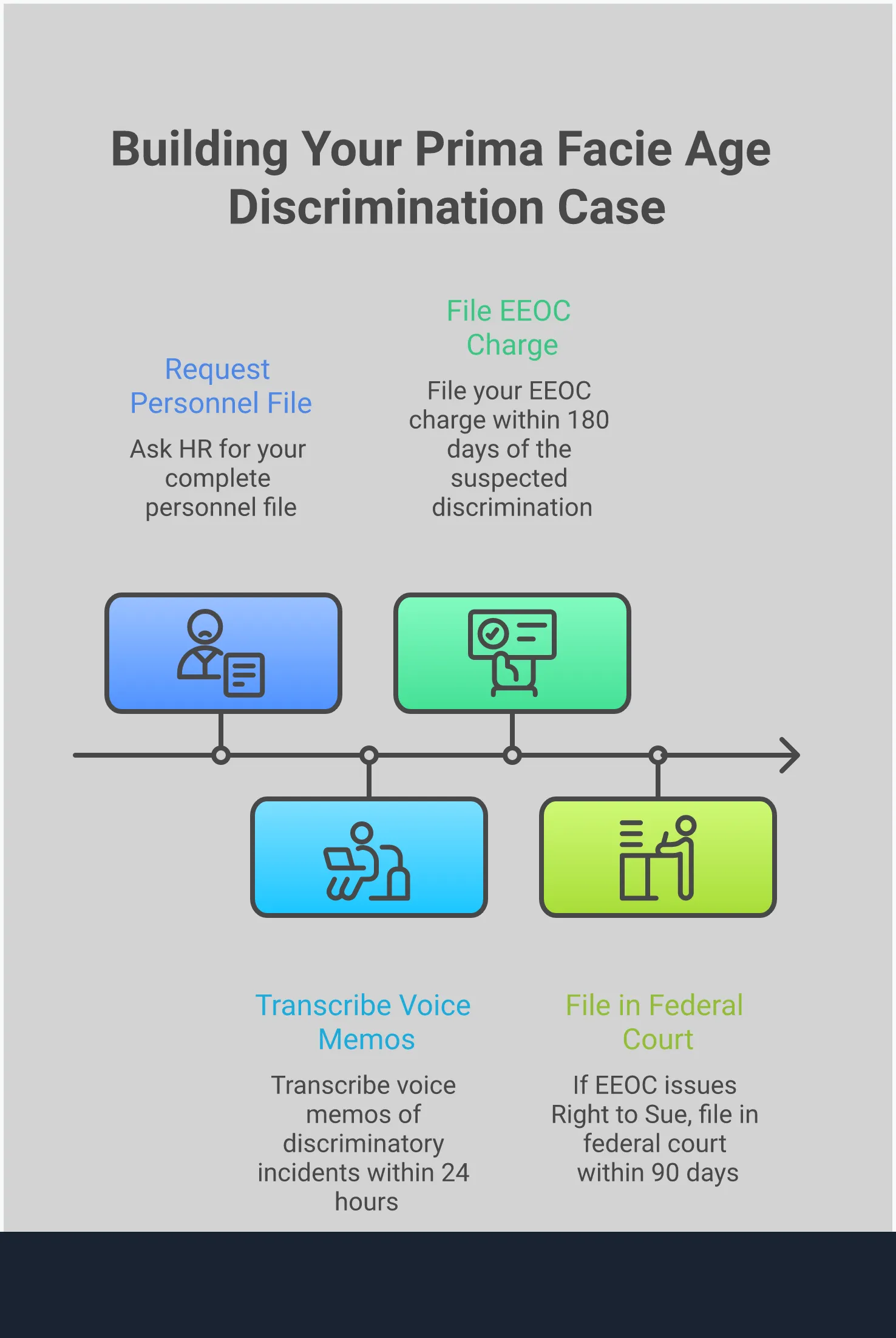
- Protect yourself with a paper trail: If you suspect discrimination, start a detailed journal of every incident, collect all relevant emails and performance reviews, and follow your company’s formal complaint procedure to build your evidence.
- Circumstantial evidence is powerful: You don’t need direct proof of discrimination; a strong case can be built by connecting the dots through patterns of biased comments, unfair performance reviews, and evidence of younger colleagues receiving better treatment.
What Is a Prima Facie Age Discrimination Claim?
If you believe you’ve been treated unfairly at work because of your age, you might hear lawyers use the term “prima facie.” In simple terms, a prima facie case is the first step in proving age discrimination. It’s the set of basic facts you need to present to show that your claim has merit and should be taken seriously. Think of it as laying the foundation for your argument. By presenting these initial facts, you create a legal presumption that discrimination occurred, which forces your employer to explain their actions. Without this crucial first step, a court could dismiss your case before you even have a chance to tell your full story.
To establish a prima facie age discrimination claim, you generally need to demonstrate four key things. First, you must be at least 40 years old, which is the age threshold set by federal law. Second, you must have experienced an adverse employment action. This is more than just a minor inconvenience; it includes serious setbacks like being fired, demoted, having your hours cut, or being passed over for a promotion you deserved. Third, you have to show that you were qualified for your job and meeting its legitimate performance expectations. Finally, you need to prove that you were replaced by a significantly younger employee or that younger colleagues were treated more favorably under similar circumstances. Presenting these four elements together creates a strong initial picture that suggests discrimination was a factor, allowing your case to move forward.
What It Means and Why It Matters
Establishing a prima facie case is a critical turning point. Once you’ve presented these initial facts, the legal burden shifts to your employer. It’s now their turn to respond. They must provide a legitimate, non-discriminatory reason for the action they took. For example, they might claim the decision was based on budget cuts or a company restructuring.
This is where the real fight often begins. After your employer gives their reason, you get the opportunity to challenge it. Your goal is to show that their explanation is just a pretext, a cover story for the real reason: age discrimination. This process ensures that employers can’t simply hide behind vague excuses when their actions appear discriminatory.
Your Rights Under the Age Discrimination in Employment Act (ADEA)
The primary federal law that protects you is the Age Discrimination in Employment Act (ADEA). This law makes it illegal for employers to treat workers aged 40 and over unfairly because of their age. It covers a wide range of workplace decisions, including hiring, firing, pay, promotions, and layoffs. The ADEA is your shield against age-based bias.
If you believe your rights have been violated, it’s crucial to act promptly. You typically have 180 days from the date of the discriminatory act to file a complaint with the Equal Employment Opportunity Commission (EEOC). Understanding these deadlines is essential to protecting your legal options. An experienced employment law attorney can help you meet these requirements and stand up for your rights.
The 4 Key Elements of an Age Discrimination Case
To build a strong age discrimination claim, you first need to establish what’s known as a prima facie case. This is a legal term that simply means you have enough evidence on the surface to suggest discrimination may have occurred. Think of it as the starting point. If you can show these four key elements, the legal burden then shifts to your employer to provide a legitimate, non-discriminatory reason for their actions. Understanding these elements is the first step in evaluating the strength of your potential case.
You’re in a Protected Age Group (40+)
First and foremost, federal and state laws protect specific groups of people. For age discrimination, the key number is 40. The Age Discrimination in Employment Act (ADEA) is a federal law that protects employees and job applicants who are 40 years of age or older from being treated unfairly because of their age. This law applies to most private employers with 20 or more employees, as well as government agencies and labor organizations. If you are over 40, you are in the legally protected age group, which is the foundational element for any age discrimination claim.
You Faced an Adverse Employment Action
Next, you must show that you experienced a negative or “adverse” employment action. This is a broad term that covers more than just being fired. An adverse action is any significant negative change in your employment status. This could include a wrongful termination, a demotion, a pay cut, being passed over for a promotion you deserved, or being transferred to a dead-end position with fewer responsibilities. Essentially, if your employer made a decision that materially harmed your career, compensation, or working conditions, it likely qualifies as an adverse employment action.
You Were Qualified for Your Job
You also need to demonstrate that you were qualified for your position and performing your job satisfactorily. This element is about showing that the adverse action wasn’t a result of your own poor performance. Evidence like positive performance reviews, a history of raises or promotions, and proof of meeting or exceeding job expectations can be very helpful here. The goal is to establish that you had the necessary skills and experience and were meeting the company’s legitimate standards. This helps counter any claims from your employer that their decision was based on your work quality rather than your age.
You Were Replaced by Someone Younger
Finally, you generally need to show that you were replaced by someone substantially younger. The law doesn’t set a specific age gap, but the difference in age should be significant enough to suggest that age was a factor. It’s important to know that your replacement doesn’t have to be under 40. For example, if a 60-year-old employee is replaced by a 42-year-old, that could still be evidence of age discrimination. In some situations, you may not have been directly replaced. Instead, you might show that your duties were absorbed by younger employees, which can also support your claim.
What Evidence Do You Need to Build Your Case?
Building a strong age discrimination case is about gathering pieces of a puzzle to create a clear picture for others to see. You don’t need a single “smoking gun” piece of evidence to have a valid claim. While direct evidence, like an email explicitly stating you’re being let go because of your age, is powerful, it’s also very rare. Most successful cases are built on a collection of circumstantial evidence, which are facts that point toward discrimination when viewed together.
Think of it like this: one comment about your age might be dismissed, but a pattern of comments combined with a sudden negative performance review and the hiring of a younger replacement tells a much more compelling story. Your goal is to collect enough proof to show that it’s more likely than not that your age was a key factor in your employer’s decision. The following types of evidence are crucial for building a solid foundation for your discrimination claim.
Gathering Documents and Written Records
Your first step should be to collect any and all paperwork related to your job. Written records are powerful because they provide a concrete, objective account of your employment history. Start by gathering your offer letter, employment contracts, your employee handbook, and any official job descriptions. Pay close attention to emails, text messages, or internal chat logs with supervisors and HR. These communications can often reveal an employer’s true motivations. If you were laid off, keep the notice and any severance agreements offered. An attorney can also help you formally request your complete personnel file from your employer, which contains a wealth of information.
Identifying Discriminatory Comments
What people say matters. If you’ve heard supervisors or colleagues make comments about your age, retirement plans, or energy levels, you need to write them down immediately. Keep a detailed journal where you log every incident. For each entry, include the date, time, location, exactly what was said, who said it, and who else was present to witness it. Comments like, “We need some new blood around here,” or “When are you planning to retire?” can be used to show a pattern of age-related bias. This documentation can be critical in establishing a hostile work environment and proving discriminatory intent.
Using Performance Reviews and Statistics
Your performance history is one of your strongest assets. A long track record of positive performance reviews can directly contradict an employer’s claim that you were fired for poor performance. If your reviews were consistently good until a new, younger manager took over, that sudden shift is a major red flag. You can also look at the bigger picture. Are you the only older employee who was let go? If your company laid off several employees over 50 while simultaneously hiring younger staff for similar roles, that statistical pattern can serve as powerful evidence of a company-wide bias and support a claim for wrongful termination.
Finding Witnesses and Comparative Evidence
You don’t have to build your case alone. Coworkers who witnessed discriminatory comments or saw you being treated unfairly can provide crucial testimony to support your claims. Think about anyone who was present during inappropriate conversations or who can speak to your strong work ethic. Another key strategy is to gather comparative evidence. This involves showing that younger employees in similar situations were treated more favorably. For example, if a younger colleague with the same job title and performance record made a similar mistake but only received a warning while you were fired, that’s a powerful piece of evidence. This helps prove you were singled out because of your age.
How to Spot Age Discrimination at Work
Age discrimination can be tricky to identify because it often hides behind seemingly legitimate business decisions. An employer is unlikely to admit they fired someone because of their age. Instead, the bias shows up in subtle patterns, offhand comments, and unfair treatment that can be hard to pin down. Learning to recognize these signs is the first step toward protecting your rights. It’s about understanding what to look for, from blatant remarks to quiet, coded language that hints at a deeper issue.
Understanding Direct vs. Circumstantial Evidence
When building an age discrimination case, evidence falls into two main categories: direct and circumstantial. Direct evidence is the “smoking gun,” a clear statement proving discriminatory intent. For example, if a manager says, “We’re letting you go because we need younger talent,” that’s direct evidence. However, this is rare. Most cases rely on circumstantial evidence, which involves facts that suggest discrimination occurred. Think of it as connecting the dots. A pattern of older employees being laid off or replaced by a younger person are pieces of circumstantial evidence that can paint a powerful picture of discrimination.
Recognizing Common Red Flags
Age discrimination often leaves a trail of warning signs. If you know what to look for, you can start documenting incidents. Keeping a detailed journal of what happened, including dates, times, and who was involved, is incredibly helpful. Here are some common red flags:
- You are suddenly left out of key meetings or projects.
- You receive an unexpectedly negative performance review after a history of positive feedback.
- Your boss or co-workers make jokes or insensitive comments about your age.
- You notice a pattern of the company hiring younger employees while laying off older ones.
- You are passed over for a promotion in favor of a younger, less-qualified person.
- Your job responsibilities are taken away, leading to a potential wrongful termination.
Watching for Subtle Bias and Coded Language
Sometimes, age bias is masked by corporate jargon. These subtle comments can be just as damaging and may be used to justify unfair decisions. Be aware of coded phrases that suggest a preference for younger employees. You might hear that the company is looking for “digital natives” or wants a “fresh perspective.” Other phrases include wanting someone with “energy” or who is a better “cultural fit,” especially if the workplace is dominated by younger staff. These terms can create a hostile work environment for older workers and can be used to unfairly screen them out. Documenting this language helps establish a pattern of age-related bias.
What to Do if You Suspect Age Discrimination
Feeling like you’re being pushed aside at work because of your age can be incredibly frustrating and isolating. It’s easy to second-guess yourself, but it’s important to trust your instincts. If you believe you’re facing age discrimination, you don’t have to accept it. Taking clear, deliberate steps can protect your rights and help you build a strong foundation for a potential claim. The key is to be methodical and proactive. By documenting what’s happening, following the proper channels, and seeking professional guidance, you can move forward with confidence. Here’s a straightforward guide on what to do next.
Document Everything
Your memory is powerful, but a written record is undeniable. Start keeping a detailed journal of every incident that feels discriminatory. For each entry, note the date, time, location, and who was involved. Write down exactly what was said or done, using direct quotes whenever possible. Save any related emails, text messages, performance reviews, or company memos that could serve as evidence. This detailed log is more than just a collection of notes; it’s the backbone of your case. Having a clear, chronological record helps establish a pattern of behavior and will be invaluable if you decide to pursue legal action for discrimination.
File an Internal Complaint
While it might feel daunting, reporting the discrimination internally is a critical step. Check your employee handbook for the company’s official complaint procedure and follow it precisely. This usually means filing a formal, written complaint with your Human Resources department or a designated manager. Submitting a complaint puts your employer on official notice and gives them a chance to address the issue. Their response, or lack of one, becomes a crucial part of your record. This formal step demonstrates that you made a good-faith effort to resolve the problem internally before seeking outside help, which can strengthen your position against potential retaliation.
Speak with an Employment Attorney
You don’t have to go through this alone. After you’ve documented the incidents and filed an internal complaint, the most important step is to consult with an experienced employment attorney. A lawyer can review your evidence, explain your legal options, and help you understand the strength of your case. They can guide you through the process of filing a formal charge with government agencies like the Equal Employment Opportunity Commission (EEOC) or California’s Civil Rights Department. An employment attorney can also help you gather additional evidence and ensure you meet all critical deadlines. Getting professional legal advice is the best way to make sure your rights are fully protected.
The EEOC Complaint Process, Explained
If you believe you’ve faced age discrimination, filing a formal complaint is a significant step toward seeking justice. The U.S. Equal Employment Opportunity Commission (EEOC) is the federal agency that handles these claims. While the process can seem complex, understanding the key stages can make it feel much more approachable. Think of it as a roadmap: you have to meet certain deadlines, participate in an investigation, and understand how federal and state laws work together to protect you. Knowing what to expect can help you prepare and ensure your case is heard.
Meeting Filing Deadlines
When it comes to legal matters, timing is everything. The EEOC has strict deadlines for filing a complaint, and it’s crucial to act quickly. Generally, you have 180 days from the date the discrimination took place to file your charge. This window is even shorter for federal employees, who must contact an Equal Employment Opportunity (EEO) counselor within 45 days. Missing these deadlines can unfortunately mean losing your right to file a claim. That’s why it’s so important to document incidents as they happen and seek legal advice promptly.
What to Expect During the Investigation
Once you’ve filed your complaint, the EEOC will begin an investigation. An investigator will gather facts by interviewing you, your employer, and any witnesses, and reviewing documents like performance reviews. If the investigation doesn’t find enough evidence of discrimination, the EEOC will close the case and issue a “Notice of Right to Sue.” This letter gives you the green light to file a lawsuit in court, but you must act within 90 days of receiving it. This is often the point where having an experienced employment attorney is essential.
Understanding State Law Protections
Federal law, specifically the Age Discrimination in Employment Act (ADEA), offers a strong foundation for protection. It covers workers who are 40 and older and applies to employers with 20 or more employees. However, the ADEA doesn’t protect younger workers from age-based bias. This is where state laws come in. Many states, including California, have laws that provide even broader protections against age discrimination. These state-level rules might apply to smaller companies or protect a wider range of employees. Federal law sets the floor, not the ceiling, for your rights.
How the Burden of Proof Shifts in Court
When you file an age discrimination claim, the legal process involves a specific back-and-forth to determine what really happened. This is known as the “burden of proof,” which essentially means who needs to prove what, and when. In discrimination cases, this burden isn’t static; it actually shifts between you and your employer in a three-step process. Think of it as a structured conversation where each side gets a chance to present its story. This framework helps the court cut through the noise and focus on the core issue: whether your age was a factor in your employer’s decision. Understanding these steps can help you see how your case might unfold and what you’ll need to demonstrate along the way.
Step 1: Establishing Your Initial Case
Your first task is to establish what’s called a “prima facie” case. It’s a legal term that just means you have enough evidence on the surface to suggest discrimination might have occurred. To do this, you generally need to show four things: you are over 40, you were meeting your employer’s job expectations, you experienced a negative employment action (like being fired or demoted), and you were replaced by a substantially younger employee. Meeting these points doesn’t mean you’ve won, but it gets your foot in the door. It creates a legal presumption of discrimination that your employer is then required to answer.
Step 2: Your Employer Responds
Once you’ve made your initial case, the burden shifts to your employer. It’s now their turn to explain their actions. They must provide a legitimate, nondiscriminatory reason for the decision they made. For example, they might claim the termination was part of a company-wide layoff, was based on documented poor performance, or that your position was eliminated for business reasons. At this stage, they don’t have to prove this reason is true beyond all doubt. They just need to clearly state a valid business justification for their actions. This step is their opportunity to show the court that their decision was based on something other than your age, potentially leading to a claim of wrongful termination.
Step 3: Proving Their Reason Is a Pretext
If your employer provides a legitimate-sounding reason, the burden shifts back to you for the final and most crucial step. You now have to show that your employer’s explanation is a “pretext,” which is just a legal way of saying it’s a cover-up for the real, discriminatory reason. You can do this in a couple of ways. You might present evidence showing their reason is factually untrue. Or, you could argue that even if their reason is true, your age was still the more likely motivating factor. This could involve showing that the company’s policies were not applied evenly or that younger employees in similar situations were treated more favorably.
Common Myths About Age Discrimination Claims
When you’re facing potential age discrimination, it’s easy to get tangled up in misinformation. These myths can be discouraging, often making people feel like they don’t have a strong enough case to move forward. But understanding the reality of how these claims work is the first step toward protecting your rights. Let’s clear up a few common misconceptions that might be holding you back.
Myth: You Need Direct Proof
Many people believe you need a “smoking gun” to prove age discrimination, like an email from your boss explicitly stating you were fired because of your age. While that would certainly be strong evidence, it’s rarely available. The good news is, you don’t need it. Courts recognize that discrimination is often subtle, so you can build your case using circumstantial evidence). This could include a pattern of laying off older employees, suspicious timing around your termination, or comments from management about wanting a more “youthful” team. The law allows you to connect the dots to show that discrimination was the most likely reason for the adverse action you experienced.
Myth: You Must Be More Qualified Than Your Replacement
Another common misconception is that you have to prove you were significantly more qualified than the younger person who replaced you. This sets an unfairly high bar. In reality, you only need to show that you were qualified for your position and that your replacement was similarly or less qualified. The key is to demonstrate that your age, not your performance, was the deciding factor. If you and your replacement were on equal footing in terms of skills and experience, it raises the question of why the company chose to let you go. Being similarly qualified is often enough to suggest that age bias played a role in the decision.
Myth: The Burden of Proof Never Shifts
It can feel daunting to think that the entire legal weight of the case rests on your shoulders from start to finish. Fortunately, that’s not how it works. Age discrimination cases follow a specific structure where the burden of proof) actually shifts. First, you present the basic elements of your claim. Then, the responsibility shifts to your employer to provide a legitimate, non-discriminatory reason for their actions. If they do, the burden shifts back to you to show that their explanation is just a pretext, or a cover-up, for the real, discriminatory reason. This framework ensures a more balanced process and gives you a fair opportunity to challenge your employer’s story.
Are You Protected From Retaliation?
One of the biggest fears people have when considering an age discrimination claim is what might happen at work afterward. Will you be fired? Demoted? Will your life be made difficult? These are valid concerns, but federal law provides strong protections against this exact scenario. The same laws that prohibit age discrimination also make it illegal for your employer to punish you for speaking up. This is called retaliation, and it’s a serious offense. Understanding these protections is a key step in feeling secure enough to assert your rights and hold an employer accountable for unlawful behavior.
Your Rights Under the ADEA
The Age Discrimination in Employment Act (ADEA) is the federal law that protects employees and job applicants aged 40 and older from unfair treatment. This protection covers all aspects of employment, from hiring and firing to promotions and pay. But the ADEA goes a step further: it also shields you from any form of retaliation at work for exercising your rights. This means your employer can’t take negative action against you for filing a complaint or even just participating in an investigation. As the U.S. Equal Employment Opportunity Commission points out, illegal harassment can include “offensive jokes or comments” that create a hostile work environment.
You Can File a Charge Without Fear
If you feel you’ve been a target of age discrimination, you can and should take action without worrying about backlash. The ADEA gives you the right to file a formal charge with the Equal Employment Opportunity Commission (EEOC), and it protects you throughout the entire process. This protection isn’t just for filing your own complaint; it also covers you if you serve as a witness in someone else’s investigation. According to the EEOC, you generally have 180 days to file a complaint, so it’s important to act promptly. This legal shield ensures you can seek justice without risking your job or facing other negative consequences from your employer.
What Can You Win in an Age Discrimination Lawsuit?
If you’ve experienced age discrimination, you might be wondering what you can gain by taking legal action. The goal of a lawsuit is to compensate you for the harm you’ve suffered and, in some cases, to restore you to the position you would have been in if the discrimination had never happened. The law provides several ways to do this, from recovering lost income to getting your job back. Understanding these potential outcomes can help you decide on your next steps.
Recovering Lost Wages (Back and Front Pay)
One of the most direct forms of compensation is recovering lost wages. This is broken down into two types: back pay and front pay. Back pay covers the money and benefits you lost from the time of the discriminatory act up to the resolution of your case. This includes your salary, bonuses, and the value of lost benefits like health insurance. Front pay is designed to compensate you for future lost earnings if you can’t be reinstated to your old job. The court calculates these damages in an age discrimination case to cover what you would have likely earned had the discrimination not occurred.
Getting Your Job Back or a Promotion
Sometimes, financial compensation isn’t the only goal. You may be able to get your job back through a remedy called reinstatement. The court can order your employer to give you back your old position or an equivalent one. Similarly, if you were unfairly passed over for a promotion because of your age, the court can order your employer to promote you. According to the U.S. Equal Employment Opportunity Commission (EEOC), these remedies for employment discrimination are meant to make you whole and place you in the career position you rightfully earned.
Securing Damages and Attorney’s Fees
Beyond lost wages, you may be entitled to other damages. Compensatory damages cover out-of-pocket expenses you incurred because of the discrimination, such as the costs of searching for a new job or medical bills for emotional distress. If your employer’s actions were particularly malicious or reckless, you might also be awarded punitive damages, which are intended to punish the company and deter future misconduct. Importantly, if you win your age discrimination claim, your employer is often required to pay your attorney’s fees and legal costs. This provision makes it possible for you to pursue justice without bearing a heavy financial burden.
Related Articles
- How to Prove Racial Discrimination at Work: Key Steps
- How to Prove Disability Discrimination: A Legal Guide
- When to Hire an Employment Discrimination Attorney
- 5 Signs You Need a Gender Discrimination Attorney
Frequently Asked Questions
What if I wasn’t fired? Can I still have a claim for age discrimination? Absolutely. Age discrimination isn’t limited to just wrongful termination. Any significant negative action your employer takes against you can qualify. This includes being demoted, having your pay cut, being passed over for a promotion you were qualified for, or even being transferred to a less desirable role with fewer responsibilities. If an employment decision negatively impacted your career because of your age, it’s worth looking into.
My replacement is also over 40. Does that mean I don’t have a case? Not necessarily. The law doesn’t require your replacement to be under 40. The key is whether they are substantially younger than you. For example, if a 62-year-old is replaced by a 45-year-old, that age gap can still be significant enough to support a discrimination claim. The focus is on whether age was a motivating factor in the decision to replace you with someone younger, regardless of their specific age.
What if my employer claims I was let go for poor performance? This is a very common defense, but it’s not the end of the story. Your history of performance reviews, commendations, and raises can be powerful evidence to counter this claim. If you have a long record of positive feedback and suddenly received a negative review right before being terminated, it can suggest their reason is just a cover story. The goal is to show that their stated reason for firing you doesn’t line up with the facts of your work history.
I don’t have any emails or texts proving discrimination. Is it still possible to build a case? Yes, it is. Most successful age discrimination cases are built without a single “smoking gun” piece of evidence. Instead, they rely on a collection of facts that, when viewed together, point to discrimination. This can include a pattern of older workers being pushed out, a history of age-related comments in the workplace, and evidence that younger employees were treated more favorably. Your detailed notes and documentation of these incidents are what create a compelling narrative.
How quickly do I need to act if I suspect age discrimination? You need to act promptly because there are strict legal deadlines. For federal claims, you generally have only 180 days from the date of the discriminatory act to file a complaint with the EEOC. These deadlines are firm, and missing them can prevent you from being able to pursue your case. Because of this, it’s a good idea to speak with an employment attorney as soon as you can to understand your options and make sure you protect your rights.
Think you were wrongfully terminated?
Get a free, confidential case evaluation from our experienced employment law attorneys.
Request Your Free Consultation