
When you are facing harassment at work, you are not powerless. The actions you take right now can directly influence the strength of your case and its potential value. A settlement is not a lottery ticket; it is the result of a carefully constructed claim built on a foundation of solid evidence. This is especially true when it comes to hostile work environment lawsuit settlement amounts. The more proof you have, the stronger your negotiating position becomes. This article will walk you through the crucial factors that determine a settlement, with a focus on what you can control. We’ll discuss the power of documentation, the importance of witness statements, and how proving the emotional and financial impact of the harassment is key to securing the compensation you deserve.
Key Takeaways
- Know the legal definition and document everything: For a workplace to be legally hostile, the behavior must be severe or pervasive and linked to a protected characteristic like race, gender, or disability. Your most powerful tool is a detailed record of every incident, including dates, times, what was said, and who was present.
- Your settlement value depends on specific details: There is no average payout for a hostile work environment claim. The final amount is built on the severity of the harassment, the strength of your evidence, your employer’s response to your complaints, and the financial and emotional harm you suffered.
- Take strategic action and get legal advice early: Protect your rights by following your company’s internal reporting procedures and speaking with an employment lawyer. An attorney can guide you through the process, and since most cases settle privately, you can often resolve the issue without a public trial.
What Legally Defines a Hostile Work Environment?
The term “hostile work environment” gets used a lot, but in a legal sense, it means something very specific. It’s more than just dealing with a difficult boss or having a bad day. For a workplace to be legally considered hostile, the behavior must meet certain standards that cross the line from unpleasant to unlawful. Understanding these legal definitions is the first step in figuring out if you have a case and what you can do about it.
The Legal Standard for Hostility
A hostile work environment is created when you experience unwelcome conduct that is so severe or pervasive it makes your job feel intimidating, abusive, or offensive. The key words here are “severe” and “pervasive.” A severe act might be a single, extreme incident, like a physical threat or a deeply offensive slur. Pervasive conduct refers to a pattern of smaller incidents that happen frequently over time, creating a consistently toxic atmosphere. The behavior must be serious enough that a reasonable person in your shoes would find the environment hostile. This is a critical part of any hostile work environment claim.
Understanding Protected Characteristics
Here’s a crucial point: for harassment to be illegal, it must be based on a protected characteristic. This means the negative treatment is happening because of your race, gender, religion, disability, age, sexual orientation, or another protected status. California law recognizes many protected classes, and this link is what separates illegal harassment from general workplace bullying. While having a rude or demanding manager is stressful, it’s not against the law unless their behavior is motivated by discrimination. Proving this connection is essential to building a successful hostile work environment case.
Examples of Hostile Behavior in the Workplace
Hostile behavior can show up in many ways, and it isn’t always obvious. It can range from verbal abuse, threats, and intimidation to displaying offensive images or sending inappropriate emails and texts. Derogatory comments, slurs, or offensive jokes about your background or identity are also common examples. One of the most frequent types of illegal harassment is sexual harassment, which includes unwelcome advances, requests for sexual favors, or other verbal or physical conduct of a sexual nature. Any of these actions, if severe or pervasive enough, can contribute to an unlawful work environment.
What Is a Typical Hostile Work Environment Settlement?
It’s natural to wonder what you might expect from a settlement, but there is no one-size-fits-all answer. Every case is unique. However, looking at general ranges can give you a clearer picture of what might be possible. For many standard cases, hostile work environment lawsuit payouts can range from $75,000 to $300,000. In situations involving severe and long-lasting misconduct, settlements can sometimes exceed $1 million.
Think of these figures as a starting point, not a guarantee. The final amount depends on many specific details of your situation. A claim for a hostile work environment is complex, and its value is tied directly to the evidence, the severity of the harm you suffered, and even your employer’s size and location. Understanding these factors is the first step in assessing the potential value of your claim. We’ll break down some of the most important elements that influence settlement negotiations, including the severity of the case, where you live, and the size of the company you work for.
How Case Severity Influences Settlement Ranges
The intensity and frequency of the harassment are critical in determining a settlement amount. A few isolated, inappropriate comments will likely result in a much lower settlement than a case involving persistent, severe abuse. Legal experts often categorize cases to estimate potential value. For instance, minor cases might settle for around $10,000 to $50,000, while moderate cases involving more consistent harassment could fall between $50,000 and $250,000.
Highly complex cases, which often involve severe forms of discrimination or retaliation over a long period, can result in settlements from $250,000 to over $1 million. The specific actions, the evidence you have, and the emotional and financial impact on you are what truly shape the final figure.
Why Your Location Can Affect Settlement Value
Where you work matters. State and local laws offer different levels of protection for employees, which directly impacts settlement values. California is known for having some of the strongest employee protection laws in the country. Because of these stricter labor laws, settlements in California are often on the higher end of the national spectrum, with many cases resolving in the $75,000 to $300,000 range.
These robust protections give employees more leverage during negotiations. An attorney who specializes in California employment law will understand how to use these state-specific regulations to build a stronger case for you. This local expertise is essential for ensuring you receive fair compensation based on the laws that apply to your workplace.
The Role of Company Size in Settlement Offers
The size of the company you work for can also influence your settlement, particularly when it comes to certain types of damages. Federal law, enforced by the U.S. Equal Employment Opportunity Commission (EEOC), places caps on compensatory damages, which cover things like emotional distress. These caps are tied to the number of employees a company has. For example, a company with fewer than 100 employees has a cap of $50,000, while a company with over 500 employees has a cap of $300,000.
It’s important to remember that these limits don’t apply to all damages. They don’t affect economic losses like back pay or front pay. An experienced lawyer can explain how these caps might apply to your case and work to maximize the compensation you can recover.
Key Factors That Determine Your Settlement Amount
When you’re dealing with a hostile work environment, it’s natural to wonder what a potential settlement might look like. There isn’t a simple calculator for this, because every case is unique. Instead, the value of your claim is built on several key factors that, when taken together, paint a full picture of your experience and the harm you’ve suffered.
Think of it less like a lottery ticket and more like a detailed assessment. The final amount depends on the specific actions of the harasser, the response (or lack thereof) from your employer, the quality of your evidence, and the tangible impact the situation has had on your life. Understanding these elements will help you set realistic expectations and build a stronger case. For example, a case involving a single offensive comment will be valued differently than one with a long-standing pattern of discriminatory behavior. Similarly, an employer who immediately investigates and resolves a complaint is viewed differently than one who ignores it or punishes the employee for speaking up. We’ll look at the most critical factors, including the nature of the harassment, the proof you can provide, your employer’s conduct, and the personal and professional toll it has taken on you.
The Severity and Frequency of the Harassment
The nature of the harassment itself is a primary factor in determining a settlement amount. A single, inappropriate comment will be viewed very differently than a relentless pattern of abuse. Courts and employers look at whether the behavior was severe or pervasive. Severe conduct might include physical threats or extremely offensive slurs, while pervasive conduct involves repeated, ongoing harassment that makes the workplace unbearable over time.
Generally, the more severe and frequent the harassment, the higher the potential settlement. A situation that continued for months or years, despite your discomfort, will carry more weight than an isolated incident. The goal is to show that the hostile work environment was not just a minor annoyance but a significant disruption to your ability to do your job.
The Strength of Your Evidence and Documentation
A strong case is built on strong evidence. Your personal account is powerful, but it becomes much more compelling when supported by documentation. This is why keeping detailed records is one of the most important things you can do. Write down every incident of harassment, including the date, time, location, what was said or done, and who was present.
Save any relevant emails, text messages, or voicemails. If there were witnesses, their testimony can be invaluable. You should also gather proof of the harm you’ve suffered, such as medical records from a therapist or doctor. The more concrete evidence you have, the clearer your story becomes and the harder it is for your employer to dispute your claim. Strong documentation is the foundation of any successful employment law case.
How Your Employer Responded to Your Complaints
What your employer did, or failed to do, after you reported the harassment is critically important. Companies have a legal responsibility to take reasonable steps to prevent and correct harassing behavior. If you reported the issue to HR or your manager and they ignored your complaint, failed to investigate properly, or didn’t take action to stop the harassment, their liability increases significantly.
Even worse is if you faced punishment for speaking up. If you were demoted, given poor performance reviews, or fired after making a complaint, you may have a separate claim for retaliation. An employer’s failure to act or, worse, their decision to punish you for reporting misconduct can substantially increase the value of your settlement.
The Impact on Your Career and Mental Well-Being
A settlement is designed to compensate you for the harm you’ve endured. This harm can be both financial and emotional. Financial losses, or economic damages, include lost wages if you were fired or forced to quit, missed opportunities for promotion, and any benefits you lost. These are often straightforward to calculate.
However, the emotional toll is frequently the most significant part of the damage. This includes compensation for anxiety, depression, emotional distress, and the cost of therapy or medical treatment. A hostile work environment can damage your confidence, harm your professional reputation, and cause lasting psychological effects. Demonstrating this impact is a key part of ensuring you are fairly compensated for everything you went through.
What Types of Damages Can You Recover?
When you pursue a claim for a hostile work environment, a potential settlement isn’t just a single, arbitrary number. Instead, it’s a carefully calculated amount designed to compensate you for the specific harm you’ve suffered. The legal term for this compensation is “damages,” and it covers everything from lost income to the emotional toll the experience took on you. The goal is to help you get back on your feet financially, professionally, and personally.
Think of damages as different categories of loss. Each category addresses a unique way the hostile work environment impacted your life. Some damages are easy to calculate, like tallying up missed paychecks. Others are less tangible but just as important, like the anxiety and stress you were forced to endure. In some cases, damages can also be used to punish the employer for their behavior. Understanding these categories will give you a clearer picture of what you may be entitled to and help you prepare for the legal process ahead. It’s about making sure you are made whole again and holding your employer accountable for failing to provide a safe workplace.
Lost Wages and Other Economic Losses
One of the most direct impacts of a hostile work environment is on your finances. If the situation became so unbearable that you were fired, forced to quit, or passed over for a promotion, you can seek compensation for lost wages. This includes the salary, bonuses, and benefits you would have earned had the harassment not occurred. It also covers the money you may have spent looking for a new job. Essentially, if the hostile environment led to a wrongful termination or stalled your career, these economic damages are meant to cover that financial gap and make up for the income you didn’t get to earn.
Compensation for Emotional Distress
The harm from a hostile workplace isn’t just financial. The daily stress, anxiety, and humiliation can have a profound effect on your mental and emotional well-being. The law recognizes this, and compensation for emotional distress is often the most significant part of a settlement. This money is intended to account for the suffering, mental anguish, depression, and anxiety you experienced because of the harassment. While no amount of money can erase that pain, it is the legal system’s way of acknowledging the very real psychological harm you endured and holding your employer accountable for it.
Medical Bills and Treatment Costs
Constant stress and anxiety can take a serious toll on your health. If you needed to see a doctor, therapist, or another medical professional because of the hostile work environment, you can be compensated for those costs. This includes any out-of-pocket expenses for therapy sessions, prescription medications, or treatment for stress-related health issues like insomnia or high blood pressure. You shouldn’t have to bear the financial burden of medical care that was only necessary because of your employer’s failure to provide a safe workplace. Be sure to keep records of all related bills and expenses.
Punitive Damages to Penalize the Employer
In some particularly severe cases, you may be awarded punitive damages. Unlike the other types of damages, which are meant to compensate you for your losses, punitive damages are designed to punish the employer. They are awarded when a company’s conduct was especially reckless or malicious, for example, if they knew about the harassment and did nothing to stop it. This form of damages sends a strong message that such behavior is unacceptable and aims to deter the company, and others, from allowing it to happen again. A claim involving retaliation at work is an example where punitive damages might be considered.
How Strong Evidence Can Increase Your Settlement
The strength of your case directly impacts your potential settlement. It’s not just about what happened; it’s about what you can prove. When an employer’s legal team sees you have a well-documented claim, they are far more likely to offer a fair settlement to avoid a costly court battle. Building a strong foundation of evidence is the most powerful step you can take to protect your rights. Think of it as building a fortress of facts around your claim, making it too strong to ignore.
Documents That Will Strengthen Your Claim
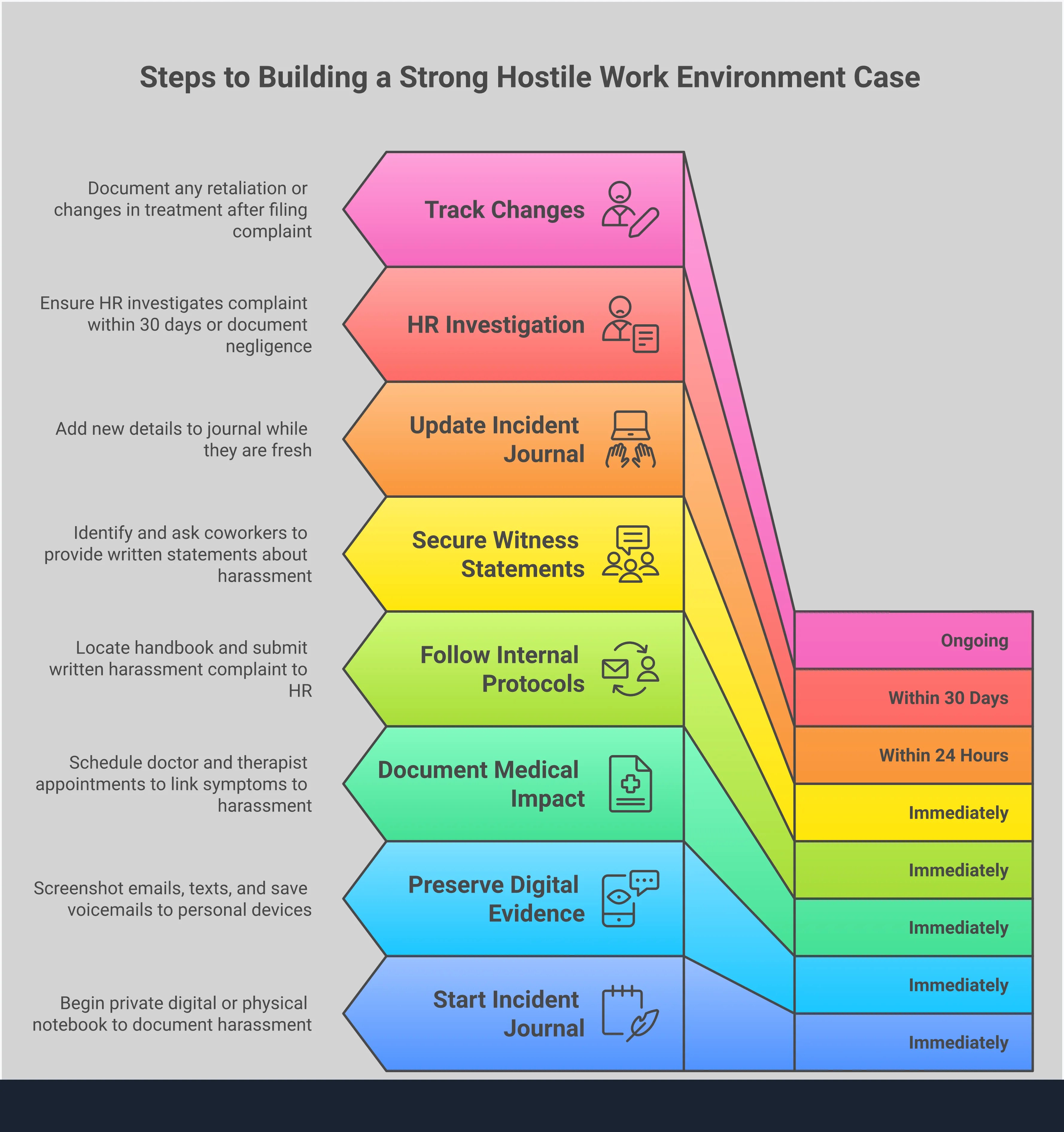
To build a compelling case, you need concrete proof. Start by keeping a detailed log of every incident: note the dates, times, locations, what was said, and who was present. This journal creates a clear timeline and shows a pattern of behavior. It’s also vital to document the impact the harassment has had on you. This includes medical records from therapy or doctor’s visits for stress-related symptoms. These documents connect the hostile actions to tangible damages, which is essential for a successful hostile work environment claim.
The Importance of Witness Testimony and HR Records
Your personal account is powerful, but having others back it up can make your case undeniable. Think about coworkers who witnessed the harassment or experienced similar behavior. Their statements can corroborate your story and show the problem is widespread. Ask trusted colleagues if they would be willing to support you. Additionally, your company’s HR records can be a goldmine. If you reported the behavior, that complaint and your employer’s response (or lack thereof) are critical pieces of proof. This shows they knew about the problem and failed to act.
Using Emails, Texts, and Other Digital Proof
In many cases, the most damning evidence comes in digital form. Save any inappropriate emails, text messages, voicemails, or images you receive, as this evidence is incredibly difficult for an employer to deny. Take screenshots and forward relevant emails to your personal account for safekeeping in case you lose access to work devices. This digital trail provides a clear, unchangeable record of the harassment. This kind of objective proof can significantly strengthen your position during negotiations and is a cornerstone of many successful employment law cases.
The Role of Emotional Distress in Your Settlement
When you’re dealing with a hostile work environment, the damage isn’t just financial. The constant stress, anxiety, and fear can take a serious toll on your mental and emotional well-being. The legal system recognizes this, which is why compensation for emotional distress is a critical part of most hostile work environment settlements. This isn’t just an add-on; it’s a core component that acknowledges the real psychological harm you’ve endured.
Settlement payouts are designed to make you whole again, and that includes addressing the non-economic damages you’ve suffered. Beyond covering lost wages or medical bills, these damages compensate for the pain and suffering caused by the harassment. Think of it as an acknowledgment of the anxiety, depression, or loss of professional self-worth you experienced. To build a strong case, your legal team will work to demonstrate the full scope of this impact, showing how the toxic workplace environment has affected your life both in and out of the office. Proving this harm is key to securing a fair settlement that truly reflects everything you’ve been through.
How to Prove Psychological Harm
Proving psychological harm requires more than just saying you were stressed. You need to build a case with solid evidence that connects your emotional distress directly to the harassment at work. Start by keeping a detailed journal of your experiences, noting specific incidents and how they made you feel. Witness testimony from colleagues who saw the harassment or noticed a change in your well-being can also be incredibly powerful. It’s also crucial to show that you reported the behavior and your employer failed to take meaningful action, as this demonstrates their negligence. An experienced employment lawyer can help you gather and organize this evidence effectively.
Why You Need Medical Documentation
Medical documentation is one of the most compelling pieces of evidence you can have when seeking damages for emotional distress. Records from a therapist, psychologist, or even your primary care doctor can provide a professional, objective assessment of your mental state. These records create a clear timeline, showing how your mental health has been affected since the harassment began. This documentation validates your claims of suffering from conditions like anxiety, depression, or insomnia. It transforms your personal experience into concrete evidence that is difficult for your employer’s legal team to dispute, significantly strengthening your case for fair compensation.
How Emotional Distress Damages Are Calculated
There isn’t a simple calculator for emotional distress. Instead, the value is determined by the severity and duration of the harm you’ve suffered. Your legal team will present a complete picture of your pain and suffering. This includes using your medical records, testimony from mental health experts, and statements from you, your family, and friends about changes in your behavior or personality. The goal is to show the full impact on your quality of life. At Bluestone Law, we carefully assemble this evidence to argue for a settlement amount that truly reflects the psychological trauma you have endured.
How Your Employer’s Actions Affect Negotiations
When you’re trying to reach a settlement for a hostile work environment claim, the focus isn’t just on what happened to you. How your employer behaved before, during, and after the harassment is just as important. Their actions, or lack thereof, can significantly influence the negotiation process and the final settlement amount.
An experienced attorney will look closely at the company’s conduct to build your case. Did they ignore your complaints? Do they have a history of similar issues? Is it a large corporation or a small business? The answers to these questions help shape the legal strategy and determine what a fair settlement looks like. Understanding these factors can give you a clearer picture of what to expect as you move forward.
The Company’s Response to Your Complaint
How your employer responds once you report harassment is a critical factor in your case. Legally, if a company knew or should have known about the harassment and did nothing to stop it, their liability increases. A weak or delayed response, a sham investigation, or outright ignoring your complaint can strengthen your position during negotiations. This is especially true if the harasser was a supervisor. An employer’s failure to take prompt and effective action demonstrates negligence, which can lead to a higher settlement value. It shows they didn’t take their responsibility to provide a safe and hostile-free work environment seriously.
A Company’s Financial Ability to Pay
The financial health of your employer plays a practical role in settlement negotiations. A large, profitable corporation generally has more resources to pay a significant settlement than a small, struggling business. While a company’s size doesn’t excuse illegal behavior, its ability to pay is a realistic consideration when determining a settlement amount. An attorney will assess the company’s financial standing to help set a reasonable target for negotiations. This ensures that the settlement demand is not only fair based on your damages but also achievable for the employer to pay. At our firm, we handle cases against companies of all sizes, tailoring our approach to each unique situation.
A Pattern of Previous Harassment Claims
A company with a history of similar harassment or discrimination complaints is in a much weaker negotiating position. A pattern of past incidents suggests a systemic problem within the company culture, not just a one-time issue with a single employee. This history can be used as powerful evidence to show that the company was aware of ongoing issues but failed to implement effective changes. Evidence of previous claims can significantly increase the pressure on an employer to settle for a higher amount. They will likely want to avoid a public trial that could expose a toxic work culture and lead to even greater damages, including punitive ones for repeated discriminatory practices.
What to Expect from the Settlement Process
If you’re considering legal action for a hostile work environment, you might be picturing a dramatic courtroom battle. The reality is usually quite different. Understanding the settlement process can help you feel more prepared for the road ahead and know what to expect as you work with your attorney to resolve your claim.
Settling Out of Court vs. Going to Trial
Most hostile work environment cases are resolved through a settlement, which is a formal agreement reached between you and your employer without going to trial. There are good reasons for this. Settling is typically much faster, less expensive, and less stressful than a public trial. For many employees, it provides closure and allows them to move forward sooner.
Employers also have strong incentives to settle. A public lawsuit can damage a company’s reputation and morale. By settling, they can resolve the matter privately and avoid the uncertainty and high costs of a court case. This mutual interest in avoiding a trial is why the vast majority of claims are negotiated and settled out of court.
The Negotiation Timeline and What It Involves
Building a strong case takes time, so it’s important to be patient. The legal process involves gathering evidence, interviewing witnesses, and filing official paperwork, which can take several months to more than a year. Before you can even file a lawsuit, you typically need to file a formal complaint with a government agency like the U.S. Equal Employment Opportunity Commission (EEOC) or California’s Civil Rights Department (CRD).
Once your attorney has built your case, they will begin negotiations with your employer. This involves presenting the evidence and making a demand for compensation. Your employer will respond, and there may be a period of back-and-forth negotiation before an agreement is reached. An experienced employment law attorney will guide you through every step.
Understanding Confidentiality Agreements
One key difference between a court verdict and a settlement is privacy. Court proceedings are public record, but settlements are private agreements. To maintain this privacy, nearly all settlement agreements include a confidentiality clause, sometimes called a non-disclosure agreement (NDA). This clause legally prevents you and your employer from discussing the details or the amount of the settlement.
While you may not be able to share the specifics, a settlement can include other important terms beyond financial compensation. For example, your attorney can negotiate for a neutral letter of reference from your former employer. This can be incredibly helpful as you search for a new job, especially if you experienced a wrongful termination connected to the harassment.
First Steps to Take if You’re Facing Harassment
When you’re dealing with harassment at work, it’s easy to feel powerless and unsure of what to do next. But taking a few strategic steps right away can protect your rights and build a strong foundation for any action you may take later. Think of these actions as your first line of defense. They help you regain a sense of control by creating a clear, factual record of what you’ve experienced.
Document Everything Immediately
This is your most important tool. Start a private journal, either in a notebook or a personal digital file that isn’t on a work device. For every incident, write down the date, time, and location. Describe exactly what happened and what was said. Note who was there and if anyone else saw or heard the incident. It’s also helpful to record how the event made you feel. Be as detailed as possible. Save any physical evidence you have, like inappropriate emails, text messages, photos, or voicemails. This detailed log is the evidence that can support your claim for a hostile work environment.
Follow Internal Reporting Procedures
Your company likely has a specific process for reporting harassment, which you can usually find in the employee handbook. Follow it. This typically means reporting the behavior to your supervisor or the Human Resources department. It’s best to make your report in writing, such as through an email, so you have a time-stamped record. This officially notifies your employer of the problem and gives them a legal opportunity to address it. Keep a copy of your complaint and any response you receive. Pay close attention to how you are treated after making the report, as any negative change could be a form of illegal retaliation.
Know When to Contact an Employment Lawyer
You don’t have to wait until you’ve exhausted every internal option to seek legal advice. In fact, speaking with an employment lawyer early in the process can be incredibly helpful. A lawyer can explain your rights, help you understand if the behavior you’re experiencing qualifies as illegal harassment, and guide you on how to best proceed with internal reporting and evidence gathering. Getting professional advice ensures you are taking the right steps to protect yourself and your potential case. An initial consultation can provide clarity and a strategic plan, giving you the confidence to handle the situation effectively.
Common Myths About Settlement Amounts
When you’re dealing with a toxic workplace, it’s easy to get caught up in stories you hear about huge lawsuit payouts. But the reality of settlement negotiations is often more complex. Let’s clear up a few common misconceptions about what you can expect.
Myth: There Are Fixed Settlement Values
One of the biggest myths is that there’s a standard payout for a hostile work environment claim. In reality, there’s no magic number. While some cases might settle for around $75,000, others involving severe, long-term misconduct can exceed a million dollars. The final amount depends entirely on the unique details of your situation. Factors like the strength of your evidence, the size of the company, and the extent of your emotional distress all play a significant role in determining the value of your case. It’s less about an “average” and more about what’s fair for your specific experience.
Myth: You Can Win with Unrealistic Expectations
It’s natural to hope for the best possible outcome, but walking into negotiations with unrealistic expectations can be counterproductive. Every case is different, and a settlement amount is built on facts, not feelings. The value of your claim is directly tied to how severe and prolonged the harassment was, how your employer reacted (or failed to react), and how well you’ve documented everything. A strong case isn’t just about what happened; it’s about what you can prove happened. This is why working with an experienced employment lawyer is so important to ground your expectations in legal reality.
Myth: You Need to Understand Legal Fees on Your Own
The thought of paying for a lawyer can be intimidating, causing many people to hesitate before seeking help. But you don’t have to figure it out alone, and you likely won’t have to pay anything upfront. Many employment law firms, including Our Firm, operate on a contingency fee basis. This simply means we only get paid if you win your case, either through a settlement or a court verdict. Our fee is a percentage of the amount we recover for you. This approach ensures that everyone has access to justice, regardless of their financial situation.
Related Articles
- Hostile Work Environment Lawsuit: Settlement Amounts
- What Makes Hostile Work Environment Cases Successful?
- How a CA Hostile Work Environment Lawyer Can Help You
- How to Report a Hostile Work Environment Step-by-Step
Frequently Asked Questions
What’s the difference between a difficult boss and an illegal hostile work environment? This is a really important distinction. A manager who is demanding, micromanages, or is just generally unpleasant to work for isn’t necessarily breaking the law. For behavior to cross the line into a legally hostile environment, it must be connected to a protected characteristic. This means the mistreatment is happening because of your race, gender, age, disability, religion, or another protected status. The hostility must be severe or pervasive enough to make your job intolerable, but that link to discrimination is what makes it illegal.
What if I don’t have ‘hard’ evidence like emails or texts? While digital proof is certainly helpful, it is not the only type of evidence that matters. One of the most powerful tools you have is your own detailed record-keeping. A consistent journal where you document every incident, including dates, times, what was said, and who was present, can be incredibly compelling. Additionally, testimony from coworkers who witnessed the harassment can be invaluable for corroborating your story. A strong case is often built from many different pieces of information, not just a single smoking gun.
Do I have to quit my job before I can file a claim? Absolutely not. You have the right to a safe workplace, and you can take action to address harassment while you are still employed. In fact, the first step is often to report the behavior internally according to your company’s policies. If your employer takes negative action against you for reporting the issue, such as demoting you or cutting your hours, that is illegal retaliation and can become part of your legal claim.
How long does a hostile work environment case usually take to resolve? It’s important to set realistic expectations. These cases are not resolved overnight. The process involves a thorough investigation, gathering evidence, filing complaints with the appropriate government agencies, and engaging in negotiations with your employer. This can take anywhere from several months to over a year. While it requires patience, following the proper legal process is essential to building a strong case and achieving a fair resolution.
What if I reported the harassment to HR and they didn’t do anything? An employer’s failure to act can actually strengthen your case. Companies have a legal obligation to investigate complaints and take reasonable steps to stop harassing behavior. When you report an issue and your employer ignores it, conducts a sham investigation, or fails to resolve the problem, it demonstrates their negligence. This inaction significantly increases their liability and shows they did not fulfill their duty to protect you.
Think you were wrongfully terminated?
Get a free, confidential case evaluation from our experienced employment law attorneys.
Request Your Free Consultation