
When people think of workplace retaliation, they often picture a dramatic firing scene right after an employee files a complaint. The truth is, retaliation is frequently much more subtle and insidious. It can be a sudden negative performance review after years of positive feedback, being excluded from important meetings you always attended, or a transfer to a less desirable shift. These actions are often designed to make your work life so difficult that you feel you have no choice but to quit. This kind of retaliation after reporting harassment for San Diego County employees is against the law, and recognizing it is key. Here, we’ll break down the various forms retaliation can take so you can identify it, document it, and understand your rights.
Key Takeaways
- Retaliation is more than just being fired: It can include any negative action that punishes you for speaking up, such as sudden poor performance reviews, being excluded from projects, or getting passed over for promotions.
- Document everything to build your case: Your strongest tool is a detailed record. Note every incident with dates, times, and witnesses, and save all related emails or messages in a personal, secure place.
- Know your rights and when to get help: California and federal laws offer powerful protections against retaliation. If you suspect you’re a target, consulting an employment attorney can clarify your options and help you take the right next steps.
What Counts as Retaliation After Reporting Harassment?
It takes courage to report harassment at work. The last thing you should face is punishment for speaking up. Unfortunately, some employers react by penalizing the very employee who raised the concern. This is called retaliation, and it’s illegal. Understanding what retaliation looks like is the first step toward protecting yourself. It isn’t always as obvious as getting fired. It can be subtle, designed to make your work life so difficult that you decide to quit. Knowing your rights can help you identify when your employer has crossed the line from managing their business to unlawfully punishing you.
Defining workplace retaliation
In simple terms, workplace retaliation happens when your employer punishes you for doing something the law protects, like reporting harassment. It’s any negative action that would deter a reasonable employee from making a complaint or supporting one. The punishment could be a demotion, a pay cut, or even a transfer to a less desirable shift. The key is the connection between your protected action (like filing a report) and the employer’s negative reaction. If your boss starts treating you poorly right after you speak to HR about harassment, you may be a victim of retaliation at work.
Common examples of retaliatory actions
Retaliation can take many forms, ranging from obvious to subtle. The most blatant examples include being fired, demoted, or having your salary reduced. However, many retaliatory actions are less direct. Your employer might suddenly give you an unfair negative performance review, change your job duties to something less desirable, or reassign you to a remote location. It can also manifest as social punishment, such as being excluded from important meetings, ignored by management, or subjected to increased scrutiny that your colleagues don’t face. These actions can create a hostile work environment intended to push you out.
Understanding your legally protected activities
The law protects your right to a safe and fair workplace. This means you are legally shielded when you engage in certain “protected activities.” Reporting sexual harassment or any form of discrimination is a classic example. Other protected activities include participating in a workplace investigation (whether it’s your complaint or someone else’s), talking to a supervisor about discriminatory behavior, or requesting reasonable accommodations for a disability. California’s Fair Employment and Housing Act (FEHA) makes it illegal for an employer to punish you for taking any of these steps. Essentially, you cannot be penalized for exercising your employment law rights.
What Laws Protect You From Retaliation in San Diego County?
If you’ve spoken up about harassment at work, you might worry about what comes next. The good news is that you’re not alone, and powerful laws are in place to protect you. Both California and the federal government have established strong anti-retaliation statutes. Understanding these laws is the first step toward safeguarding your career and holding your employer accountable for any illegal actions they take against you.
Protections under California’s FEHA
California provides some of the strongest employee protections in the country, primarily through the Fair Employment and Housing Act (FEHA). This state law makes it illegal for an employer to punish you for engaging in legally protected activities. This includes reporting harassment or discrimination, participating in an investigation, or even just opposing practices you reasonably believe are unlawful. FEHA ensures you can speak up about misconduct without fearing that your employer will demote you, cut your hours, or fire you as a result. It’s a critical shield that allows you to defend your rights and contribute to a safer workplace for everyone.
How federal laws shield you
In addition to California’s FEHA, federal laws offer another layer of defense against retaliation. The most significant is Title VII of the Civil Rights Act of 1964, which applies to employers with 15 or more employees. Much like FEHA, Title VII prohibits employers from retaliating against employees who report, oppose, or participate in an investigation of discrimination or harassment. Other federal laws, like the Americans with Disabilities Act (ADA) and the Age Discrimination in Employment Act (ADEA), also have anti-retaliation provisions. This dual protection means you often have multiple avenues for seeking justice if you become a victim of retaliation at work.
Special protections for whistleblowers
California law offers specific and robust protections for whistleblowers. If you report illegal activity, fraud, or unsafe conditions, you are shielded from retaliation under laws like Labor Code Section 1102.5. This statute makes it illegal for an employer to punish an employee for disclosing information to a government agency or law enforcement about a violation of state or federal law. These whistleblowing laws are designed to encourage employees to expose wrongdoing that could harm the public or other workers. They ensure you can act as a responsible citizen without having to sacrifice your job or professional well-being.
How to Spot the Warning Signs of Retaliation
Retaliation isn’t always as dramatic as a sudden firing. Often, it’s a series of smaller, subtle actions designed to make your work life difficult and push you out. After you’ve spoken up about harassment or other illegal activities, it’s crucial to pay attention to how your employer’s behavior toward you changes. Trust your instincts; if something feels off, it probably is. Being aware of these patterns is the first step in protecting yourself and understanding if you’re a victim of retaliation at work. Recognizing these signs for what they are can help you decide on your next steps.
Sudden shifts in your work environment
One of the most common signs of retaliation is a sudden change in your day-to-day work life. You might notice that your manager, who was once friendly and supportive, is now cold, distant, or avoids speaking with you. You could be excluded from meetings you previously attended or left off important email chains. This can also extend to your colleagues, who may suddenly start giving you the cold shoulder. These actions are often intended to isolate you and can contribute to a hostile work environment, making you feel unwelcome and unsupported in a place where you once felt comfortable.
Unfair criticism of your performance
Did you have a great track record and stellar performance reviews right up until you filed a complaint? If you’re now facing constant, unfounded criticism, it could be a form of retaliation. This might look like a sudden negative performance review with no concrete examples or constructive feedback. Your work might be scrutinized in ways it never was before, with minor mistakes being blown out of proportion. This is often a tactic used to create a paper trail to justify demotion, denial of a raise, or even a wrongful termination. A sudden shift from positive to negative feedback without a real change in your work quality is a major red flag.
Being excluded or socially isolated
Retaliation can also take the form of social exclusion. Your employer might move your desk to an isolated part of the office, away from your team. You could be deliberately left out of team lunches, social events, or even work-related conversations. In some cases, this can escalate to targeted jokes or public comments meant to embarrass you. The goal is to make you feel like an outsider and create an environment so uncomfortable that you feel pressured to quit. This type of social isolation is a clear tactic to punish you for speaking up and can be incredibly damaging to your mental well-being.
Getting passed over for promotions or raises
Another tangible sign of retaliation is being denied opportunities for advancement that you have clearly earned. If you were on track for a promotion or a raise and are suddenly passed over for a less-qualified colleague, you should question the reason why. This can also include being denied access to training or special projects that would help you grow in your career. When you are blocked from professional growth shortly after engaging in a protected activity, it can be a strong indicator that your employer’s decision is retaliatory and potentially a form of discrimination.
What to Do If You Suspect Retaliation
Feeling like you’re being punished for speaking up is incredibly stressful, but you don’t have to go through it alone. Taking clear, deliberate steps can protect you and build a strong foundation if you decide to take legal action. If your gut tells you something is wrong, it’s time to be proactive. Here’s what you can do to handle the situation effectively.
Document every incident in detail
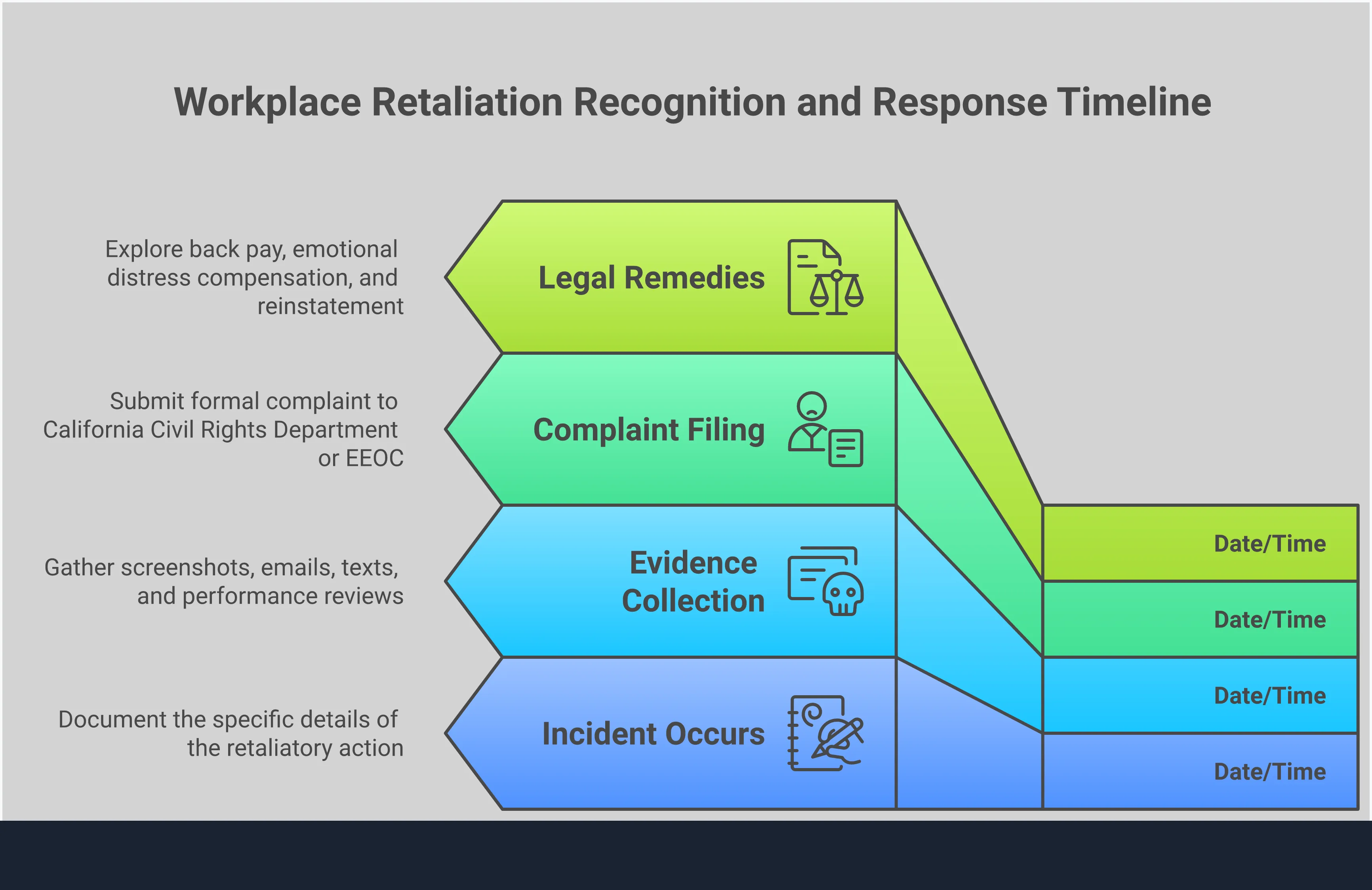
Your memory is powerful, but a written record is undeniable. Start keeping a detailed log of every incident that feels retaliatory. For each entry, note the date, time, location, and who was involved. Write down exactly what was said or done and include the names of any witnesses. This isn’t just about major events; even small slights or comments can form a pattern. Keep records of all relevant communications, including emails, text messages, and internal memos. A clear timeline of what happened before and after you reported the initial issue can be one of the most crucial pieces of your case.
Preserve key evidence and communications
Strong evidence is essential for proving a retaliation claim. Beyond your personal notes, gather any physical or digital proof you can safely access. This includes copies of your performance reviews (especially ones from before and after your complaint), emails from your manager, or any written directives that seem unfair. If you have a trusted coworker who witnessed the behavior, their account could also be valuable. Proving you are a victim of retaliation at work often depends on this documentation. Make sure to save these documents in a secure, personal place outside of your work computer or accounts, like a personal email address or cloud drive.
Follow internal reporting procedures (if safe)
Many companies have internal procedures for resolving workplace disputes, often through a human resources department. If you feel safe doing so, consider using these channels. Reporting the retaliation internally shows that you made a good-faith effort to resolve the issue. However, you should use your judgment here. If the person you are supposed to report to is the one retaliating, or if you have reason to believe HR will not handle your complaint fairly, this step may not be in your best interest. Your safety and well-being come first, so don’t feel pressured to report internally if it feels unsafe.
Know when to seek legal help
You don’t have to wait for the situation to become unbearable before talking to a professional. If you believe you are experiencing retaliation, contacting an experienced employment law attorney can provide clarity and support. A lawyer can help you understand your rights, evaluate the strength of your case, and explain your options. Many employment lawyers offer free initial consultations and work on a contingency basis, which means they only get paid if you win your case. Getting expert advice early on can make a significant difference in the outcome.
How to File a Formal Retaliation Complaint
If reporting retaliation internally hasn’t worked or you don’t feel safe doing so, your next move is to file a formal complaint with a state or federal agency. This step makes your complaint an official record and starts a formal investigation process. It’s a significant step toward holding your employer accountable and protecting your rights. While it might seem daunting, understanding the process can make it much more manageable.
Filing with California’s Civil Rights Department (CRD)
For employees in California, the Civil Rights Department (CRD) is the state agency that enforces laws against workplace retaliation. You can start the process by filing a complaint on the CRD website, but you must act within three years of the retaliatory incident. When you file, be ready to provide all your supporting documents to build a strong case. This is how you can formally hold your employer accountable when you’ve been the victim of retaliation at work.
Filing with the federal EEOC
You also have rights under federal law, which are enforced by the U.S. Equal Employment Opportunity Commission (EEOC). If your employer’s actions violate federal statutes, you can file a charge with the EEOC. The deadline is shorter here, usually 300 days from the incident. Thankfully, you don’t need to file twice. The CRD and EEOC have a work-sharing agreement, so you can request to have your complaint “cross-filed” with both agencies at once, which is a huge time-saver.
Don’t miss the strict deadlines
Timing is critical when filing a retaliation complaint. State and federal laws have strict deadlines, known as statutes of limitations. For California claims with the CRD, you generally have three years. For federal claims with the EEOC, the window is much tighter at just 300 days. If you miss these deadlines, you could permanently lose your right to take legal action. This is why it’s so important to act quickly if you believe you’ve experienced retaliation or wrongful termination.
What documentation you’ll need
A strong retaliation claim depends on solid evidence. Before filing, collect every document that supports your case: emails, texts, performance reviews showing a sudden negative change, and other communications. Create a detailed timeline of events, starting from your initial report and noting every adverse action that followed. Witness statements from supportive colleagues can also be powerful. Your goal is to clearly connect your protected action to the hostile work environment or unfair treatment you faced afterward.
What to Expect During the Investigation Process
Once you file a formal complaint, the official investigation process begins. This can feel like a waiting game, and it’s easy to get anxious when you don’t know what’s happening behind the scenes. But understanding the steps involved can help you feel more prepared and less stressed. The investigating agency, whether it’s a state or federal body, will act as a neutral fact-finder. They will gather evidence from both you and your employer to determine if illegal retaliation occurred.
This process is your opportunity to have your story heard by an impartial party. While it requires patience, it’s a critical step toward holding your employer accountable. Having an experienced attorney guide you through the investigation can make a significant difference, ensuring your rights are protected every step of the way. They can help you communicate with investigators and present your evidence clearly.
The typical investigation timeline
This is where you’ll need to be patient. Investigations by government agencies like California’s Civil Rights Department (CRD) or the federal Equal Employment Opportunity Commission (EEOC) are thorough, but they aren’t fast. It can easily take several months, and sometimes over a year, for an investigation to be completed.
After you file, the agency will notify your employer of the complaint. An investigator will then be assigned to your case. They will likely request documents from your employer, such as your personnel file and performance reviews, and may interview you, your colleagues, and your managers. Throughout this period, it’s a good idea to check in with your investigator periodically for updates, but understand that progress can be slow.
Your rights and responsibilities
First and foremost, you have the right to participate in an investigation without being punished for it. The law is very clear: your employer cannot legally take any adverse action against you for cooperating with investigators or providing truthful information about workplace harassment. This protection is central to ensuring that employees feel safe coming forward. You also have the right to be represented by an attorney who can speak on your behalf.
Your main responsibility is to be honest and cooperative. Provide the investigator with the detailed documentation you’ve been keeping and answer all questions truthfully. Being organized and clear with your information will help the investigator understand your case. Responding promptly to their requests will also help keep the process moving forward as smoothly as possible.
Potential outcomes and remedies
At the end of the investigation, the agency will issue its findings. If they find sufficient evidence of retaliation, they may try to facilitate a settlement between you and your employer. If a settlement can’t be reached, the agency might decide to file a lawsuit on your behalf or issue a “right-to-sue” letter, which gives you the green light to pursue a private lawsuit.
If your case is successful, either through a settlement or a court verdict, you may be entitled to various remedies. These can include recovering lost wages and benefits, compensation for emotional distress, and reimbursement for legal fees. In some cases, a wrongful termination can be reversed through reinstatement to your job. The goal is to make you “whole” again, as if the retaliation never happened.
What Can You Recover in a Retaliation Case?
If you can prove that your employer retaliated against you for exercising your legal rights, the law provides ways to compensate you for the harm you’ve experienced. These remedies are meant to restore you to the financial and professional position you would have been in if the illegal action had never happened. The specific compensation, often called “damages,” depends on the unique facts of your case. It can include recovery for financial losses, emotional harm, and even changes to your workplace. Let’s break down the most common types of relief you can pursue in a successful retaliation claim.
Lost wages and benefits
One of the most direct impacts of retaliation is financial. If you were fired, demoted, or had your hours cut, you can seek to recover the income you lost. This is known as “back pay,” and it covers everything from your salary and bonuses to commissions you would have earned. It also includes the value of lost benefits, like health insurance coverage, paid time off, and retirement contributions. If you were forced to find a new job, you may also be compensated for the costs of your job search. The goal is to make you financially whole for the period you were unfairly impacted by your employer’s wage and hour violations.
Compensation for emotional distress
Workplace retaliation doesn’t just affect your wallet; it can take a serious toll on your mental and emotional well-being. Facing a hostile work environment, unfair discipline, or wrongful termination can cause significant stress, anxiety, humiliation, and sleepless nights. California law recognizes this as a real injury. You can be awarded damages for this emotional distress and suffering. While no amount of money can erase the experience, this compensation is intended to acknowledge the personal harm you endured and provide a sense of justice for the intangible, yet very real, damage to your mental health and reputation.
Getting your job back and other solutions
Sometimes, the goal is not just about money. In some cases, you can ask for your job back through a remedy called “reinstatement.” However, returning to a place where you were mistreated isn’t always the best or most practical solution. There are other non-monetary remedies available. For example, a court can order your employer to remove negative performance reviews from your file, provide you with a neutral job reference, or even require managers to undergo anti-retaliation training. These solutions can help repair your professional standing and prevent similar retaliation from happening to others in the future.
Covering your attorney’s fees and costs
The thought of paying for a lawyer can be intimidating, but you shouldn’t let it stop you from seeking justice. In California, employment laws are designed to protect employees. If you win your retaliation case, the law often requires your employer to pay your reasonable attorney’s fees and legal costs. This “fee-shifting” provision makes it possible for you to stand up to a company with far more resources. It levels the playing field, ensuring that you can afford high-quality legal representation from our firm to protect your rights without having to bear the financial burden of litigation yourself.
How Bluestone Law Can Help You Fight Back
Facing retaliation after you’ve already done the right thing by reporting harassment can feel incredibly isolating and unfair. But you don’t have to face it alone. Having an experienced legal team on your side can make all the difference, providing clarity and a clear path forward. At Bluestone Law, we specialize in advocating for employees, and we’re here to help you stand up for your rights.
First, we’ll help you understand the strong legal protections you have. California laws, like the Fair Employment and Housing Act (FEHA), are specifically designed to shield employees from payback for reporting misconduct. We’ll sit down with you, listen to your story, and explain exactly how these laws apply to your situation. Our goal is to ensure you know you’re not just feeling wronged; you are legally protected as a victim of retaliation at work.
Building a strong retaliation case often comes down to connecting the dots. We can help you show the clear link between your report of a hostile work environment and the negative actions you’re now experiencing. To do this, we’ll work with you to establish three key things: that you engaged in a “protected activity” (like reporting harassment), that you suffered a “negative job action” (like being fired or demoted), and that one caused the other. We have the experience to identify the evidence that makes this connection undeniable.
Taking swift, strategic action is crucial. We guide you on what to do next, starting with documenting every single incident. Keeping detailed records of unfair treatment, saving emails, and noting conversations are vital steps in supporting your claim. We’ll help you organize this information and determine the best course of action, whether it’s using an internal complaint process or moving forward with a formal legal complaint. Our team at Bluestone Law will handle the legal complexities so you can focus on what matters most.
Related Articles
- Retaliation After Reporting Harassment: A Guide
- What Is Workplace Sexual Harassment? A Clear Guide
- Workplace Retaliation Lawyer: A Complete Guide
Frequently Asked Questions
What if the harassment I reported isn’t proven? Can I still be protected from retaliation? Yes, absolutely. The law protects you for making a complaint in “good faith,” which means you genuinely believed you were reporting something illegal. The protection isn’t based on whether your complaint is ultimately proven true. As long as you had a reasonable belief that you were opposing unlawful behavior, your employer cannot legally punish you for speaking up. The focus is on protecting your right to raise concerns without fear.
Is it still retaliation if the negative action happens months after my complaint? It can be. While retaliation is often easiest to prove when it happens immediately after your complaint, a significant delay doesn’t automatically mean you don’t have a case. An employer might wait, thinking it will hide their motive. We can still build a case by showing a pattern of behavior that started after your report or by using other evidence to connect the dots between your complaint and the negative action, no matter when it occurred.
What’s the difference between a manager being tough and actual retaliation? This is a great question because the line can feel blurry. A tough but fair manager holds everyone to the same high standard. Retaliation, however, is about a change in behavior directed specifically at you because you engaged in a protected activity. The key is the motive. If your once-supportive boss suddenly starts micromanaging you, giving you unfair reviews, or excluding you right after you spoke to HR, that behavior is likely not about performance; it’s about punishment.
I quit because the retaliation was so bad. Have I lost my right to file a claim? Not at all. In fact, this is a very common situation. When an employer makes your work environment so hostile or intolerable that any reasonable person would feel they had no choice but to resign, it’s known as “constructive termination.” The law treats this situation as if you were fired. You can still pursue a claim for wrongful termination and retaliation even though you were the one who officially submitted the resignation.
Do I have to report the retaliation to my company before I can contact a lawyer? No, you are not legally required to report the retaliation internally before seeking legal advice. While some situations might benefit from giving your employer a chance to fix the problem, it is not a prerequisite for taking legal action. If you don’t feel safe reporting it, or if you believe HR will not handle your complaint fairly, your best first step is to speak with an employment attorney to understand your rights and options.
Think you were wrongfully terminated?
Get a free, confidential case evaluation from our experienced employment law attorneys.
Request Your Free Consultation