
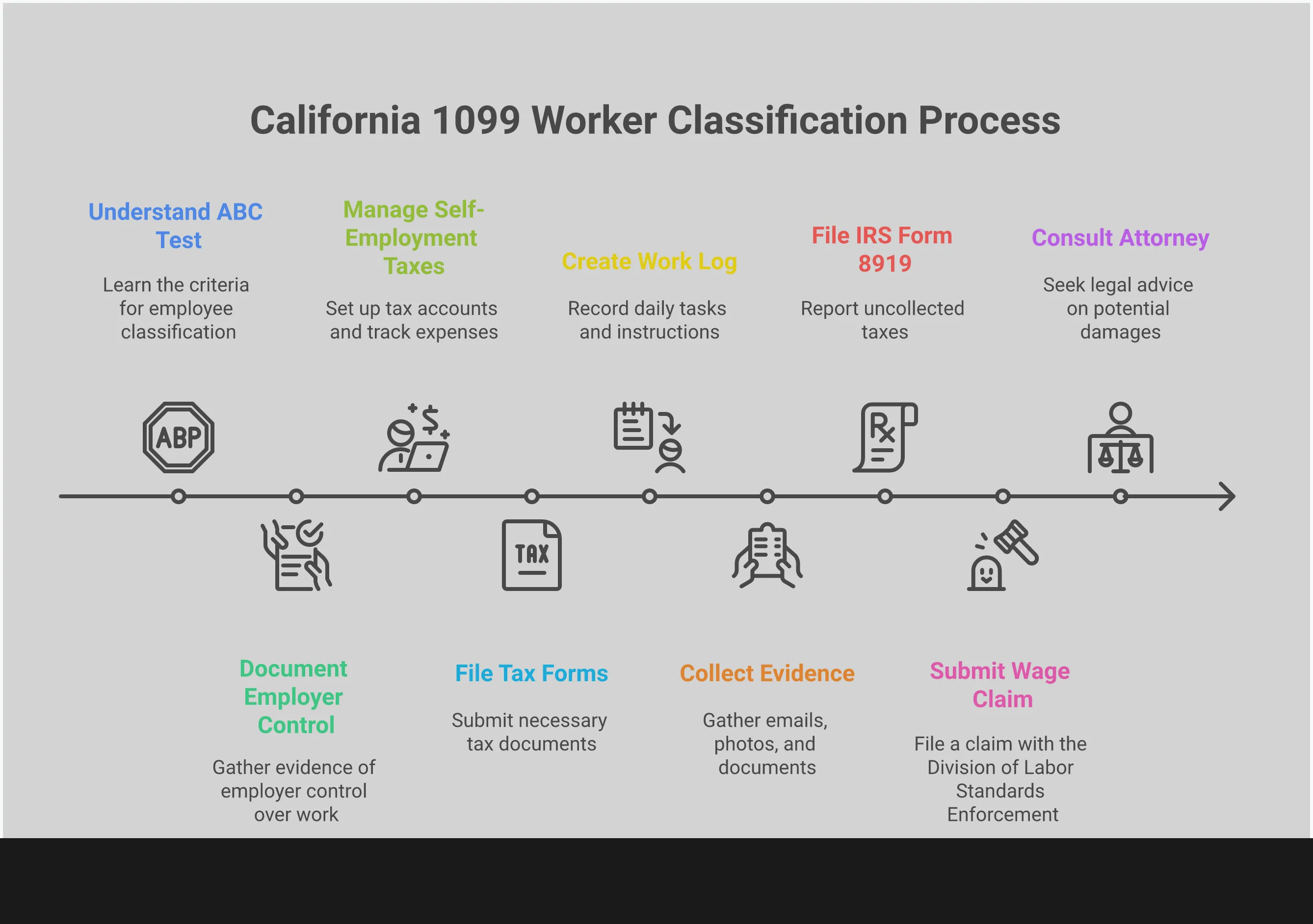
In California, your worker classification isn’t just a suggestion—it’s the law. The state has some of the strongest worker protection laws in the country, and it takes misclassification very seriously. Simply receiving a 1099 form doesn’t automatically make you an independent contractor, especially under California’s strict “ABC test.” This test presumes you are an employee unless the company can prove otherwise. If your work is part of the company’s core business and they control how you do your job, you are likely an employee entitled to full legal protections. Knowing what are the rules for 1099 employees in California is essential, as you may be entitled to back pay for overtime, meal breaks, and other benefits your employer illegally denied you.
Key Takeaways
- Your Work Reality Defines Your Status, Not Your Title: California law focuses on the level of control a company has over your work. If an employer dictates your hours, methods, and tasks, you are likely an employee entitled to legal protections, regardless of the tax form you receive.
- Classification Determines Your Paycheck and Protections: W-2 employees receive benefits, overtime pay, and automatic tax withholding. As a 1099 contractor, you are responsible for your own self-employment taxes, health insurance, and retirement, and you are not covered by most wage and hour laws.
- Misclassification Can Be Challenged: If you are treated like an employee but paid as a contractor, you may be entitled to back pay, benefits, and other damages. Recognizing the warning signs of misclassification is the first step toward protecting your rights and recovering what you are owed.
1099 Contractor vs. W-2 Employee: What’s the Difference?
Understanding your classification as a worker is more than just a label for your taxes—it defines your rights, benefits, and relationship with the company you work for. Whether you’re a 1099 independent contractor or a W-2 employee determines everything from how you’re paid to what legal protections you have. Many employers misclassify their employees as independent contractors to cut costs, leaving workers without critical benefits and legal safeguards.
If you believe your rights have been violated, our Wage & Hour Claims California team can help you understand your options and pursue your claim.
The core difference lies in the level of control a company has over the worker. An employee is on the company’s payroll, following its direction on how, when, and where to work. A contractor, on the other hand, operates their own business and is hired to provide a specific service. They have much more control over their work. Knowing where you fall is the first step in ensuring you receive the pay and protections you are legally owed. If your role feels like a regular job but you’re being paid like a contractor, it might be time to take a closer look at your classification.
How You’re Classified
At its simplest, a W-2 employee is part of the company. The employer dictates their schedule, provides the tools and equipment, and directs the work. In contrast, a 1099 contractor is an independent business owner. They are hired to complete a specific project or provide a service for a set period. They typically use their own tools, set their own hours, and have the freedom to work for multiple clients. The key isn’t what your contract calls you, but the reality of your working relationship. California law is very specific about this distinction, and simply being handed a 1099 form doesn’t automatically make you a contractor.
Who Handles Your Taxes
One of the most immediate differences you’ll notice is in your paycheck. For a W-2 employee, the employer withholds federal and state income taxes, Social Security, and Medicare from each check. For a 1099 contractor, the company pays you the full amount you’ve earned without any deductions. You are then responsible for calculating and paying your own taxes to the IRS and the state. This includes the “self-employment tax,” which covers your Social Security and Medicare contributions. This is a significant financial responsibility and often a source of confusion in wage and hour claims.
Your Access to Benefits and Protections
This is where the distinction matters most. W-2 employees are covered by a wide range of labor laws that provide crucial protections. They are entitled to minimum wage, overtime pay, and legally mandated meal and rest breaks. They also have access to employer-sponsored benefits like health insurance, paid sick leave, and retirement plans. Independent contractors, however, receive none of these. They are not protected by most employment laws, are not eligible for unemployment benefits, and must cover the cost of their own health insurance and time off. This lack of a safety net is a primary reason why fighting worker misclassification is so important.
How Is Your Worker Status Determined?
You might think your job title or the tax form you receive decides your worker status, but it’s not that simple. Your classification as an independent contractor or an employee depends on the reality of your working relationship with the company, not just the label they give you. Government agencies, like the IRS and California’s labor department, have specific tests to figure out who is truly an employee entitled to legal protections.
The core of their analysis comes down to one main question: who has the right to direct and control the work? If the company you work for dictates the details of how, when, and where you do your job, you are likely an employee, regardless of what your contract says. This distinction is critical because it affects everything from your tax obligations to your eligibility for benefits and protection under employment law. An employer can’t just call you a contractor to avoid paying overtime or providing meal breaks. The facts of your job matter more than the title. Understanding these factors is the first step in figuring out if you’ve been misclassified.
Who Controls How You Work?
The most significant factor is the degree of control the company has over your work. This is often called “behavioral control.” Ask yourself: Does the company tell you exactly how to do your job? If they provide detailed instructions, require you to attend specific training, or dictate the methods and processes you must use, that points toward an employee relationship. Other signs include set work hours, a requirement to work at the company’s location, or needing permission to work for other companies. A true independent contractor, on the other hand, typically has the freedom to decide how they will achieve the final result, using their own methods and working on their own schedule.
Who Controls the Financial Side?
Money matters, and how it’s handled is a big clue to your worker status. This is known as “financial control.” Consider who provides the tools, equipment, and supplies needed for the job. If the company provides them, you’re more likely an employee. Independent contractors usually use their own. Also, look at how you’re paid. Are you paid a regular salary or hourly wage? That’s typical for an employee. Contractors are often paid a flat fee per project. Another key point is whether you can realize a profit or loss. If your income is guaranteed and your business expenses are reimbursed, you have less financial risk, which is characteristic of an employee.
What Does Your Work Relationship Look Like?
The nature of your relationship with the company also provides important clues. Think about the permanence of the arrangement. Is the work relationship ongoing with no clear end date, or is it for a specific project or a limited time? An indefinite relationship suggests employment. You should also consider whether the work you do is a key aspect of the company’s regular business. If your role is integral to the company’s success, it’s harder to argue you’re just a temporary contractor. Finally, look for employee-style benefits. If the company provides you with things like health insurance, paid vacation, or a retirement plan, it’s a strong indicator that you are an employee, not a contractor.
The IRS’s Three-Factor Test
The IRS consolidates these ideas into a framework to help determine worker status. While there’s no single magic formula, they focus on three main categories of evidence. The first is Behavioral Control, which covers whether the company has the right to direct and control how you do your work. The second is Financial Control, which looks at who directs the business aspects of your job, like how you’re paid and who covers expenses. The third is the Type of Relationship, which examines how you and the company perceive your relationship, considering written contracts, benefits, and the permanence of the job. Answering the questions in these three areas gives a clear picture of your proper classification.
Your Tax Responsibilities as a 1099 Contractor
One of the biggest shifts when you move from a W-2 role to a 1099 contract is how you handle taxes. Instead of your employer withholding taxes from each paycheck, the responsibility falls entirely on you. It might sound intimidating, but once you understand the system, it becomes a manageable part of running your own business. Think of it as taking full control of your finances. You’ll need to be proactive about setting money aside and paying the government on a regular schedule, but you also get to take advantage of deductions that aren’t available to traditional employees. Let’s walk through what you need to know to stay on top of your tax obligations and avoid any surprises when tax season rolls around.
Understanding Self-Employment Tax
When you’re a W-2 employee, your employer pays half of your Social Security and Medicare taxes, and the other half is deducted from your paycheck. As an independent contractor, you’re responsible for paying both the employee and employer portions. This combined amount is called the self-employment tax, and the rate is currently 15.3% of your net earnings. It’s crucial to factor this into your budget. A good rule of thumb is to set aside 25% to 30% of every payment you receive to cover your federal and state income taxes, plus this self-employment tax. This way, you’ll have the funds ready when it’s time to pay.
Making Quarterly Estimated Tax Payments
Because no one is withholding taxes for you, you can’t just wait until April to pay a year’s worth of taxes in one lump sum. Instead, the IRS requires you to pay estimated taxes in four quarterly installments throughout the year. This applies to your income tax and your self-employment tax. You’ll need to make these payments to both the IRS for your federal taxes and to the California Franchise Tax Board for your state taxes. Staying on top of these deadlines is important, as failing to pay enough tax by the quarterly due dates can result in penalties, even if you’re due a refund when you file your annual return.
Keeping Records and Filing Your Return
Meticulous record-keeping is your best friend as a contractor. You should receive a Form 1099-NEC from any client who paid you $600 or more during the year. However, you are responsible for reporting all your income, whether you receive a 1099 form or not. Keep detailed records of every payment you receive. When it’s time to file your annual tax return, you’ll report your business income and expenses on a Schedule C (Form 1040), “Profit or Loss from Business.” The net profit from your Schedule C is then carried over to your personal tax return, Form 1040, to calculate the tax you owe.
Deducting Business Expenses
Here’s where being a contractor has some financial perks. You can deduct ordinary and necessary business expenses, which lowers your net income and, therefore, your tax bill. Common deductions include home office expenses, business-related mileage, software subscriptions, office supplies, and even health insurance premiums. Keeping detailed receipts and records for these expenses is essential. This documentation not only helps at tax time but also provides a clear picture of your business operations, which is crucial if you ever need to address issues around your classification or potential wage and overtime claims.
What Rights and Protections Do You Have as a 1099 Contractor?
When you work as a 1099 contractor, you trade the traditional safety net of employment for greater flexibility. This means you have far fewer legal protections than a W-2 employee. Your rights are not defined by federal and state labor laws, but primarily by the terms of your contract. Understanding this distinction is the first step in protecting your interests and ensuring you aren’t being taken advantage of. If your working arrangement feels more like a regular job than a freelance gig, it’s worth taking a closer look at your classification and the rights you might be missing out on.
Gaps in Labor Law Protection
One of the most significant differences for independent contractors is the lack of coverage under most major labor laws. As one guide puts it, “1099 workers are not covered by most labor laws, meaning no minimum wage or overtime pay guarantees.” This means you aren’t entitled to the state minimum wage for the hours you work. If a project takes you 60 hours in one week, you won’t receive time-and-a-half pay. These fundamental protections, which form the basis of wage and hour claims, simply don’t apply. Similarly, laws that protect against workplace discrimination and harassment are often written specifically for “employees,” leaving contractors in a vulnerable position if they face mistreatment.
Missing Out on Traditional Benefits
Beyond your paycheck, the benefits that often come with a W-2 position are absent for contractors. You won’t receive traditional job perks like paid vacation, sick days, or employer-sponsored health insurance. This also extends to crucial protections like paid leave. For instance, you aren’t covered by the Family and Medical Leave Act, which guarantees job-protected leave for qualifying family and medical reasons. As a contractor, you are responsible for funding your own time off, securing your own health insurance, and setting up your own retirement accounts. These costs should always be factored into the rate you charge for your services.
The Importance of Your Contract
Since labor laws don’t protect you, your contract becomes your single most important document. It’s the legally binding agreement that outlines the entire scope of your working relationship. That’s why it’s critical to “always have a written contract that explains what both sides expect.” A strong contract should clearly define the project deliverables, payment rates and schedule, deadlines, and who owns the final work product. It should also include terms for how either party can terminate the agreement. Without a detailed contract, you have little recourse if a client refuses to pay or keeps adding to the workload without increasing your compensation.
No Coverage for Workplace Injuries
If you get hurt while working, your client is generally not responsible. That’s because “independent contractors are not covered by the employer’s workers’ compensation insurance.” This system is designed to provide medical care and wage replacement to employees who suffer job-related injuries. As a contractor, you are on your own. You are responsible for your medical bills and will have to absorb any income lost while you recover. This is a significant financial risk, and it’s why many independent contractors purchase their own liability and disability insurance policies for protection. It’s also a major reason some companies misclassify employees—to avoid the cost of workers’ comp premiums.
The Consequences of Worker Misclassification
When a company misclassifies an employee as a 1099 independent contractor, it’s not just a simple paperwork mistake—it’s a serious issue with significant fallout. This practice allows employers to sidestep their legal obligations, leaving workers without critical protections and benefits. For you, it can mean losing out on overtime pay, health insurance, and unemployment benefits. For the employer, it can lead to severe financial and legal penalties. Understanding these consequences is the first step toward protecting your rights and ensuring you’re treated fairly under the law.
Penalties Employers Face
Employers who misclassify workers face steep consequences from both federal and state agencies. The IRS and the Department of Labor can impose significant penalties, including hefty fines and orders to pay back taxes. Beyond that, a company can be held liable for all the unpaid benefits and wages it should have provided. This includes covering the costs of back overtime pay, contributions to Social Security and Medicare, and unemployment insurance premiums. These financial hits can be substantial, making it a risky gamble for any business trying to cut corners. It underscores why wage and hour claims are taken so seriously.
Your Legal Options If You’re Misclassified
If you believe you’ve been wrongly classified as an independent contractor, you have options. You aren’t powerless in this situation. One of the first steps you can take is to report your income and the Social Security and Medicare taxes you believe your employer should have paid using IRS Form 8919. More importantly, you may be entitled to recover unpaid wages, benefits, and other damages. Speaking with an experienced attorney for wage and hour violations can help you understand the strength of your case and what you could be owed. Protecting your rights often starts with a single conversation to explore your legal options.
How the IRS Gets Involved
The IRS plays a key role in determining a worker’s official status. If a business is unsure how to classify someone, it can file Form SS-8, Determination of Worker Status for Purposes of Federal Employment Taxes and Income Tax Withholding. This asks the IRS to make an official ruling. As a worker, you can also file this form if you want the IRS to weigh in on your classification. An official determination from the IRS can be a powerful piece of evidence if you decide to pursue legal action to recover lost wages or challenge a wrongful termination that resulted from questioning your status.
California’s Enforcement Actions
California is known for having some of the strongest worker protection laws in the country, and it takes misclassification very seriously. The state has been particularly aggressive in enforcing its laws, especially since the passage of Assembly Bill 5 (AB5). This law established a stricter “ABC test” that makes it much harder for companies to classify workers as independent contractors. As a result, California agencies are actively investigating and penalizing businesses that don’t comply. This means that if you’re working in California, you have a strong legal framework supporting your right to be classified correctly under employment law.
What a Proper 1099 Arrangement Looks Like
A legitimate independent contractor relationship is built on clarity and autonomy. It’s about more than just how you’re paid; it’s about the nature of your entire working arrangement. When everything is above board, you’ll see specific practices that protect both you and the company you’re working with. These arrangements are defined by clear agreements, professional financial processes, and a genuine respect for your independence as a business owner.
A Clear, Written Contract Is Key
Every legitimate 1099 arrangement starts with a solid, written contract. This document is your roadmap, clearly defining the relationship from the outset. It should detail the specific scope of work, project deadlines, and your payment terms. Think of it as a business-to-business agreement, not an employment offer. A well-drafted contract establishes expectations and helps prevent misunderstandings down the line. It’s the foundation that confirms you are an independent professional providing a service, not an employee taking direction. Without this clarity, the lines can easily become blurred.
Proper Invoicing and Payment Practices
The way money changes hands is another telltale sign of a proper 1099 relationship. As a contractor, you should be submitting invoices for your work, whether it’s based on an hourly rate or a flat project fee. The company then pays that invoice without withholding taxes for Social Security, Medicare, or income tax—those are your responsibility. This clean, professional transaction reinforces your status as a separate business entity. If a company is handling your pay in a way that looks more like a standard employee payroll, it could be a sign of misclassification and may affect your wage and hour rights.
Your Independence Is Respected
The word “independent” is the most important part of “independent contractor.” A proper arrangement respects your autonomy. This means you control how and when you complete the work, as long as you meet the agreed-upon deadlines. You should be using your own tools, equipment, and workspace. The company is hiring you for your expertise and the final result, not to manage your day-to-day process. If a manager is dictating your work hours or micromanaging your methods, your role may be closer to that of an employee under California employment law.
Red Flags: When to Question Your Status
It’s crucial to recognize the warning signs of misclassification. A major red flag is when a company exerts significant control over how you perform your job, essentially treating you like a W-2 employee without the benefits. Be cautious if the company requires you to work on-site during specific hours, provides extensive training on their methods, or prevents you from working for other clients. These practices suggest an employer-employee dynamic. If your situation feels less like a partnership and more like direct supervision, it may be time to question your 1099 status and understand your rights.
Frequently Asked Questions
My contract says I’m an independent contractor, but my job feels like a regular employee role. Which one is it? The reality of your working relationship almost always matters more than what your contract says. California law and the IRS look at the amount of control a company has over your work. If your employer dictates your hours, tells you exactly how to do your job, and provides the tools you need, you are likely functioning as an employee. An employer can’t just use a 1099 label to get around their legal responsibilities.
What’s the first step I should take if I suspect I’m being misclassified? Start by documenting everything. Keep detailed records of your hours, your job duties, and any instructions or training you receive from the company. Note who provides your tools and equipment. Having a clear record of how much control the company exercises over your work is incredibly helpful. Once you have this information organized, speaking with an employment law attorney can help you understand your specific situation and what options you have.
Can I be penalized by the IRS if my employer has been misclassifying me? Generally, no. The legal and financial responsibility for proper worker classification falls on the employer, not the worker. If it’s determined you were misclassified, the employer is the one who will face penalties for things like unpaid payroll taxes. While you are responsible for the taxes on the income you received, there are specific IRS forms you can use to resolve the situation without being penalized for your employer’s mistake.
What are the biggest financial differences I should be aware of as a 1099 contractor? The two biggest financial shifts are taxes and the lack of a benefits safety net. As a contractor, you are responsible for paying the entire 15.3% self-employment tax for Social Security and Medicare, whereas employees split that cost with their employer. You also have to manage your own health insurance, retirement savings, and paid time off, which are significant costs that W-2 employees often have covered or subsidized by their company.
Why would a company misclassify an employee as a contractor? The primary reason is usually to cut costs and avoid legal obligations. By classifying a worker as a contractor, a company avoids paying for its share of payroll taxes, unemployment insurance, and workers’ compensation coverage. They also sidestep the legal requirement to provide benefits like minimum wage, overtime pay, meal and rest breaks, and paid sick leave, shifting significant financial burdens and risks onto the worker.
Related Articles
- Misclassification of Employees: Know Your Rights
- How to Report a Company to the Labor Board Anonymously
- Misclassified Employees Awarded $1.3 Million: Are You Owed?
Owed wages, overtime, or break pay?
California employers who underpay can owe back pay plus penalties. Get a free, confidential case review.
Request Your Free Consultation