
Facing punishment at work for taking care of your health or your family can feel like a deep betrayal. The FMLA was designed to prevent this very scenario, giving you job-protected leave when you need it most. When an employer breaks this promise, they break the law. You don’t have to accept it. Taking action is about more than just justice; it’s about recovering your financial stability and professional standing. This guide provides a roadmap for what to do next, from gathering evidence and filing a formal complaint to exploring your legal options for suing over FMLA violations and retaliation.
Key Takeaways
- Identify the type of violation: An FMLA violation can be subtle. Interference happens when your employer tries to stop you from taking leave, while retaliation is any punishment you receive after requesting or taking time off.
- Create a detailed evidence file: Your strongest tool is documentation. Immediately save all emails, performance reviews, and written leave requests, and keep a log of conversations to build a clear and factual timeline of events.
- Consult an attorney to prove pretext: Employers will offer excuses for their actions. An experienced lawyer is crucial for cutting through these pretexts, meeting strict legal deadlines, and fighting to recover everything you’ve lost, from wages to your job.
What Are Your Rights Under the FMLA?
When you’re dealing with a serious health issue or a major family event, the last thing you should have to worry about is losing your job. That’s where the Family and Medical Leave Act (FMLA) comes in. It’s a federal law designed to help you balance your work and family responsibilities by allowing you to take unpaid, job-protected leave for specific reasons.
If you believe your rights have been violated, our Family and Medical Leave Act team can help you understand your options and pursue your claim.
Related articles: How to Find a Lawyer for FMLA Retaliation | Can You Be Fired While FMLA is Pending? The Real Answer | 5. How FMLA Cases Are Won by Employees: A Guide
Understanding your rights is the first step toward protecting them. The FMLA provides a critical safety net, ensuring you don’t have to choose between your health—or your family’s health—and your paycheck. Let’s break down what the law covers, who is eligible, and how it protects you from unfair treatment.
What the FMLA Covers
At its core, the FMLA is about providing job security during critical life moments. According to the U.S. Department of Labor, “The Family and Medical Leave Act (FMLA) lets eligible workers take unpaid time off from work for certain family and medical reasons. When they come back, their job is protected, and they keep their health insurance.” This means you can take time off for events like the birth and care of a newborn child, the placement of a child for adoption or foster care, or to care for an immediate family member with a serious health condition. It also covers your own serious health condition if it makes you unable to perform your job. This family and medical leave is a right, not a privilege.
Are You Eligible for FMLA Leave?
Figuring out if you qualify for FMLA can feel complicated, but it comes down to a few key requirements. To be eligible, you must meet three specific criteria. First, you need to work for a covered employer, which includes public agencies, schools, and private-sector employers with 50 or more employees. Second, you must have worked for that employer for at least 12 months—they don’t have to be consecutive. Finally, you must have worked at least 1,250 hours for that employer during the 12 months immediately before your leave starts. If you check all three of these boxes, you are likely eligible to take FMLA leave and receive its protections.
How Your Job and Benefits Are Protected
The FMLA does more than just grant you time off; it protects you from being penalized for taking it. Your employer cannot use your FMLA leave as a negative factor in any employment action, such as hiring, promotions, or disciplinary decisions. As the Department of Labor states, “Employers cannot treat you unfairly, punish you, or fire you for taking FMLA leave or for speaking up about FMLA issues.” This protection is crucial. It means your employer is prohibited from engaging in retaliation against you for exercising your rights. When you return from leave, you must be restored to your original job or an equivalent one with the same pay, benefits, and other terms and conditions of employment.
Did Your Employer Violate Your FMLA Rights?
Knowing you have rights under the FMLA is the first step, but spotting a violation isn’t always straightforward. An employer’s illegal actions can be obvious, like firing you for taking leave, but they can also be much more subtle. Sometimes, it’s a manager making discouraging comments or a sudden negative performance review right after you return to work. These actions can make you feel uncertain and question whether you’re just being sensitive or if something is genuinely wrong.
Generally, FMLA violations fall into two main categories: interference and retaliation. Interference happens when your employer prevents or discourages you from exercising your right to take family and medical leave. This could be anything from denying a valid request to creating so many hurdles that you give up trying. Retaliation, on the other hand, is when your employer punishes you for having requested or taken that leave. Understanding the difference can help you identify what’s happening and figure out your next steps. If something feels off, it’s worth paying close attention to the details.
Common FMLA Violations to Watch For
Violations can take many forms, and they often hide in plain sight. Your employer might not explicitly say, “I’m firing you for taking leave,” but their actions can send the same message. It’s important to recognize the red flags that suggest your rights are being ignored.
Here are some common ways employers violate the FMLA:
- Denying your request for FMLA leave even though you are eligible and have a qualifying reason.
- Discouraging you or making threats to prevent you from taking leave.
- Failing to inform you of your FMLA rights.
- Stopping your health insurance benefits while you are on approved leave.
- Requiring you to do work while you are on leave.
- Demoting you or firing you after you request or take FMLA leave.
How to Spot FMLA Retaliation
The FMLA makes it illegal for your employer to punish you for using your protected leave. If you face any negative consequences at work after requesting or taking time off, you may be a victim of retaliation. This can include being demoted, receiving a poor performance review, being excluded from important projects, or even being fired.
Employers will rarely admit their true motives. Instead, they might offer a seemingly legitimate reason for their decision, like “budget cuts” or “performance issues.” This is known as pretext—a false reason given to hide the real, illegal one. The key is timing. If the negative action happens shortly after you exercise your FMLA rights, it could be a strong indicator of retaliation.
Understanding Interference vs. Retaliation
While they sound similar, interference and retaliation are two distinct types of FMLA violations. Think of it this way: interference is about putting up roadblocks, while retaliation is about punishment.
Interference is any action your employer takes to stop you from using your FMLA leave in the first place. This includes denying a valid request, delaying approval without reason, or creating a hostile environment that discourages you from taking time off.
Retaliation happens after you’ve already requested or taken leave. It’s any adverse action your employer takes against you because you exercised your rights. If you were fired, demoted, or disciplined shortly after returning from leave, you may have a retaliation claim, which could also be a form of wrongful termination.
What to Do If Your FMLA Rights Are Violated
Realizing your employer may have violated your rights can be incredibly stressful and confusing. You took legally protected leave, and now you’re facing demotion, termination, or another form of punishment. It’s easy to feel powerless, but you have options. Taking the right steps can protect you and help you build a strong case if you decide to take legal action.
The key is to act methodically. You need to create a clear record of what happened and follow the proper channels to address the violation. This process not only helps you organize your thoughts and evidence but also shows that you made a good-faith effort to resolve the issue. If your employer refuses to correct their mistake, you’ll be in a much better position to hold them accountable. Here are the four essential steps to take if you believe your employer has violated your FMLA rights.
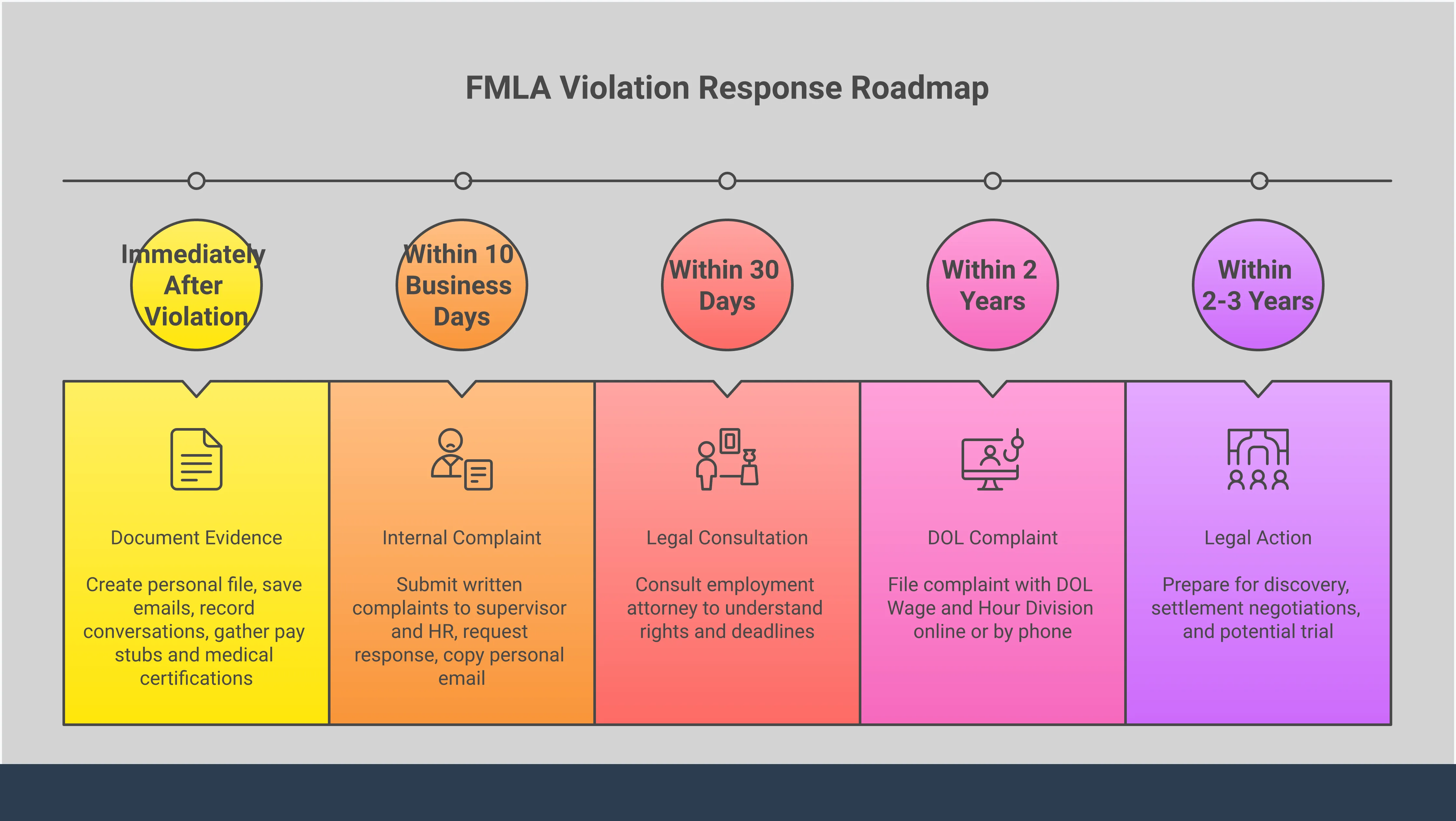
Document Everything Immediately
Your memory is powerful, but a written record is undeniable. Start documenting every detail related to your FMLA leave and the potential violation right away. To build a successful case, you’ll need proof that you were eligible for leave, your reason was covered, you followed company procedures, and your employer broke the law. Create a timeline of events, including the dates you requested and took leave, who you spoke with, and what was said.
Save every email, text message, and official letter about your leave. If you have conversations in person or on the phone, send a follow-up email summarizing the discussion to create a paper trail. Keep copies of your performance reviews, especially if your ratings suddenly dropped after you requested leave. Store these documents in a personal file, not on a work computer or device. This record is the foundation of any action you might take for retaliation or wrongful termination.
Report the Violation to Your Employer
Before escalating the issue, it’s often wise to report the violation internally. Sometimes, an FMLA violation is the result of a simple mistake or a manager’s misunderstanding of the law. Giving your employer a chance to fix the problem can sometimes lead to a quick resolution. Put your complaint in writing and send it to your direct supervisor and the Human Resources department.
In your email or letter, clearly and professionally state the facts. Explain that you believe your rights under the Family and Medical Leave Act were violated and describe the specific action that occurred (e.g., you were demoted, your job was given away, or you were denied reinstatement). Referencing specific dates and conversations from your documentation will make your complaint stronger. This step either resolves the issue or provides more evidence that your employer was aware of the problem and chose not to act.
File a Complaint with the Department of Labor
If reporting the issue internally doesn’t work, your next step is to file a formal complaint. The U.S. Department of Labor’s (DOL) Wage and Hour Division is the federal agency responsible for enforcing the FMLA. You can file a complaint with them online, by mail, or over the phone. This is a serious step that prompts a government investigation into your employer’s actions.
The DOL will review your claim and may contact your employer, interview witnesses, and examine payroll and leave records. If they find that a violation occurred, they can order your employer to restore your job and pay any lost wages or benefits. Filing a complaint with the DOL is a formal way to seek justice without immediately heading to court. It’s a critical tool for employees who have faced illegal discrimination or retaliation for taking necessary medical or family leave.
Consult an Employment Attorney
Navigating an FMLA claim is complex, and you shouldn’t have to do it alone. Consulting with an experienced employment attorney is the most important step you can take to protect your rights. A lawyer can assess the details of your situation, explain your legal options, and help you decide on the best course of action. They understand the specific evidence needed to prove that your employer’s actions were a pretext for discrimination.
An attorney can guide you through reporting the violation, filing a DOL complaint, and, if necessary, filing a lawsuit. They will handle communications with your employer, gather evidence, and build a compelling case on your behalf. Facing a wrongful termination or retaliation is daunting, but having a legal expert in your corner ensures your voice is heard and you have the best possible chance of securing the justice you deserve.
How to File an FMLA Lawsuit
Deciding to file a lawsuit is a major step, but it’s often the most effective way to hold an employer accountable for violating your FMLA rights. The process involves more than just showing up in court; it requires strategic planning, careful documentation, and a clear understanding of legal procedures. Generally, the journey begins with filing a formal complaint with a government agency. This administrative step is often required before you can take your case to court.
Throughout this process, your goal is to build a compelling case that demonstrates how your employer interfered with your FMLA rights or retaliated against you for taking protected leave. This means gathering evidence, meeting strict deadlines, and clearly articulating the harm you’ve suffered. While it can feel overwhelming, remember that you don’t have to do it alone. Working with an experienced attorney can help you manage each step and ensure your rights are protected.
What the Legal Process Looks Like
The first formal step is typically filing a complaint with a government agency. You can file a complaint with the U.S. Department of Labor’s Wage and Hour Division (WHD), which is responsible for enforcing the FMLA. This agency will investigate your claim to determine if a violation occurred. Alternatively, if your case involves discrimination or retaliation, you might file with California’s Civil Rights Department (CRD). If the agency’s investigation doesn’t resolve the issue, they may issue a “Right to Sue” letter, which allows you to proceed with a private lawsuit. This is where you and your attorney will formally sue your employer in court, presenting evidence to prove you were a victim of retaliation at work.
Know Your Filing Deadlines
Timing is everything in an FMLA case. You generally have two years from the date of the last violation to file a lawsuit. This deadline, known as the statute of limitations, can be extended to three years if you can prove the employer’s violation was willful. Because these deadlines are strict, it’s critical to act quickly. If you miss the window, you could lose your right to sue altogether. The clock starts ticking from the moment the adverse action occurs—for example, the day you were fired or demoted. Understanding the nuances of employment law and its timelines is essential, so consulting with an attorney as soon as possible is always the best course of action.
What to Expect When You Sue
When you sue your employer, the central challenge is proving a direct link between your FMLA leave and the negative action they took against you. You’ll need to show that your decision to take leave was a “motivating factor” in their decision. Your employer will almost certainly offer a different, legitimate-sounding reason for their actions, such as poor performance or company restructuring. A key part of your case will be demonstrating that their explanation is merely a pretext—a cover story for illegal retaliation. This is where strong evidence, like emails, performance reviews, and witness testimony, becomes invaluable in cases of wrongful termination or other adverse actions.
What Can You Recover in an FMLA Lawsuit?
If your employer violated your FMLA rights, you’re likely feeling stressed, uncertain, and worried about your finances. The good news is that the law provides ways for you to be made whole again. Filing an FMLA lawsuit isn’t just about holding your employer accountable; it’s about recovering what you’ve lost so you can get back on your feet.
The goal of a lawsuit is to put you back in the financial position you would have been in if the violation had never happened. This can include recovering lost wages, getting your job back, and even receiving additional damages for the trouble your employer caused. Depending on the specifics of your case, you may be able to recover several types of compensation. These damages cover everything from the salary you missed out on to the cost of your legal fees. Understanding what you can potentially recover can help you decide on the best path forward.
Back Pay and Lost Benefits
When an employer illegally denies your leave or fires you for taking it, the most immediate impact is on your wallet. That’s why the primary form of compensation in an FMLA case is back pay. This includes all the wages, salary, overtime, and bonuses you would have earned from the date of the violation up to the date of the judgment. It also covers the value of any lost benefits, such as health insurance coverage, retirement contributions, or paid time off. The court calculates these losses to ensure you are fully compensated for the income you were denied.
Job Reinstatement and Front Pay
One of the FMLA’s core protections is your right to return to your job or an equivalent position after your leave ends. If you were the victim of a wrongful termination, a court can order your employer to reinstate you. However, sometimes returning to that workplace isn’t practical or desirable—the relationship may be too damaged. In these situations, you may be awarded “front pay” instead. Front pay is compensation for future lost earnings, designed to bridge the financial gap until you can find a comparable new job.
Liquidated Damages and Attorney Fees
The FMLA includes a provision for “liquidated damages” to compensate you for the harm caused by the violation. This is typically an amount equal to your back pay award, effectively doubling your recovery. An employer can only avoid paying liquidated damages if they can prove to the court that they acted in good faith and had reasonable grounds to believe they weren’t breaking the law. On top of that, if you win your case, the law requires your employer to pay your reasonable attorney’s fees and court costs. This provision makes it possible for employees to seek justice without bearing a heavy financial burden.
Other Potential Compensation
Sometimes, an FMLA violation is part of a larger pattern of illegal behavior. For example, if your employer denied your leave for a serious health condition that also qualifies as a disability, you may have a separate claim for disability discrimination. Similarly, if you were retaliated against for taking leave related to a pregnancy, other laws may have been broken. When FMLA violations overlap with other forms of discrimination or retaliation, you may be able to recover additional damages, such as compensation for emotional distress. An experienced attorney can help identify all potential claims in your case.
How to Strengthen Your FMLA Case
Winning an FMLA case isn’t just about being right; it’s about being able to prove it. When you take legal action, your employer will come prepared with their own version of events. To counter this, you need a strong, well-documented case that clearly shows how your rights were violated. Building this case starts long before you step into a courtroom. It involves careful record-keeping, understanding your employer’s motives, and getting the right professional support. Taking these steps can make a significant difference in the outcome of your claim and your ability to secure the justice you deserve.
Build a Strong Evidence File
The foundation of any successful FMLA claim is solid evidence. Your personal account is powerful, but it becomes undeniable when backed by documentation. To build a strong case, you’ll need proof that you were eligible for FMLA, your reason for leave was covered, you followed the correct procedures to request it, and your employer illegally interfered or retaliated.
Start by gathering every relevant document. This includes pay stubs to confirm your hours worked, medical certifications for your serious health condition, and copies of your written leave requests. Keep all communications with your employer, such as emails or letters, about your family and medical leave. If your employer took negative action against you, collect your past performance reviews (especially if they were positive), any disciplinary write-ups, and your termination letter. This paper trail creates a clear timeline and helps dismantle any false narratives your employer might create.
Prove Your Employer’s Intent
Employers rarely admit to breaking the law. Instead, they will likely offer a seemingly legitimate reason for firing, demoting, or otherwise penalizing you—like “budget cuts” or “poor performance.” Your task is to show that this explanation is just a pretext, a cover story for illegal retaliation. Proving your employer’s true intent is critical.
You can do this by highlighting suspicious circumstances. For example, if the negative action happened shortly after you requested or returned from FMLA leave, the timing itself can be compelling evidence. You can also point to inconsistencies in your employer’s reasoning or show that other employees in similar situations who didn’t take leave were treated more favorably. A history of positive performance reviews that suddenly turns negative after your leave request can also expose your employer’s actions as a form of retaliation at work.
Partner with an Experienced Lawyer
Trying to handle an FMLA violation on your own can be incredibly challenging. Employment law is complex, and employers have legal teams dedicated to protecting their interests. Partnering with an experienced employment lawyer levels the playing field. An attorney can evaluate the strength of your case, explain your legal options, and guide you through every step of the process.
A skilled lawyer knows exactly what evidence is needed to build a persuasive case and how to effectively counter the employer’s arguments. They will handle the legal filings, deadlines, and negotiations, allowing you to focus on your health and family. If you believe your FMLA rights have been violated, consulting with a dedicated employment law attorney is the most important step you can take to protect yourself and fight for the compensation you are owed.
Related Articles
- 7 Red Flags of FMLA Violations by Employers
- FMLA 3-Day Rule Explained | Know Your Job-Protected Right
- The Secrets to FMLA Cases Won by Employees
- Family and medical leave act pregnancy – Bluestone Law
Frequently Asked Questions
What if I only need to take leave occasionally, not all at once? The FMLA allows for “intermittent leave,” which is perfect for situations that don’t require a single block of time off. If you have a chronic health condition that flares up or need to attend regular medical appointments, you can use your FMLA leave in smaller chunks, like a few hours or a full day at a time. The key is that all the time off is for the same qualifying reason and is medically necessary.
Can my employer contact me while I’m on FMLA leave? Your employer can contact you for minor issues, like asking where a file is or getting a password. However, they cannot ask you to perform any substantial work while you are on protected leave. If your boss is regularly calling you with tasks or expecting you to answer emails, they are likely interfering with your right to take leave. Your time off is meant for you to recover or care for your family, not to be on-call for your job.
My boss is making negative comments about my leave. Is that illegal? This is a gray area, but it can absolutely be a sign of an FMLA violation. While a single offhand comment might not be illegal, a pattern of discouraging remarks, passive-aggressive behavior, or threats about your workload can create a hostile environment. This type of behavior is often considered interference because it’s designed to make you feel guilty or scared to use your protected leave. Be sure to document every comment, including the date, time, and any witnesses.
What’s the difference between FMLA and paid leave? This is a common point of confusion. The FMLA itself provides unpaid, job-protected leave. Its main purpose is to ensure you have a job to return to after a serious family or medical event. It does not require your employer to pay you during this time. However, many employers have policies that require you to use any accrued paid leave, like sick days or vacation time, at the same time as your FMLA leave.
I’m scared to report a violation because I might get fired. What should I do? This is a completely valid fear, and it’s the exact reason FMLA retaliation protections exist. The law makes it illegal for your employer to punish you in any way for reporting a violation or exercising your rights. The best first step is to discreetly document everything that’s happening and then speak with an employment attorney. A lawyer can explain your rights, assess the risks, and help you plan a course of action that protects you as much as possible.
Think you were wrongfully terminated?
Get a free, confidential case evaluation from our experienced employment law attorneys.
Request Your Free Consultation