
Proving wrongful termination in California starts with evidence that connects your firing to an illegal reason. An unfair or sudden termination is not automatically unlawful. You need records that show your employer fired you because of discrimination, retaliation, whistleblowing, protected leave, contract rights, public policy, or another protected basis. This guide explains what to save, how to build a timeline, how to challenge the employer’s stated reason, and when to speak with a California wrongful termination lawyer.
If you were fired after reporting misconduct, requesting leave, complaining about discrimination, or standing up for your rights, contact Bluestone Law for a free consultation. Our team can help you understand whether your firing may support a claim.
Key Takeaways
- An unfair firing is not always illegal. In California, the proof must connect your termination to an unlawful reason such as discrimination, retaliation, whistleblowing, protected leave, contract rights, or public policy.
- Documents and timing matter. Save the termination letter, performance reviews, HR messages, emails, texts, pay records, and a timeline showing what happened before and after the firing.
- Pretext is often the center of the case. Strong evidence can show that the employer’s stated reason, such as poor performance or restructuring, does not match the facts.
What Do You Need to Prove Wrongful Termination in California?
Losing a job is a deeply unsettling experience. It’s natural to feel that your firing was unfair, especially if it came without warning or seemed to be for a trivial reason. However, in the eyes of the law, there’s a significant difference between a firing that feels unfair and one that is actually illegal. A wrongful termination occurs when an employer fires an employee for an illegal reason. This could mean violating a specific law, breaching an employment contract, or going against established public policy.
If you believe your rights have been violated, our Wrongful Termination Attorney in California team can help you understand your options and pursue your claim.
Helpful next steps: Read Bluestone Law’s California wrongful termination guide, review what to do after being fired in California, and learn how wrongful termination retaliation in California may apply when a firing follows protected activity.
The key is the reason behind the termination. For example, being fired because your boss didn’t like your personality might be unfair, but it’s likely not illegal. On the other hand, being fired because of your race, for reporting unsafe working conditions, or for taking legally protected medical leave is against the law. Understanding this distinction is the first step in figuring out if you have a valid legal claim. Before you can build a case, you need to be clear on what the law actually protects. It’s not about fairness in a general sense, but about whether your employer crossed a specific legal line. This involves looking at the concept of “at-will” employment and its many exceptions, and clearing up common myths that can cause confusion and prevent people from seeking the justice they deserve.
The Legal Definition vs. an Unfair Firing
It’s a tough pill to swallow, but most “unfair” firings are perfectly legal. An employer can fire you for reasons that seem arbitrary-like they think you aren’t a good fit for the company culture or they simply want to hire their nephew instead. Legally, they don’t always need a “good” reason. A firing crosses the line into wrongful termination when the employer’s motivation violates your legal rights. This happens when the termination is based on discrimination against a protected characteristic (like age, gender, or disability), is a form of retaliation for a protected activity (like whistleblowing), or breaches the terms of your employment agreement. The focus isn’t on whether the firing was nice or justified, but whether it was driven by an illegal motive.
“At-Will” Employment and Its Exceptions
California is an “at-will” employment state. This means that, in most cases, your employer can fire you at any time, for any reason, or for no reason at all-as long as that reason isn’t illegal. Likewise, you have the right to quit your job at any time without giving a reason. This doctrine gives employers a lot of flexibility, but it is not a blank check to disregard the law. The “at-will” rule has major exceptions. Federal and state laws create a safety net of protections for employees. For instance, an employer cannot fire you for a reason that violates anti-discrimination laws or as a form of retaliation for exercising your legal rights. These exceptions are the foundation of most wrongful termination cases and ensure that “at-will” does not mean employers can act with impunity.
Common Myths That Can Weaken Your Case
Misconceptions about wrongful termination can prevent people from standing up for their rights. One of the biggest myths is that an employer must have a valid reason to fire you. As we’ve covered, in an at-will state like California, that’s not true unless their reason is illegal. Another common myth is that you can’t file a wrongful termination lawsuit if you were forced to quit. If your employer made your working conditions so intolerable that any reasonable person would feel compelled to resign, you may have a case for “constructive discharge.” Many also mistakenly believe that only employees with written contracts are protected. In reality, every employee is protected by laws that create an implied contract and prohibit illegal actions, regardless of whether you have a formal document. Understanding the full scope of employment law is crucial.
Evidence That Can Support a Wrongful Termination Claim
It’s one thing to be fired for a legitimate reason, but it’s another to be let go for reasons that are flat-out illegal. While California is an “at-will” employment state, meaning an employer can fire you for almost any reason, there are major exceptions. If your termination feels personal, unfair, or just plain wrong, it’s worth looking closer. Certain situations are protected by law, and recognizing them is the first step toward understanding if you have a case for wrongful termination. The key is to connect your firing to an illegal motive, like discrimination or retaliation.
- Termination letter or written explanation for the firing.
- Recent performance reviews, awards, positive feedback, sales numbers, or productivity records.
- Emails, texts, Slack messages, HR complaints, leave requests, accommodation requests, or whistleblower reports.
- Names and contact information for witnesses who saw discrimination, retaliation, harassment, or inconsistent treatment.
- Pay stubs, benefits records, unemployment documents, and job-search records that help show financial harm.
Not sure which documents matter? Bluestone Law can review what happened and help you understand whether your firing may be illegal.
Termination letter and employer’s stated reason
Your employer cannot fire you based on your identity. Federal and state laws protect employees from discrimination based on protected characteristics. This includes your race, gender, religion, national origin, age (if you’re over 40), disability, pregnancy status, or sexual orientation. If you were performing your job well and were suddenly fired shortly after revealing a pregnancy, requesting a disability accommodation, or after a new manager made comments about your age, you may have been a victim of discrimination. The timing of these events is often a crucial piece of evidence. Think about whether your termination was linked to any of these personal traits rather than your actual job performance.
Performance reviews, commendations, and discipline records
Were you fired shortly after you engaged in a legally protected activity? That’s a huge red flag for retaliation. This happens when an employer punishes you for exercising your rights. Common examples include being fired after reporting sexual harassment, filing a complaint about unpaid overtime, participating in an investigation into workplace misconduct, or acting as a whistleblower. If you stood up for yourself or a colleague by reporting something illegal or unsafe and then lost your job, your employer may have broken the law. The connection between your action and the firing is key to proving a retaliation claim.
Emails, texts, Slack messages, and HR communications
Even in an at-will state, employers must follow their own rules. Did you have an employment contract-either written or implied-that outlined specific terms for termination? Many employee handbooks also detail a disciplinary process, such as a series of warnings before termination. If your company has a standard procedure for firing employees but didn’t follow it in your case, it could be considered a breach of contract. For example, if the handbook promises three written warnings before termination and you were fired on the spot for a minor issue, that inconsistency could support a wrongful termination claim.
Witnesses and comparative treatment
Sometimes, an employer tries to avoid a wrongful termination lawsuit by making your work life so miserable that you have no choice but to quit. This is called “constructive discharge,” and the law often treats it as a firing. If your employer created or allowed a hostile work environment-perhaps through harassment, demotion, or drastic changes to your job duties-with the goal of pushing you out, you may still have a case. The standard is whether a reasonable person in your situation would feel compelled to resign. You don’t have to wait to be formally fired to have your rights violated.
How to Show the Employer’s Reason Was a Pretext
If you suspect your firing was illegal, your next steps are crucial. A successful wrongful termination claim depends on the quality of the evidence you can present. Think of yourself as a detective building a case-every document, email, and conversation matters. Your employer will have their own version of events, and your goal is to gather concrete proof that tells your side of the story. This isn’t about finding one “smoking gun” but about piecing together a clear picture of what really happened. Strong evidence can show that your employer’s stated reason for firing you was just a pretext for an illegal one, like discrimination or retaliation. Taking the time to organize your proof now will create a solid foundation for your case and give you the best chance at a just outcome.
Pay stubs, benefits records, and job-search documentation
Start by gathering all the official paperwork related to your job. This includes your offer letter, employment contract or agreement, the employee handbook, and any written warnings or disciplinary actions. Most importantly, if you received a termination letter, keep it in a safe place. These documents establish the formal terms of your employment and the official reason your employer gave for letting you go. This paper trail is the backbone of your case, helping to prove you had a job, you were fired, and the circumstances surrounding your dismissal.
Witness statements and firsthand accounts
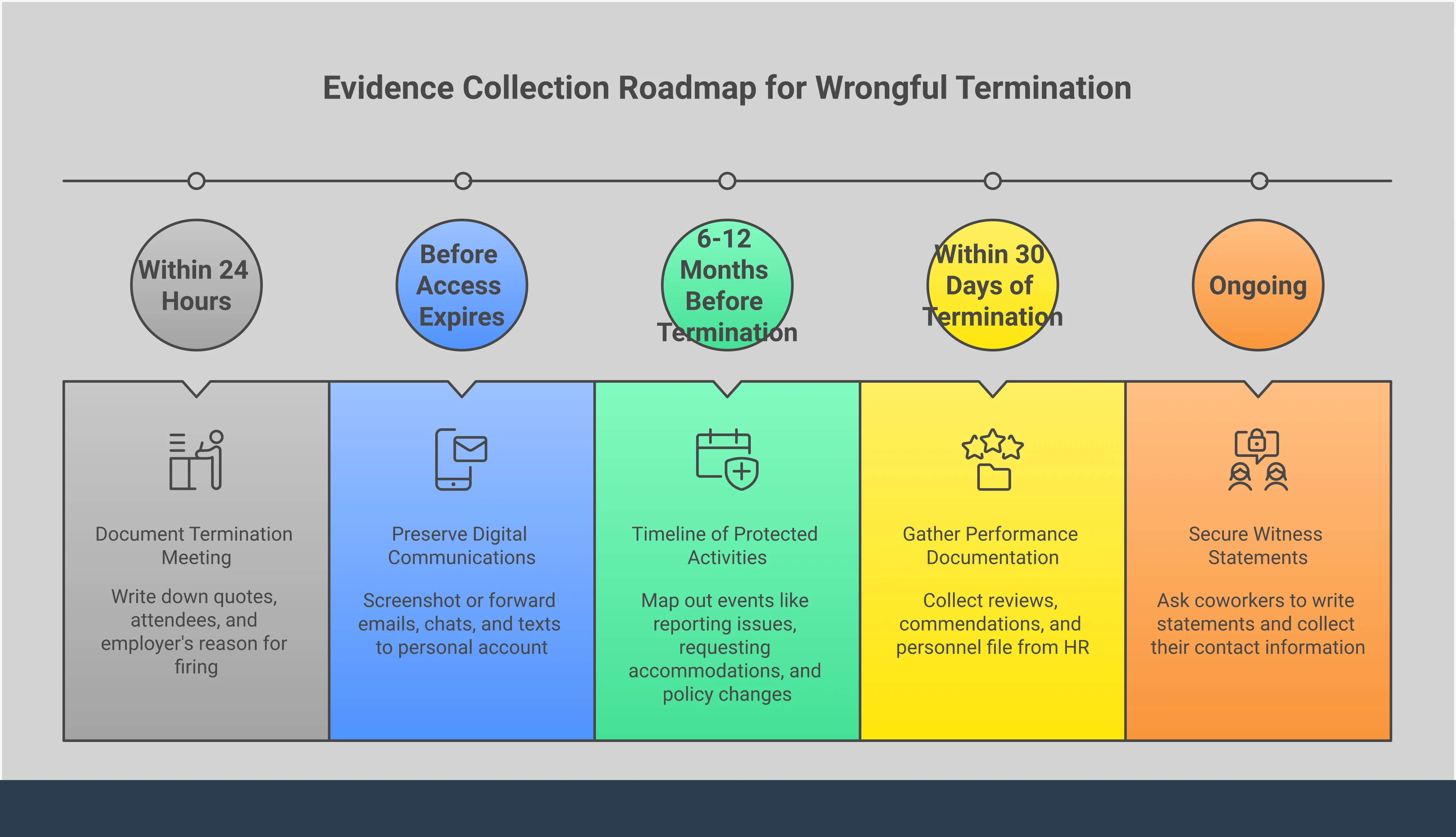
What other people saw and heard can be incredibly powerful. If you have coworkers who witnessed the unfair treatment, heard inappropriate comments, or can speak to your strong work ethic, their accounts can significantly support your claim. Ask them if they would be willing to write down what they observed, including dates, times, and specific details. A firsthand account of a manager making discriminatory jokes or admitting to retaliating against you can transform a case, especially when it feels like your word against theirs in a hostile work environment.
Performance history that contradicts the firing reason
Did your employer claim you were fired for “poor performance” even though you have a history of positive feedback? Your performance reviews are vital evidence to challenge that narrative. Gather all your past reviews, emails from your boss praising your work, and any awards or recognitions you received. This documentation helps demonstrate that you were a competent employee, which can suggest the stated reason for your termination was a cover for illegal retaliation at work. Pay stubs and timesheets are also important for proving your employment history and compensation.
Digital records that show timing or motive
In today’s workplace, so much communication happens digitally. Don’t overlook this critical source of evidence. Carefully save any emails, text messages, or instant messages (like Slack or Microsoft Teams) that could be relevant to your case. This could be a message from a supervisor that shows bias, an email thread where you reported an issue, or any communication that contradicts the reason you were given for being fired. These digital records provide a time-stamped, unaltered account of events and can be some of the most compelling proof of disability discrimination or other illegal actions.
A timeline connecting protected activity to termination
Sit down and write out a detailed timeline of everything that happened leading up to your termination. Start from the first instance of trouble and note every significant event, conversation, and action. Be sure to include dates. For example, note the date you reported harassment, the date your manager’s behavior toward you changed, and the date you were fired. This timeline helps connect the dots between a protected activity-like whistleblowing-and the negative action your employer took against you. A clear sequence of events makes it much easier to argue that one caused the other.
What Should You Do Immediately After Being Fired?
Being fired is a jarring experience, and it’s easy to feel lost and overwhelmed in the immediate aftermath. But the moments and days right after your termination are critical. Taking a few clear, deliberate steps can protect your rights and lay the essential groundwork for a potential wrongful termination claim. Think of this as your initial action plan. It’s about shifting from reacting to the shock to proactively gathering what you need to build a strong case. By focusing on these immediate priorities, you can secure important information before it disappears and put yourself in the best possible position to seek justice. These actions don’t require a legal degree, just a clear head and a focus on the facts.
Document the Termination Details Immediately
The very first thing you should do is write down everything you can remember about the termination meeting. Don’t wait. Memories fade, and crucial details can become fuzzy. Grab a notebook or open a new document and record the date, time, and location of the conversation. Who was in the room? What was the exact reason they gave for firing you? Write down direct quotes if you can recall them. Also, note their tone and demeanor, as well as your own responses. This detailed account creates a contemporaneous record that is incredibly valuable. Proving a wrongful termination often comes down to showing that the company’s stated reason for firing you was just a pretext for an illegal one.
Preserve and Organize All Your Evidence
Now is the time to gather every piece of work-related documentation you have. Create a dedicated folder, either physical or digital, and start collecting your records. This includes your original offer letter, employment contract, performance reviews, and the employee handbook. Find your pay stubs, timesheets, and any emails, texts, or other messages that could be relevant to your case. If you have a list of colleagues who witnessed unfair treatment or can speak to your strong performance, save their contact information. This evidence is the foundation of your claim, helping to paint a clear picture of your work history and the circumstances surrounding your dismissal.
California employees may also have the right to request certain personnel and payroll records. Ask for copies in writing and keep your request professional. These records can help compare the employer’s official explanation against your documented work history.
Ask for the Reason You Were Fired in Writing
If your employer was vague about why you were let go, it’s important to ask for a clear reason in writing. Send a polite and professional email to your former manager or HR representative requesting the specific reason for your termination. This simple step can be incredibly powerful. It encourages your employer to provide an official explanation, which they will have to stick to later. You can then compare their stated reason against your performance reviews and the evidence you’ve collected. If their story doesn’t add up, it can be a strong indicator of an illegal motive, such as retaliation for reporting misconduct.
Know Where to File a Complaint (EEOC & DFEH)
Before you can file a lawsuit for many types of wrongful termination, you must first file a complaint with a government agency. If your termination involves illegal discrimination or harassment, you’ll need to file with either the federal Equal Employment Opportunity Commission (EEOC) or California’s Civil Rights Department (CRD), which was formerly known as the DFEH. These agencies will investigate your claim and issue a “right-to-sue” letter. Filing this administrative complaint is a mandatory first step that preserves your right to take your employer to court later. An experienced attorney can help you decide which agency is the best choice for your specific situation and ensure your complaint is filed correctly.
Don’t Miss Critical Deadlines (Statute of Limitations)
This is one of the most important things to understand: you have a limited time to take legal action. This deadline is called the statute of limitations, and if you miss it, you could lose your right to file a claim forever, regardless of how strong your case is. For many claims in California, you have three years from the date of your termination to file a complaint with the CRD (DFEH). However, federal deadlines with the EEOC are much shorter, often just 180 days. Because these time limits can be complex and vary depending on your specific claim, it is vital to act quickly. Do not wait to figure out your next steps or hope the situation resolves itself.
Common Mistakes That Can Hurt Your Evidence
Building a wrongful termination case can feel like an uphill battle. Your former employer will have their own version of events, and it’s unlikely they will simply admit to breaking the law. Instead, they will almost certainly offer a reason for your firing that sounds perfectly legal and legitimate. Your job, with the help of your evidence, is to show that their official story is a pretext-a cover for the real, illegal reason you were let go.
Anticipating your employer’s arguments is a key part of building a strong case. They might claim your performance was poor, that you violated a company policy, or that your position was eliminated for business reasons. These are common defenses, but they can often be challenged with the right evidence and a clear strategy. Understanding these potential obstacles from the start allows you to gather the specific proof needed to counter them and expose the truth behind your termination. This section will walk you through the most common challenges and give you actionable steps to address them.
Meeting the “Burden of Proof”
In any legal claim, the “burden of proof” falls on the person bringing the case-in this situation, that’s you. It means you have the responsibility to provide enough evidence to convince a judge or jury that your termination was illegal. Since employers rarely confess to an unlawful motive, this requires you to do more than just state that you were fired unfairly. You must present compelling evidence that demonstrates their stated reason for firing you isn’t the real one. The goal is to show that the actual reason was an illegal one, such as discrimination or retaliation.
Countering Your Employer’s Excuses
Employers often rely on a few common excuses to justify a termination. They might point to “poor performance,” “insubordination,” or “company-wide layoffs.” Your task is to dismantle these arguments with evidence. For example, if they claim your performance was inadequate, a history of positive performance reviews, raises, and bonuses can directly contradict their story. If they cite a violation of company policy, you can present evidence that other employees committed similar infractions but were not fired, suggesting you were unfairly targeted. Showing that their excuse doesn’t hold up is a powerful step toward proving your wrongful termination claim.
What to Do with Limited Documentation or No Witnesses
Many people worry they can’t build a case without a “smoking gun” email or a coworker willing to testify. While those things are helpful, they aren’t always necessary. If you have limited documentation, start by creating your own records. Write down everything you can remember about conversations and events, including dates, times, and who was present. You can also ask your former employer to provide the reason for your termination in writing. Their response can become a key piece of evidence. An experienced attorney knows how to build a strong case from many small pieces of information, creating a compelling timeline that reveals a pattern of illegal behavior like a hostile work environment.
Using California’s Strong Employee Protections
Fortunately, California has some of the most robust employee protection laws in the nation. A key concept is “wrongful termination in violation of public policy.” This legal principle makes it illegal for an employer to fire you for exercising a legal right or fulfilling a legal duty. For example, you cannot be fired for reporting illegal activity (whistleblowing), taking protected family and medical leave, or filing a workers’ compensation claim. Understanding these powerful protections is essential, as your termination may be illegal under California law even if it doesn’t seem to fit into a traditional category like discrimination.
How to Connect Your Evidence to a Legal Violation
Ultimately, every piece of evidence you gather must serve one purpose: to draw a clear line between your protected status or activity and your termination. You need to show that you had a job, you were fired or forced to quit, and the reason for your termination was illegal. For instance, you can use your timeline to show you were fired just one week after you reported sexual harassment. This close timing, known as temporal proximity, creates a strong inference that you were the victim of retaliation at work. An employment lawyer specializes in weaving together documents, witness accounts, and timelines to tell a clear and persuasive story that satisfies the legal requirements of a wrongful termination claim.
When Should You Contact a California Wrongful Termination Lawyer?
Deciding to contact an attorney can feel like a big step, but you don’t have to be certain you have a case to ask for help. If something about your termination feels wrong, a consultation can bring clarity and peace of mind. An experienced employment lawyer can listen to your story, explain your rights, and help you understand your options without any pressure. The goal is simply to get you the information you need to decide what’s best for you. Many people hesitate, worrying about the cost or complexity, but an initial conversation is often the most straightforward way to figure out if you have a strong claim and what to do next. It’s about arming yourself with knowledge from a professional who deals with these situations every day. You don’t have to go through this alone, and getting expert advice early on can make all the difference in protecting your rights and securing your future. Think of it less as starting a fight and more as getting a professional opinion, just like you would for any other major life event. It’s a proactive step to ensure you’re treated fairly.
Signs You Need Legal Help Immediately
If you were fired shortly after reporting illegal activity, requesting medical leave, or complaining about harassment, it’s time to call a lawyer. These situations are major red flags for retaliation. Another critical reason to act quickly is the statute of limitations-a strict deadline for filing a legal claim. If you miss this window, you could lose your right to seek justice forever. Don’t wait until it’s too late. If you suspect your termination was connected to your race, gender, disability, or another protected characteristic, getting legal advice right away is essential to protecting your rights and ensuring your voice is heard.
How an Attorney Strengthens Your Case Strategy
Proving wrongful termination is challenging, especially since California is an “at-will” employment state. Your former employer will have a reason for firing you, and your job is to show that their stated reason is a pretext for an illegal one. An employment attorney knows exactly what evidence is needed to connect the dots and build a compelling case. They handle the complex rules, deadlines, and paperwork, and can formally request documents from your employer that you couldn’t get on your own. A lawyer acts as your advocate, ensuring your story is heard and your case is presented in the strongest possible light, taking the burden off your shoulders.
What Is Your Claim Worth? Calculating Potential Damages
It’s natural to wonder what you could recover in a wrongful termination lawsuit. While every case is unique, potential compensation, known as damages, is meant to help make you whole again. This can include money for lost wages and benefits (both past and future), emotional distress caused by the illegal firing, and reimbursement for your attorney’s fees and court costs. In cases where an employer’s conduct was particularly harmful, you may also be awarded punitive damages, which are intended to punish the company and deter similar behavior in the future. An attorney can help you calculate a realistic estimate of what your claim might be worth based on the specifics of your situation.
The Legal Process: A Step-by-Step Overview
The first step is a confidential consultation with an employment lawyer to review the facts of your situation. If you decide to move forward, your attorney will help you file a formal complaint with a government agency like the California Department of Fair Employment and Housing (DFEH) or the federal Equal Employment Opportunity Commission (EEOC). This is a required step before you can file a lawsuit. Your lawyer will manage all communications, gather evidence, and represent you through every stage, whether it’s negotiating a settlement or fighting for you in court. Their guidance ensures you follow the correct procedures from the very beginning, so you can focus on moving forward.
Your fight starts with a free call. Contact Bluestone Law to discuss a possible wrongful termination claim with a team that represents California employees.
Frequently Asked Questions
My boss didn’t give me a reason for firing me. Is that allowed? Yes, in most cases, it is. California is an “at-will” employment state, which means your employer doesn’t have to provide a reason for letting you go. However, they still can’t fire you for an illegal reason, like discrimination or retaliation. The lack of a stated reason can sometimes be a red flag, especially if your performance was good. This is why it’s a smart move to ask for the reason in writing, as it requires them to put an official explanation on the record.
I wasn’t fired, but my boss made my life so miserable I had to quit. Can I still sue? You might be able to. This situation is known as “constructive discharge,” and the law often treats it as a form of wrongful termination. If your employer intentionally created working conditions so intolerable that any reasonable person would feel they had no choice but to resign, you may have a valid claim. The key is proving that the environment was deliberately made hostile to push you out for an illegal reason.
What if I don’t have a written contract or a “smoking gun” email? You don’t need a single “smoking gun” to build a strong case. Wrongful termination claims are often proven by piecing together a pattern of behavior and circumstantial evidence. Things like a timeline of events showing you were fired right after reporting harassment, consistently positive performance reviews that contradict a claim of “poor performance,” and statements from coworkers can be incredibly powerful. An experienced lawyer knows how to weave these different elements into a compelling story.
How long do I have to take action after being fired? There are strict deadlines, called statutes of limitations, for filing a wrongful termination claim, and if you miss them, you lose your right to sue. In California, the time limit can vary depending on the specifics of your case, but for some claims, it can be as short as 180 days. Because these deadlines are so critical and complex, it is vital to speak with an attorney as soon as possible to understand the specific timeline that applies to your situation.
Do I have to pay a lawyer upfront to take my case? Not usually. Most reputable employment law firms, including Bluestone Law, work on a contingency fee basis. This means you don’t pay any attorney’s fees unless they win your case, either through a settlement or a court verdict. The lawyer’s fee is then paid as a percentage of the money recovered. This arrangement allows you to seek justice without having to worry about upfront costs, especially when you’ve just lost your source of income.
Related Articles
- Unlawful Termination Lawsuit: A Step-by-Step Guide
- How to Write a Resignation Letter for Constructive Dismissal
- Your Guide to Finding the Right Employee Rights Lawyer
Think you were wrongfully terminated?
Get a free, confidential case evaluation from our experienced employment law attorneys.
Request Your Free Consultation