
You followed the rules. You submitted your paperwork and took legally protected leave to handle a serious family or medical issue. But when you returned, everything had changed. Maybe you were demoted, given a poor performance review, or even let go. This is called retaliation, and it’s a serious violation of your rights that can significantly impact your case. When an employer punishes you for exercising your rights, it demonstrates a willful disregard for the law. This can dramatically increase potential FMLA lawsuit settlement amounts. This article explains how to identify retaliation, the types of damages you can recover, and how proving your employer acted in bad faith strengthens your claim.
Key Takeaways
- Compensation is calculated, not estimated: A fair settlement is based on your specific financial losses, including back pay and future earnings, and can be doubled if your employer willfully violated the law.
- Punishment for taking leave is illegal retaliation: If your employer demoted you, gave you an unfair review, or took any other negative action because of your FMLA leave, it can significantly increase your case’s value.
- Your strongest tools are documentation and expert guidance: Keep detailed records of every communication and document related to your leave, and partner with an employment attorney to protect your rights and build a powerful case.
What is the Family and Medical Leave Act (FMLA)?
Life happens, and sometimes you need to step away from work to take care of yourself or your family. That’s where the Family and Medical Leave Act (FMLA) comes in. Think of it as a safety net. The FMLA is a federal law that provides eligible employees with up to 12 weeks of unpaid, job-protected leave per year. It also requires that your group health benefits be maintained during your time away.
The core purpose of this law is to ensure you don’t have to choose between your job and your family during a serious health crisis, the birth of a child, or other significant life events. It allows you to take the time you need with the peace of mind that your position—or an equivalent one—will be waiting for you when you return. Understanding your rights under the FMLA is the first step in protecting yourself and your livelihood when you need it most. If you believe your employer has violated your rights, it’s important to understand the options available for family and medical leave issues.
Are You Eligible for FMLA?
Not everyone qualifies for FMLA, so it’s important to check if you meet the specific criteria. First, you must work for a covered employer. This includes public agencies, schools, and private-sector employers with 50 or more employees. Second, you need to have worked for that employer for at least 12 months—they don’t have to be consecutive. Finally, you must have worked at least 1,250 hours for your employer during the 12 months immediately before your leave starts. If you can check all three of these boxes, you are likely eligible for FMLA protection.
What Does FMLA Cover?
The FMLA is designed to cover significant life events that require your full attention. You can take FMLA leave for several reasons, including welcoming a new child into your family, whether through birth, adoption, or foster care. It also covers situations where you need to care for a spouse, child, or parent who has a serious health condition. Additionally, if you are unable to work because of your own serious health condition, you are covered. The law also includes provisions for military families, allowing for leave for qualifying situations arising from a family member’s military service.
How FMLA Protects Your Job and Benefits
The FMLA offers two critical protections. First, it protects your job. When you return from leave, your employer must restore you to your original job or an equivalent one. An equivalent position means it has the same pay, benefits, and other terms and conditions of employment. They can’t demote you or change your role simply because you took leave. Second, your employer must maintain your coverage under any group health plan on the same terms as if you had continued to work. An employer who fires you for taking FMLA leave may be engaging in unlawful retaliation.
What Factors Shape an FMLA Settlement?
If you’re wondering what your FMLA case might be worth, it’s important to know that there’s no simple calculator for settlement amounts. Every case is unique, and the final figure depends on a combination of specific factors. Think of it less like a fixed price tag and more like a puzzle where each piece—from the nature of your employer’s actions to the strength of your evidence—plays a role in forming the complete picture. Understanding these key elements can help you set realistic expectations and build a stronger case for the compensation you deserve.
The Severity of the Violation
Not all FMLA violations are created equal, and the seriousness of your employer’s actions is a major factor in determining a settlement amount. A minor administrative error, like a delay in paperwork, will likely result in a much smaller settlement than a case where an employee was fired while on approved leave. The more significant the impact on your career and livelihood, the higher the potential value of your claim. While minor cases might settle for between $10,000 and $50,000, more severe violations can range from $80,000 to over $300,000, with the most egregious cases sometimes exceeding $1 million. An experienced attorney can help you understand where your situation falls on this spectrum.
Calculating Your Financial Losses
A large part of any FMLA settlement is designed to make you financially whole again. This means calculating all the money you lost because of your employer’s illegal actions. The most significant component is typically lost wages, which includes the salary, bonuses, and benefits you would have earned if you hadn’t been demoted or terminated. Your salary and how long you were out of work are key variables in this calculation. The goal is to recover not just the income you’ve already lost (back pay) but also potentially the earnings you’ll miss out on in the future (front pay) while you search for a comparable job.
The Power of Strong Evidence
A strong case is built on strong evidence. The more proof you have, the harder it is for your employer to argue against your claim. Solid documentation is your best tool for demonstrating that your rights were violated. This includes records of your FMLA eligibility, copies of your leave requests, emails or letters from your employer regarding your leave, and any evidence of the negative action taken against you, such as a termination letter. Having clear, organized proof that you were entitled to family and medical leave and that your employer broke the law is crucial for securing a fair settlement.
Why Your Legal Team Matters
Trying to handle an FMLA claim on your own can be incredibly challenging. An experienced employment lawyer does more than just file paperwork; they become your strategic partner and advocate. A skilled attorney can accurately assess the strengths and weaknesses of your case, gather critical evidence, and calculate the full extent of your damages. They know the tactics employers and their legal teams use and can build a compelling argument on your behalf. Having the right legal team ensures you follow all the necessary steps and puts you in the best position to negotiate a settlement that truly reflects what you’ve lost.
Your Employer’s Conduct During Negotiations
How your employer behaves throughout the legal process can also influence the final settlement. If an employer made a rash, emotional decision to fire you, they may be more motivated to settle quickly to avoid a costly and embarrassing trial. On the other hand, if an employer refuses to negotiate in good faith or it becomes clear they intentionally violated your rights, it can strengthen your case for additional damages. An employer’s conduct can reveal a lot about the strength of their defense and can sometimes be a clear sign of workplace retaliation, which can significantly increase the value of your claim.
What Damages Can You Recover in an FMLA Lawsuit?
If your employer violated your FMLA rights, you’re likely dealing with financial stress and emotional turmoil. A lawsuit can help you recover what you’ve lost and hold your employer accountable. The goal of an FMLA lawsuit is to compensate you for the harm caused by your employer’s illegal actions. This compensation, known as “damages,” covers a range of losses, from missed paychecks to the emotional distress you’ve endured. Understanding these potential damages can help you see what a fair settlement might look like for your specific situation.
The law is designed to make you “whole” again—to put you back in the financial and professional position you would have been in if the violation had never occurred. This involves a careful calculation of everything you’ve lost, both tangible and intangible. It’s not just about getting your job back; it’s about ensuring you are compensated for every setback caused by your employer’s failure to follow the law. From lost income and benefits to penalties for intentional misconduct, several types of damages can contribute to your final settlement amount. Let’s break down what you may be able to recover.
Recovering Past Lost Wages
This is often the most straightforward part of a settlement. Known as “back pay,” this compensation covers the money you lost from the moment your employer violated your rights up until your case is resolved. It’s designed to put you back in the financial position you would have been in if the violation had never happened. Back pay isn’t just about your base salary; it also includes lost commissions, bonuses, and the value of benefits like health insurance or retirement contributions. If you found a new job with lower pay, back pay can also cover the difference in your earnings. These are tangible losses that can be calculated based on your pay stubs and employment records, forming a critical foundation for your wage and hour claims.
Compensation for Future Lost Earnings
Sometimes, an FMLA violation causes long-term damage to your career. If you were wrongfully terminated and struggle to find a new job with comparable pay and responsibilities, you may be entitled to “front pay.” This is compensation for wages you are projected to lose in the future because of your employer’s actions. Front pay is typically awarded when getting your old job back isn’t a practical option—perhaps the work environment has become too hostile, or the trust is completely broken. Calculating front pay can be complex, but it acknowledges that a wrongful termination can have a lasting impact on your financial stability and career trajectory, and you deserve to be compensated for that setback.
Penalties for Willful Violations
The law includes a special penalty for employers who knowingly or recklessly disregard your FMLA rights. These are called “liquidated damages,” and they essentially act as a punishment for willful misconduct. In most successful FMLA cases, you are awarded an amount equal to your back pay, effectively doubling that portion of your recovery. The burden is on your employer to prove they acted in good faith and had reasonable grounds to believe they weren’t breaking the law. If they can’t, these additional damages are typically granted. This provision underscores how seriously the law treats violations of your right to take family and medical leave.
Damages for Emotional Distress
Losing your job or facing retaliation for taking legally protected leave is incredibly stressful. The FMLA recognizes the emotional toll these situations can take, allowing you to seek damages for things like anxiety, depression, and mental anguish. While it can be more challenging to put a dollar amount on emotional suffering than on lost wages, this compensation is a vital part of making you whole again. Documenting how the FMLA violation has impacted your mental and emotional well-being is key. This type of harm is often a component of cases involving a hostile work environment, where the stress and anxiety are a direct result of an employer’s unlawful actions.
Covering Your Attorney’s Fees
Many people hesitate to pursue legal action because they worry about the cost. Fortunately, the FMLA includes a fee-shifting provision. This means that if you win your case, the court can order your employer to pay your reasonable attorney’s fees and other legal costs. This provision is designed to ensure that everyone has access to justice, regardless of their financial situation. It allows you to hire a qualified attorney to fight for your rights without the fear of being buried in legal bills. When you partner with our firm, we can explain exactly how this works and help you seek the full compensation you deserve.
What is a Typical FMLA Lawsuit Settlement?
It’s completely understandable to wonder what your case might be worth. While there’s no magic calculator that can spit out a precise number, looking at common outcomes can give you a general idea. The value of an FMLA lawsuit depends entirely on the unique details of your situation—from the financial losses you suffered to the severity of your employer’s actions.
The most important thing to remember is that these are just reference points. A settlement is the result of a negotiation that considers many different factors, including the strength of your evidence and the skill of your legal team. The goal is to reach a figure that fairly compensates you for the harm you’ve experienced after being denied your legal right to take family and medical leave.
Common Settlement Ranges
While every case is different, FMLA settlements generally fall into a few broad categories based on the specifics of the violation. For relatively minor issues, where the financial impact was limited, settlements might be in the $10,000 to $50,000 range. These cases often involve situations where leave was improperly delayed or questioned but didn’t result in termination.
For more moderate violations, such as being demoted or passed over for a promotion after returning from leave, settlements can range from $80,000 to $300,000. The most severe cases, which often involve wrongful termination or significant retaliation, can result in settlements from $300,000 to over $1,000,000. These higher amounts reflect substantial financial losses and potentially egregious conduct by the employer.
How Violation Severity Impacts Payouts
The severity of your employer’s violation is one of the biggest drivers of your settlement value. A minor violation might involve your employer making things difficult for you when you requested leave but ultimately granting it. While still illegal and stressful, the damages are likely lower than in other scenarios.
A moderate violation could be returning from your FMLA leave to find you’ve been moved to a less desirable position with fewer responsibilities, even if your pay is the same. This directly impacts your career trajectory and can be a form of retaliation. High-severity violations are the most clear-cut and damaging, such as being fired while on approved leave or immediately upon your return. These actions result in significant financial and emotional hardship, which is reflected in higher settlement values.
Why Every FMLA Case is Different
There is no “average” FMLA settlement because no two cases are exactly alike. The final amount is tailored to your specific circumstances. Key factors that influence your case’s value include your salary, how long you were employed, and the total financial losses you incurred because of the violation. For example, a higher-earning employee who was out of work for a year will have a much larger lost wages claim than a lower-earning employee who found a new job quickly.
Other elements, like the cost of lost health benefits, job search expenses, and the emotional distress the experience caused you, also play a crucial role. The strength of your documentation and the conduct of your employer throughout the process will further shape the final settlement amount.
Debunking FMLA Settlement Myths
A common myth is that employers can legally penalize you for using the leave you are entitled to. The reality is that the FMLA explicitly forbids this. Any negative action taken against you for requesting or taking leave can be considered illegal retaliation. Many employers either don’t understand the law or choose to ignore it, leading to valid legal claims.
Another misconception is that you are on your own to cover all damages. The FMLA includes a provision for “liquidated damages,” which can double the amount of your compensation. These damages are often awarded automatically when you win your case unless your employer can prove they acted in good faith and had reasonable grounds to believe they weren’t breaking the law. This provision adds significant weight to your claim and holds employers accountable for their actions.
How Does a Retaliation Claim Affect Your Settlement?
When you take FMLA leave, you’re exercising a protected right. If your employer punishes you for it, that’s not just unfair—it’s illegal. This is called retaliation, and it’s a separate legal claim that can run alongside your initial FMLA violation. Proving that your employer retaliated against you can significantly change the dynamics of your case and increase the potential value of your settlement. It shows a willful disregard for your rights, and the law takes that very seriously. Instead of just addressing the denial of leave, your case now also tackles the punishment you received for trying to follow the rules.
What Qualifies as FMLA Retaliation?
FMLA retaliation happens when your employer takes any negative or “adverse” action against you because you requested or took protected leave. It’s their way of getting back at you for using your rights. This can be obvious, like being fired or demoted right after you return. But it can also be more subtle, such as being excluded from important meetings, receiving an unfair performance review, having your hours cut, or being reassigned to a less desirable position. The key is proving the connection between your FMLA leave and the negative action. If your boss’s behavior changed dramatically after you submitted your leave request, that could be strong evidence of retaliation.
Additional Damages for Retaliation
A retaliation claim doesn’t just strengthen your case; it introduces new categories of damages you can recover. Beyond the back pay for your improperly denied leave, you may be entitled to compensation for emotional distress caused by the retaliatory actions. In cases where the employer’s conduct was particularly malicious, you could even be awarded punitive damages, which are designed to punish the company and deter future misconduct. One of the most significant additions is liquidated damages. For a willful violation of the Family and Medical Leave Act, the law allows for an award equal to your financial losses, effectively doubling your compensation.
The Impact of Retaliation on Your Case’s Value
Adding a retaliation claim fundamentally increases the value of your FMLA case because it demonstrates your employer’s bad faith. Juries and judges tend to look unfavorably on companies that punish employees for exercising their legal rights. A severe violation, like a wrongful termination in response to an FMLA request, often leads to a higher settlement. The potential for liquidated damages also gives your attorney significant leverage during negotiations. Unless your employer can prove they made an honest, good-faith mistake, these double damages are often automatically awarded when retaliation is proven. This financial risk makes employers more likely to offer a fair settlement rather than take their chances at trial.
What to Expect from the FMLA Settlement Process
If you’ve filed an FMLA claim, you might be picturing a dramatic courtroom battle, but the reality is that most employment lawsuits are resolved through a settlement. A settlement is a formal agreement where your employer agrees to pay you a certain amount of money in exchange for you dropping the lawsuit. For employers, this is often a practical business decision. The average cost to simply defend an FMLA lawsuit is around $80,000, and that’s before any potential judgment against them. Settling allows them to avoid the uncertainty and expense of a trial.
The settlement process is essentially a structured negotiation. Your attorney will present the evidence of your case and calculate the full extent of your damages—from lost wages to emotional distress. From there, they will negotiate with your employer’s legal team to arrive at a fair resolution. This process can feel intimidating, but it’s where having a dedicated advocate is crucial. They handle the legal complexities and fight for the compensation you deserve, allowing you to focus on moving forward. The goal is to reach an agreement that acknowledges the harm you’ve suffered and provides the financial resources to help you recover.
A Look at the Settlement Timeline
One of the first questions people ask is, “How long will this take?” Unfortunately, there’s no simple answer. The timeline for an FMLA settlement can vary widely, from a few months to more than a year. It depends on several factors, including the complexity of your case, the amount of evidence to review, and how willing your employer is to negotiate in good faith. The process generally moves through a few key phases: filing the initial claim, a period of “discovery” where both sides exchange information and evidence, and finally, the negotiation stage. While it’s natural to want a quick resolution, patience is important. Rushing the process could mean accepting a lower offer than you deserve.
Key Negotiation Strategies
Successful negotiation starts with a clear understanding of what your case is worth. The value of an FMLA case depends on your specific circumstances, including the type of violation, your salary, and how long you were deprived of your rightful pay or benefits. Your attorney will begin by sending a “demand letter” to your employer, which outlines the facts of your case, the laws that were broken, and the total damages you are seeking. This letter kicks off the negotiation process, which usually involves a series of offers and counteroffers. The strength of your evidence is your greatest asset here, as it provides the leverage needed to secure a fair settlement.
Deciding Whether to Accept a Settlement Offer
When your employer makes a settlement offer, the decision to accept it is ultimately yours, but it’s one you’ll make with the close guidance of your attorney. A good offer should fairly compensate you for all your losses, including back pay, future lost earnings, and any out-of-pocket expenses. In cases where an employer willfully violated the law or engaged in retaliation, you may also be entitled to “liquidated damages,” which can double the amount of your back pay award. This potential penalty often encourages employers to make a reasonable offer. Accepting a settlement is a final decision that closes your case, so it’s vital to ensure the terms are right for you.
How to Strengthen Your FMLA Lawsuit Settlement
If you believe your employer has violated your FMLA rights, you’re likely feeling overwhelmed and unsure of what to do next. It’s a stressful and often isolating experience to have your job security threatened simply for taking legally protected time off to care for yourself or your family. While every case is unique, there are concrete steps you can take to build a strong foundation for your claim and work toward a fair settlement. It’s about being prepared, strategic, and well-informed from the very beginning.
Taking proactive steps doesn’t just help your potential case—it can also be empowering. By gathering evidence, seeking professional guidance, and understanding your options, you shift from feeling like a victim to becoming an advocate for your own rights. This preparation is crucial because a strong case is built on clear, compelling evidence that demonstrates how your employer failed to follow the law. The actions you take now can make a significant difference in how your case unfolds, whether you’re negotiating a settlement or presenting your claim. By focusing on these key areas, you put yourself in a much better position to secure the compensation and justice you deserve.
Keep Detailed Records of Everything
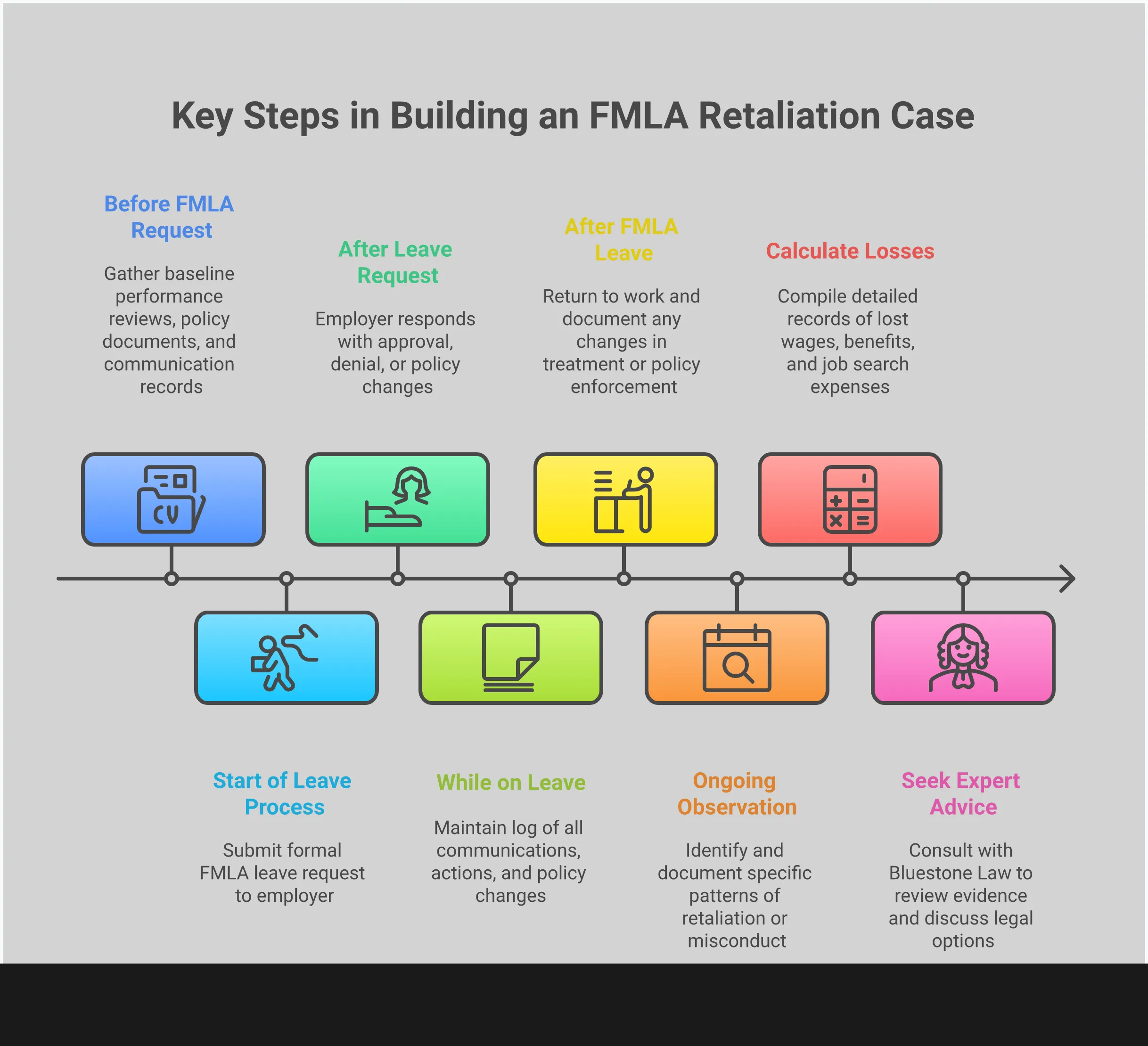
Documentation is one of your most powerful tools in an employment dispute. To build a strong FMLA case, you need to show that your employer broke the rules—whether they denied your leave, punished you for taking it, or failed to reinstate you. Start a file and keep everything related to your employment and your leave request. This includes copies of your official FMLA request, any email or text correspondence with HR or your manager, your performance reviews (especially those before and after your leave), and any written denial of your request. It’s also wise to keep a personal log of conversations, noting the date, time, who was present, and what was said. This detailed evidence helps create a clear timeline and can be crucial in proving your claim.
Partner with an Experienced Employment Attorney
Trying to handle an FMLA claim on your own can be incredibly difficult, as the laws are complex and the process can be intimidating. A good lawyer is crucial for building a strong case and getting the best possible outcome. An experienced employment law attorney understands the nuances of these cases, from accurately calculating your total damages to negotiating effectively with your employer’s legal team. They can assess the strength of your evidence, handle all the legal filings, and build a compelling argument on your behalf. Having a professional advocate levels the playing field and ensures your rights are protected every step of the way, allowing you to focus on your health and family.
Understand Your Rights and Legal Options
When your FMLA rights have been violated, you generally have two main paths forward. First, you can file a complaint with the Department of Labor’s Wage and Hour Division (WHD). The WHD will investigate your claim and may work to recover back wages for you. Your second option is to file a private lawsuit directly against your employer. This route often allows you to seek a broader range of damages, including compensation for emotional distress and other losses. Understanding the pros and cons of each option is key to making the right choice for your situation. An attorney can help you weigh these choices and decide on the best strategy for pursuing your family and medical leave claim.
Related Articles
- 7 Red Flags of FMLA Violations by Employers
- Family and medical leave act pregnancy – Bluestone Law
- The Secrets to FMLA Cases Won by Employees
Frequently Asked Questions
What’s the very first thing I should do if I think my employer violated my FMLA rights? Your first step is to gather any documentation you have related to your leave request and your employer’s response. This includes emails, letters, and any notes you took during conversations. The next, and most important, step is to speak with an employment law attorney. Acting quickly is key, as there are strict deadlines for filing a claim. A lawyer can review your situation, confirm whether your rights were violated, and explain your options before you make any decisions.
Can my employer punish me for just asking about FMLA leave, even if I don’t end up taking it? Absolutely not. The law protects you from retaliation not only for taking FMLA leave but also for inquiring about it or expressing your intent to use it. Any negative action your employer takes against you simply because you asked about your rights can be considered illegal retaliation. The protection begins the moment you engage in a protected activity, and asking about your leave is one of them.
What if I can’t afford a lawyer? Can I still pursue a case? Yes, you can. Many people worry about legal costs, but most employment attorneys, including our firm, handle FMLA cases on a contingency fee basis. This means you don’t pay any attorney’s fees unless you win your case through a settlement or verdict. Additionally, the FMLA includes a provision that can require your employer to pay your legal fees if you win. This makes it possible for anyone to seek justice, regardless of their financial situation.
My boss didn’t fire me, but my job is completely different and worse since I returned from leave. Is that illegal? This could definitely be illegal. The FMLA requires your employer to restore you to your original job or an “equivalent” one. An equivalent position must have the same pay, benefits, responsibilities, and working conditions. If you’ve been moved to a dead-end role, stripped of your duties, or placed in a less desirable position, your employer may have violated the law. This is a common form of retaliation that a lawyer can help you address.
How long do I have to file an FMLA lawsuit? There are strict time limits, known as the statute of limitations, for filing an FMLA claim. Generally, you have two years from the date of the violation to file a lawsuit. However, if the violation was willful or intentional on the part of your employer, that deadline extends to three years. Because these deadlines are firm, it is critical to contact an attorney as soon as you suspect your rights have been violated to ensure you don’t miss your window to take action.
Think you were wrongfully terminated?
Get a free, confidential case evaluation from our experienced employment law attorneys.
Request Your Free Consultation