
If you work for a small business, you might assume that job-protected leave for family or medical reasons is a benefit reserved for employees at large corporations. Fortunately, in California, that isn’t the case. The California Family Rights Act (CFRA) was specifically designed to extend these vital protections to more workers by applying to companies with just five or more employees. This is a major difference from federal law and a huge win for California’s workforce. This means your right to take time off to care for a loved one or yourself is protected. Learning about CFRA California is the first step to using this essential benefit.
Key Takeaways
- CFRA protects workers at most companies, big and small: California law applies to employers with five or more employees, meaning you likely have access to job-protected leave even if you don’t work for a large corporation.
- Your core benefits are secure while you’re on leave: CFRA ensures you can return to your same or a similar job and that your employer continues your health insurance. This protection is separate from whether your leave is paid, which is covered by other programs like Paid Family Leave.
- California law provides more leave than federal FMLA: Expectant parents can combine Pregnancy Disability Leave with CFRA for more time off. The law also recognizes a broader definition of family, allowing you to care for domestic partners, grandparents, and siblings.
What is the California Family Rights Act (CFRA)?
Life happens, and sometimes it requires you to step away from work. The California Family Rights Act (CFRA) is a state law designed to give you that breathing room without risking your job. Think of it as a critical safety net. The law allows eligible employees to take up to 12 weeks of leave within a 12-month period for significant life events. This isn’t a vacation; it’s job-protected time off for when you need it most.
This leave can be used for several important reasons, like welcoming a new child into your family through birth, adoption, or foster care. You can also use it to care for a spouse, child, or parent who has a serious health condition, or if you are dealing with your own serious health issue that makes it impossible to do your job. A key part of this protection is that your employer must continue to maintain your health benefits under the same conditions as if you were still actively working. Understanding your rights under CFRA is the first step in confidently managing your work and family responsibilities.
Why CFRA matters for California workers
CFRA is more than just legal text; it’s about providing peace of mind during some of life’s most challenging or joyful moments. The core of this law is the concept of job-protected leave. This means you can focus on your health or your family’s well-being without the constant fear of being replaced or fired. It allows you to be present for a newborn child or support a sick parent without sacrificing the career you’ve worked hard to build. This protection is fundamental to creating a healthy work-life balance and ensures that you don’t have to choose between your family and your financial stability.
Your core protections under the law
Under CFRA, your primary protection is your job. While the leave itself is generally unpaid, your employer cannot terminate you for taking it. When you return, you are entitled to the same or a comparable position. This protection applies whether you’re taking time for your own serious medical condition, bonding with a new baby, or caring for a seriously ill family member. This right is a cornerstone of California’s commitment to its workforce, ensuring you can handle personal matters without professional penalty. If you believe your employer has denied your right to family and medical leave, it’s important to understand your options.
How recent updates expanded your rights
It’s important to know that California law is often updated to provide stronger protections for workers. A significant recent change expanded the financial support available to you while on leave. While CFRA provides job protection, California’s Paid Family Leave (PFL) program provides partial wage replacement. The PFL program was updated to provide up to 8 weeks of payments per year, an increase from the previous 6 weeks. This means you get more financial support during your time away from work, making it more feasible to take the full leave you are entitled to without facing as much financial strain. This change reflects a better understanding of the real-world needs of employees and their families.
Do You Qualify for CFRA Leave?
Before you can use the protections offered by the California Family Rights Act, you need to make sure you’re eligible. The requirements are fairly straightforward and cover three main areas: the size of your company, how long you’ve worked there, and the reason you need to take leave. Let’s walk through each one so you can feel confident about where you stand.
Check your employer’s size (5+ employees)
One of the best things about CFRA is that it applies to many small businesses. If your employer has five or more employees, you are likely covered. This is a significant expansion from the federal Family and Medical Leave Act (FMLA), which only applies to companies with 50 or more employees. This means many more California workers have access to protected leave when they need it most. If you work for a small company, don’t assume you aren’t covered. The first step is always to confirm your employer’s size to see if you meet this initial requirement for family and medical leave.
Review your time on the job (12 months, 1,250 hours)
Next, you’ll need to look at your work history with your current employer. To qualify for CFRA, you must have worked for them for at least 12 months. It’s important to know that these 12 months do not need to be consecutive. Additionally, you must have worked at least 1,250 hours in the 12-month period immediately before your leave begins. This averages out to about 24 hours per week. You can usually find your hours worked on your pay stubs. These specific time-on-the-job requirements ensure that the law protects employees with a consistent work history.
Other key eligibility requirements
Finally, your reason for taking leave must be a qualifying one. CFRA allows you to take time off to bond with a new child (by birth, adoption, or foster care), care for a family member with a serious health condition, or manage your own serious health issue. During your leave, your employer must maintain your health benefits under the same conditions as if you were still working. It’s also illegal for your employer to punish you for taking this legally protected time off. If you face any negative consequences, it could be considered a form of workplace retaliation.
What Can You Use CFRA Leave For?
The California Family Rights Act (CFRA) provides job-protected leave for several significant life events, acting as a crucial safety net when you need to step away from work. It’s designed to give you the breathing room to handle major family and health situations without the added stress of worrying about your job. Think of it as your right to be present for your family or for yourself when it matters most, without having to sacrifice your career. The law is quite specific about when you can use this leave, covering everything from welcoming a new child to managing a serious illness. Understanding these qualifying reasons is the first step in confidently asserting your rights and getting the time off you are entitled to. Let’s walk through the main situations where CFRA has your back.
Bonding with a new child
One of the most common reasons to use CFRA leave is to bond with a new child. This applies whether you are welcoming a child through birth, adoption, or foster care placement. The law ensures you have protected time to build a connection and care for your new family member during those critical early stages. This isn’t just a perk—it’s a protected right that acknowledges how important that initial bonding period is for families. You can take this leave at any point within the first year of your child’s arrival, giving you and your family flexibility in how you structure this important time together.
Caring for a family member with a serious health condition
Life happens, and sometimes the people we love need our full attention. CFRA allows you to take leave to care for a family member with a serious health condition. This includes your child, parent, spouse, or registered domestic partner. A “serious health condition” is typically an illness, injury, or impairment that requires inpatient care or continuing treatment by a healthcare provider. This provision means you don’t have to make the impossible choice between your job and providing essential support to a loved one during a difficult health crisis. It’s a core component of your rights under California’s family and medical leave laws.
Managing your own serious health condition
Your health should always be a priority. CFRA provides leave for your own serious health condition when it makes you unable to perform your job duties. This could be for a planned surgery with a long recovery, a chronic condition that flares up, or a sudden illness or injury. This protection is vital, as it allows you to focus on getting better without the anxiety of potential job loss looming over you. If your condition is ongoing, it’s also worth knowing that you have separate protections against disability discrimination, which requires employers to provide reasonable accommodations for your health needs at work.
Understanding the expanded definition of “family”
California law is often more inclusive than federal law, and CFRA is a perfect example. The act’s definition of “family” is broader, which means more workers are covered when a loved one needs care. Specifically, CFRA extends leave rights to care for registered domestic partners, treating them the same as spouses. It also covers a child of a domestic partner, parents-in-law, grandparents, grandchildren, and siblings. This modern, expanded definition ensures that the law reflects the reality of diverse family structures, allowing you to take protected leave to care for the people who count on you, regardless of a traditional family label.
CFRA vs. FMLA: What’s the Difference?
If you’ve heard of the federal Family and Medical Leave Act (FMLA), you might think it’s the same as the California Family Rights Act (CFRA). While they share the goal of providing job-protected leave, they have some key differences—and in many cases, CFRA offers more extensive protections for California employees. Think of CFRA as California’s own version of FMLA, tailored with more inclusive definitions and broader coverage.
Understanding these distinctions is crucial because you might be eligible for leave under California law even if you don’t qualify under federal law. The differences can affect everything from who you can take leave to care for, how pregnancy-related leave is handled, and even which employers are required to provide leave in the first place. Knowing your rights under both laws helps you make the best decisions for yourself and your family without jeopardizing your job. We’ll walk through the most important distinctions so you can feel confident about your options.
Why CFRA covers more California workers
The single biggest difference between CFRA and FMLA is the size of the company they apply to. While FMLA generally covers employers with 50 or more employees, CFRA applies to any employer with just five or more employees. This change dramatically expands the number of people who can access job-protected leave in California. The core protection remains the same: The California Family Rights Act allows eligible employees to take up to 12 weeks of job-protected leave within a year, meaning your employer must hold your job for you. Because of the smaller company size requirement, many workers at small businesses across the state have rights under CFRA they wouldn’t have otherwise.
How CFRA and Pregnancy Disability Leave (PDL) interact
For expectant parents, California law provides significantly more leave time than federal law. This is because California has a separate Pregnancy Disability Leave (PDL), which allows a pregnant employee to take up to four months of leave for the time they are disabled by their pregnancy, childbirth, or a related medical condition. The best part? This leave is completely separate from your CFRA leave. After using PDL, you can then take an additional 12 weeks of CFRA leave for baby bonding. This means you could have up to seven months of job-protected leave, a benefit not available under FMLA. This is a critical protection for family and medical leave.
The truth about job protection vs. getting paid
It’s easy to get confused about whether you’ll be paid during your leave. Here’s the simple breakdown: CFRA and FMLA are laws that provide job protection. They ensure you have a job to return to, but they don’t require your employer to pay you. Getting paid while you’re off work comes from other sources. You might use your accrued paid time off (like vacation or sick days), or you can apply for state programs like Disability Insurance (DI) or Paid Family Leave (PFL). As the Employment Development Department clarifies, you need FMLA or CFRA for job protection, while programs like PFL provide wage replacement.
Special considerations: domestic partners and flexible leave
CFRA is often more inclusive than its federal counterpart. For example, CFRA’s definition of a family member is much broader. You can take leave to care for a domestic partner, grandparent, grandchild, sibling, or parent-in-law—none of whom are covered under FMLA. This reflects a more modern understanding of family structures. Furthermore, CFRA allows you to take leave in smaller increments, providing flexibility for things like recurring medical appointments. If you believe your employer is denying your rights under these expanded definitions, it’s important to understand your options for holding them accountable under California’s employment law.
Know Your Rights: Protections Under CFRA
Understanding that you qualify for CFRA is the first step. The next is knowing exactly what protections you have. These rights are in place to ensure you can take the leave you need without fearing for your job, your health insurance, or your professional standing. Think of these protections as your safety net, legally guaranteed by the state of California. Let’s walk through the key rights you’re entitled to when you take CFRA leave.
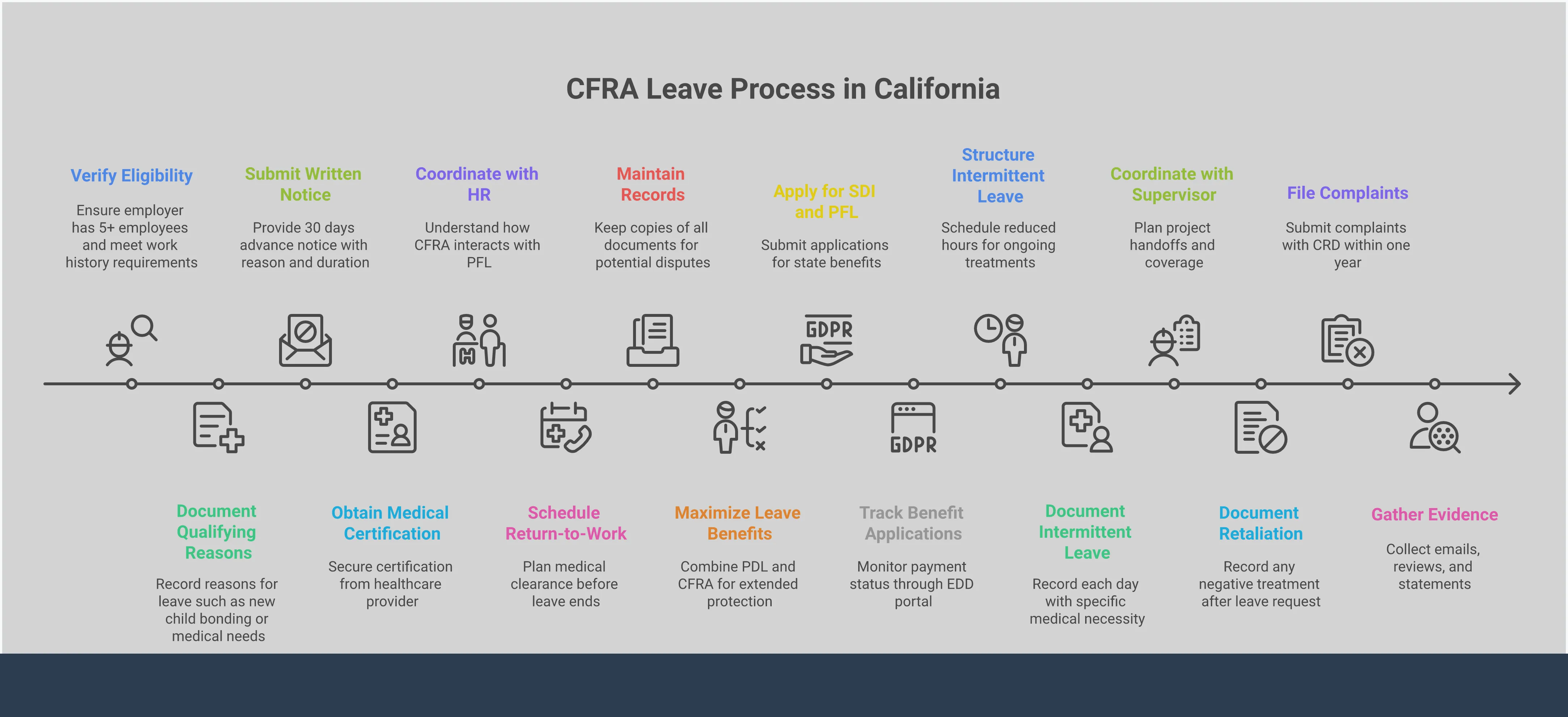
Your right to job security
The most significant protection CFRA offers is that your leave is job-protected. This means that when you take up to 12 weeks of leave, your employer must hold your position for you. When you’re ready to return, they are required to reinstate you to the same or a comparable job—one with similar pay, benefits, duties, and location. This security allows you to focus on your health or your family without the added stress of potentially losing your livelihood. This core guarantee is central to California’s family and medical leave laws.
Keeping your health benefits
Worried about losing your health insurance while on leave? CFRA has you covered. During your leave, your employer must continue to pay for your group health benefits just as if you were still actively working. You will still be responsible for your portion of the premium, but the company’s contribution remains the same. This ensures that you and your family maintain continuous health coverage when you may need it most. It’s a critical protection that provides peace of mind during a challenging time.
Giving notice and providing documentation
To ensure a smooth process, you have a responsibility to communicate with your employer. You should provide advance notice of your need for leave when possible. Your employer can also require you to provide certification, such as a note from a healthcare provider, to support your request. This is a standard part of the process. Keep in mind that your employer can require you to use CFRA leave concurrently with other benefits like Paid Family Leave (PFL), as long as your company is covered by these laws. You can find more details on the EDD’s FAQ page.
Protection against retaliation
It is illegal for your employer to punish you for exercising your right to take CFRA leave. This means your employer cannot fire, demote, harass, or otherwise discriminate against you for requesting or taking time off. Your job is safe, and you should not face any negative consequences for using this legally protected benefit. If you feel you are being treated unfairly after requesting leave, you may be a victim of retaliation at work. These protections are strictly enforced to ensure employees can use their leave without fear.
What to do if your rights are violated
If you believe your employer has denied your CFRA leave, failed to reinstate you, or retaliated against you, you have options. Your first step can be to file a complaint with the California Civil Rights Department (CRD), the state agency responsible for enforcing CFRA. However, navigating this process can be complex, and the deadlines are strict. It is often wise to seek legal advice from an experienced employment lawyer who can help you understand your options and advocate for your rights.
Related Articles
- 7 Red Flags of FMLA Violations by Employers
- Family and medical leave act pregnancy – Bluestone Law
- FMLA 3-Day Rule Explained | Know Your Job-Protected Right
- The FMLA 3 Day Rule Explained: A Complete Guide
- Pregnancy Discrimination Act of 1978: Know Your Rights
Frequently Asked Questions
How do I actually request CFRA leave from my employer? The best approach is to give your employer written notice as soon as you know you’ll need the leave, ideally at least 30 days in advance if the need is foreseeable. Your request should state the reason for the leave and the expected timing and duration. Your employer can ask for a medical certification from a healthcare provider to confirm the need for leave, which is a standard part of the process.
Will I get paid during my CFRA leave? CFRA guarantees that your job is protected, but it doesn’t require your employer to pay you during your time off. However, you can often use your accrued paid time off, like vacation or sick days, to receive a paycheck. You can also apply for partial wage replacement through state programs like California’s Paid Family Leave (PFL) or State Disability Insurance (SDI), which are designed to provide financial support while you’re away from work.
Can my employer deny my request for CFRA leave? If you meet the eligibility requirements and are taking leave for a qualifying reason, your employer cannot legally deny your request. They are allowed to ask for proper documentation to verify your need for leave, but they cannot refuse the leave itself. If your valid request is denied or if you face any negative consequences for asking, it could be a violation of your rights.
What if I don’t need a full 12 weeks off at once? Can I take CFRA leave intermittently? Yes, you can. CFRA is flexible and allows you to take leave in smaller chunks of time if needed. This is known as intermittent leave. For example, you could use it to work a reduced schedule for a few weeks while recovering from a health condition or to take a day off each week to take a family member to recurring medical appointments.
I’m pregnant. Do I use CFRA or Pregnancy Disability Leave (PDL)? In California, you can use both. They are two separate leaves that work together to provide extensive protection. You would typically use Pregnancy Disability Leave (PDL) first for the time you are physically unable to work due to pregnancy, childbirth, or a related condition. After your PDL ends, you can then take your 12 weeks of CFRA leave to bond with your new baby.